How to select an appropriate pH indicator for titration?

How do we select an appropriate pH indicator for titration?

Let’s consider the same indicator as in the previous article: bromocresol green. If the pH of the analyte containing bromocresol green is between 0 and 3.8, it appears yellow; if the pH is between 5.4 and 14, it appears blue. Between 3.8 and 5.4, the colour changes from yellow to blue as the concentration ratio of [In]/[HIn] changes from 10 to 0.1. In fact, when [In] = [HIn], the colour of the titrand is green, indicating equal amounts of the yellow acid and the blue conjugate base.

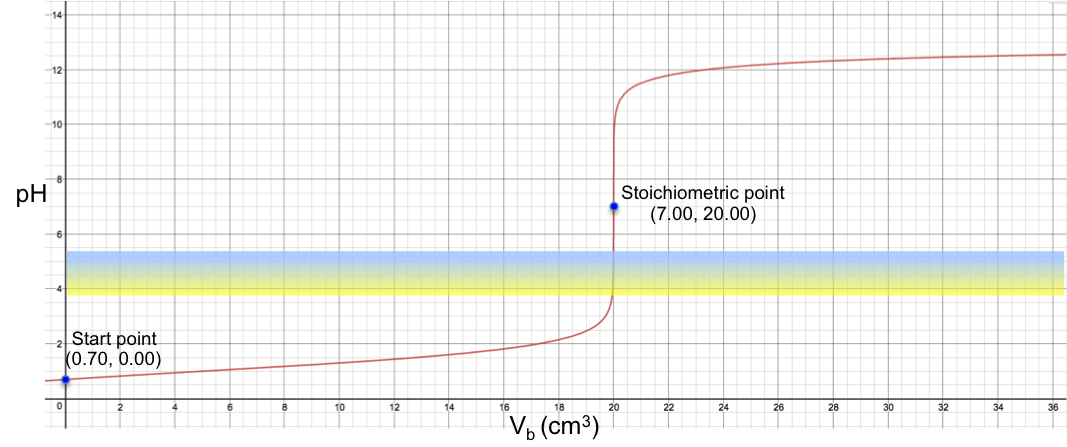
Therefore, bromocresol green is a suitable indicator for a titration with a stoichiometric point (SP) that involves a sharp change of pH from less than 3.8 to more than 5.4 when about 0.1 cm3 of solution (about two drops) is added to the analyte. For example, the titration of 10 cm3 of 0.200 M of HCl with 0.100 M of NaOH sees a colour change of yellow to blue at the SP (see table and graph below).

One drop before SP

SP

One drop after SP

Volume, cm3

19.95

20.00

20.05

pH

3.78

7.00

10.22

In other words, a suitable pH indicator for titration is one whose pH range is narrower than and within the range of the change in pH of the analyte at the stoichiometric point (ideally with one or two drops of solution added).

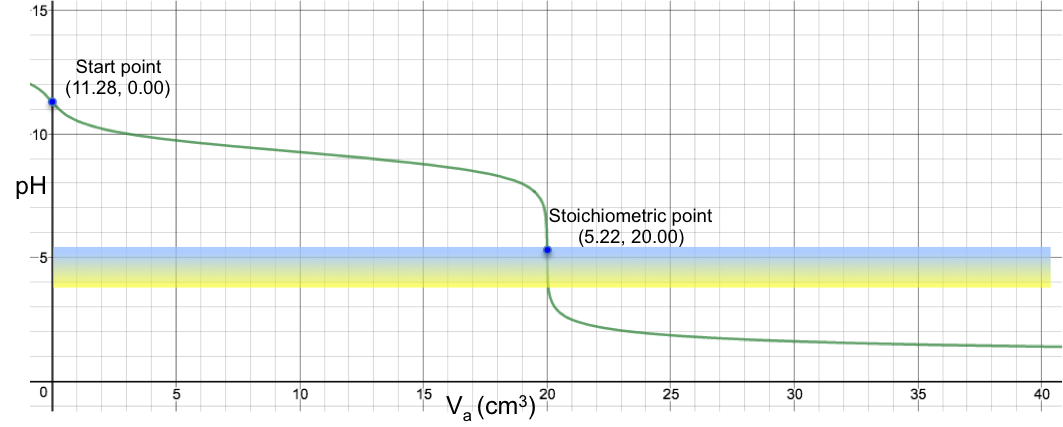
Another example is the titration of 10 cm3 of 0.200 M of aqueous NH3 (Ka = 1.8 x 10⁻⁵) with 0.100 M of HCl, which sees a colour change from blue to yellow at the SP (see table and graph below).

One drop before SP

SP

One drop after SP

Volume, cm3

19.95

20.00

20.05

pH

6.65

5.22

3.78

The following table lists some common indicators and their pH ranges:

Indicator

Low pH colour pH range High pH colour

pKa

Thymol blue (first transition)

red 1.2 – 2.8 yellow

1.65

Thymol blue (second transition)

yellow 8.0 – 9.6 blue

8.96

Methyl yellow

red 2.9 – 4.0 yellow

3.30

Bromophenol blue

yellow 3.0 – 4.6 blue 3.85
Congo red blue-violet 3.0 – 5.0 red

4.10

Methyl orange

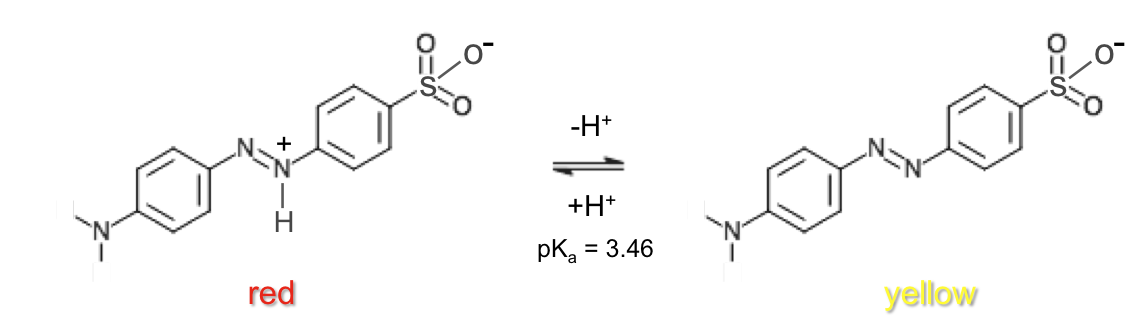
red 3.1 – 4.4 yellow 3.46

Screened methyl orange (second transition)

purple-grey 3.2 – 4.2 green 3.70

Bromocresol green

yellow 3.8 – 5.4 blue 4.66

Methyl red

red 4.4 – 6.2 yellow

5.00

Bromothymol blue (second transition)

yellow 6.0 – 7.6 blue

7.10

Phenol red yellow 6.4 – 8.0 red

7.81

Phenolphthalein (second transition)

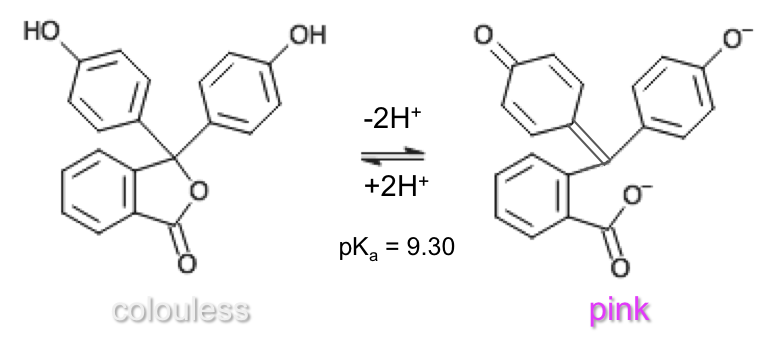
colorless 8.3 – 10.0 purple-pink 9.30
Thymolphthalein (second transition) colorless 9.3 – 10.5 blue

9.90

Alizarine Yellow R

yellow 10.2 – 12.0 red 11.2
Indigo carmine blue 11.4 – 13.0 yellow

12.2


Next article: structures of common indicators
PREVIOUS ARTICLE: THE PH RANGE OF AN INDICATOR
Content page of ph indicators
Content page of Intermediate chemistry
Main content page

Structures of common indicators

The diverse chemical structures of common pH indicators, ranging from simple organic dyes to complex conjugated systems, play a crucial role in their ability to visually signal changes in acidity and alkalinity.

Methyl orange is a commonly used indicator. At low pH, protonation of the nitrogen at the para position of the benzenesulphonate moiety is preferred over protonation of the negatively charged oxygen in the sulphonate group, as this confers resonance stabilization (benzenoid-quinonoid tautomerism) to the acid form of methyl orange.

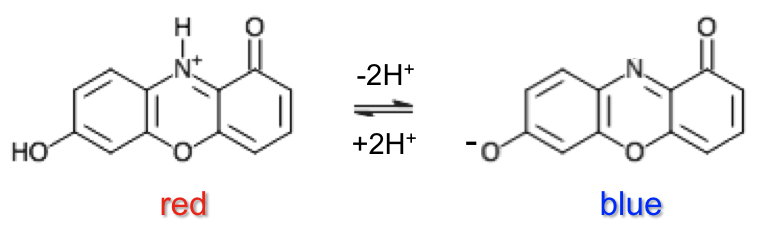
Litmus, extracted from lichen, is processed and applied onto filter paper. It has a pH range of 4.5 to 8.3 and contains the chromophore, 7-hydroxyphenoxazone, which occurs in the following states:

Phenolphthalein has three pKa values with four different forms. However, stoichiometric points of titrations are most commonly monitored with the middle pKa value of 9.30, which involves the lactone and phenolate (dianionic) forms:

Thymol blue has two transition range with pKa1 = 1.65 and pKa2 = 8.96.

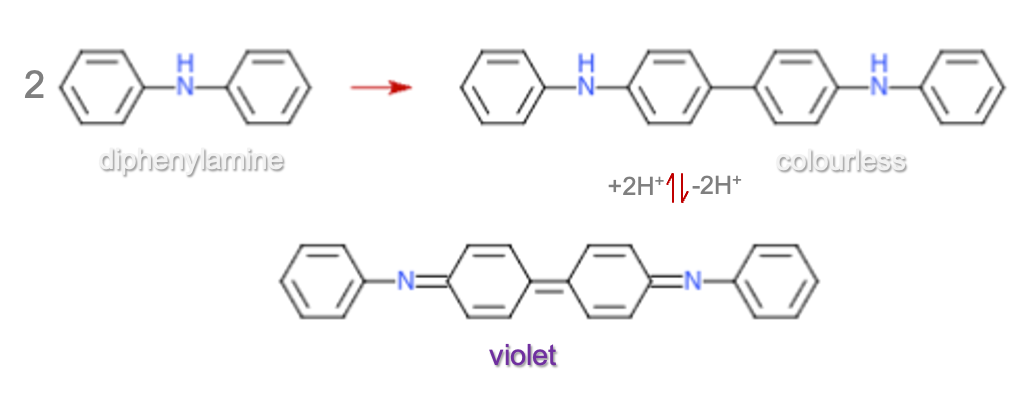
Diphenylamine acts as a redox indicator in titrations involving potassium dichromate (K₂Cr₂O₇). In a typical redox titration (e.g. FeSO4 with K₂Cr₂O₇), once all Fe²⁺ is converted to Fe3⁺, any excess dichromate will begin to oxidise diphenylamine, which changes colour — typically from colourless to a deep blue or violet, indicating that the endpoint has been reached.

Previous article: How to select an appropriate ph indicator for titration?
Content page of ph indicators
Content page of Intermediate chemistry
Main content page

The pH range of an indicator

The pH range of an indicator is the pH interval in which the indicator changes colour.

To elaborate further, we will use the Henderson-Hasselbalch equation to study the equilibrium of a pH indicator, which is a weak acid.

pH=pK_{In}+log\frac{In^-}{HIn}

Consider a titration using two drops of bromocresol green with pKin = 4.7. We have

pH=4.7+log\frac{In^-}{HIn}\; \; \; \; \; \; \; \; (1)

Since the concentration of the indicator in the analyte is very low, the contribution of H+ from the indicator is negligible and does not affect the total concentration of H+ in the solution. Hence, the pH value in eq1 is solely due to the H+ of the analyte; that is, the pH of the analyte determines the position of the equilibrium of the indicator.

When bromocresol green is predominantly in the form HIn, it appears yellow. If it is predominantly in the form In, we see it as blue.

\begin{matrix} HIn(aq)\\yellow \end{matrix}\rightleftharpoons H^+(aq)+\begin{matrix} In^-(aq)\\blue \end{matrix}

As a rule of thumb, our eyes can perceive a complete change in the colour of the indicator from its acid form to the conjugate base and vice versa, when the concentration of one form is ten times greater than the other. So, bromocresol green appears blue when:

[In^-]\geqslant 10[HIn]\; \; \; \; \; \; \; \; (2)

which corresponds to the indicator in a pH environment of pH ≥ 5.7 (by substituting eq2 in eq1).

At the other limit, bromocresol green appears yellow when:

[HIn]\geqslant 10[In^-]\; \; \; \; \; \; \; \; (3)

which corresponds to the indicator in a pH environment of pH ≤ 3.7 (by substituting eq3 in eq1).

In other words, if a few drops of bromocresol green are added to an analyte with a pH ≥ 5.7 and another with a pH ≤ 3.7, the solutions will appear blue and yellow, respectively.

We call this difference in pH (3.7 to 5.7 for bromocresol green) the pH range of the indicator.

NEXT ARTICLE: HOW TO SELECT an APPROPRIATE PH INDICATOR FOR TITRATION
Previous article: Overview
Content page of ph indicators
Content page of Intermediate chemistry
Main content page

Strong base to weak acid titration curve: overview

We have explained the shape of a strong-base-to-strong-acid titration curve in a basic level article. We shall now describe the shape of a strong-base-to-weak-acid titration curve using simple equations like the Henderson-Hasselbalch equation. To do so, we need to analyse the curve at different stages of the titration. These stages are:

    • Start point
    • After start point but before stoichiometric point
    • Maximum buffer capacity point
    • Stoichiometric point
    • Beyond stoichiometric point

Proceed to the next few articles to understand the mathematics and assumptions behind the formulae for the various stages of the pH curve.


next article: start point of titration
Content page of strong base to weak acid titration curve
Content page of intermediate chemistry
Main content page

Stoichiometric point of titration

The stoichiometric point of titration is the moment when the moles of titrant added precisely neutralise the moles of analyte in the solution, indicating a complete reaction between the two species.

Generally, the pH of the titration of a strong acid and a strong base at the stoichiometric point is 7 at 25°C. However, the pH of the titration of a strong base and a weak acid at the stoichiometric point is greater than 7 at 25°C. This is because the salt of a weak acid and a strong base (e.g. CH3COOH and NaOH) is a weak conjugate base, which hydrolyses in water, i.e. it reacts with water to reform the acid according to the following reaction:

CH_3COO^-(aq)+H_2O(l)\; \begin{matrix}K_h\\ \rightleftharpoons \end{matrix}\; CH_3COOH(aq)+OH^-(aq)

where Kh is the hydrolysis constant.

This results in a basic solution since OH is formed. During the titration of a strong base and a weak acid between the start point and the stoichiometric point, the presence of unneutralised acid in the reaction flask causes the equilibrium of the hydrolysis reaction to shift to the left. However, when the stoichiometric point is reached, the weak acid is completely neutralised by the base and we can no longer ignore the effects of hydrolysis on the pH of the solution. Since,

K_a=\frac{[CH_3COO^-][H^+]}{[CH_3COOH]}\; \; \; and\; \; \; K_w=[H^+][OH^-]

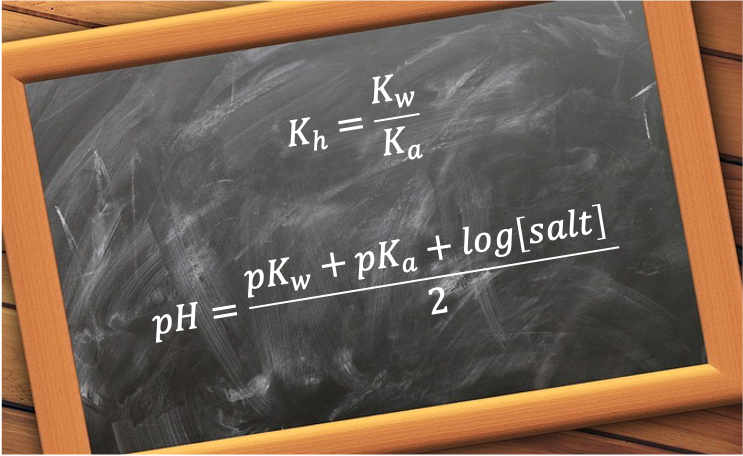
K_h=\frac{[CH_3COOH][OH^-]}{[CH_3COO^-]}=\frac{K_w}{K_a}

From the hydrolysis equation, [CH3COOH] = [OH], so

\frac{K_w}{K_a}=\frac{[CH_3COOH][OH^-]}{[CH_3COO^-]}=\frac{[OH^-]^2}{[CH_3COO^-]}

[OH^-]=\sqrt{\frac{K_w}{K_a}[CH_3COO^-]}

\frac{K_w}{[H^+]}=\sqrt{\frac{K_w}{K_a}[CH_3COO^-]}

Taking the logarithm on both sides of the above equation and applying the definitions of pH, pKa and pKw,

pH=\frac{pK_w+pK_a+log[A^-]}{2}\; \; \; \; \; \; \; \; (4)

where [A] = [CH3COO], the concentration of the salt at the stoichiometric point before hydrolysis.

Eq4 is the general equation to calculate the pH of a strong base to weak acid titration at the stoichiometric point. 

Question

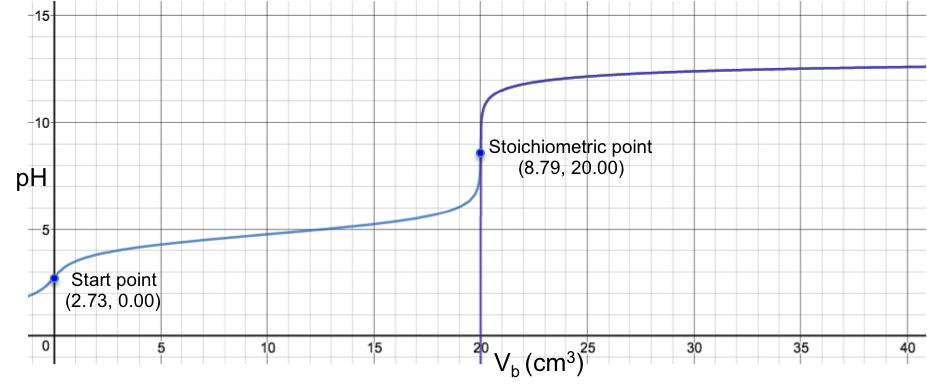
Calculate the pH of the titration of 10 cm3 of 0.200 M of CH3COOH (Ka = 1.75 x 10⁻⁵) with 0.100 M of NaOH at the stoichiometric point.

Answer

Using eq4,

pH=\frac{-log10^{-14}-log\left ( 1.75\times 10^{-5}\right)+log\left ( \frac{0.100\times 0.02}{0.01+0.02} \right )}{2}=8.79

Note that [A] can be computed using either the acid or the base.


The same logic applies when determining the equation for the pH of a strong acid to weak base titration at the stoichiometric point, with the expected pH lower than 7.


Question

Calculate the pH of the titration of 25.0 cm3 of 0.200 M of aqueous ammonia (Kb = 1.8 x 10⁻⁵) with 0.100 M of HCl at the stoichiometric point.

Answer

The salt NH4Cl at the stoichiometric point undergoes the following hydrolysis:

where .

Since and , we have

It follows that


next article: Beyond stoichiometric point of titration
Previous article: After start point and before stoichiometric point of titration
Content page of strong base to weak acid titration curve
Content page of intermediate chemistry
Main content page

Beyond stoichiometric point of titration

Beyond the stoichiometric point of titration, the pH of the solution experiences significant shifts, often leading to rapid changes that highlight the excess of titrant and the resultant dominance of the strong base or acid in the solution.

To characterised this region, we make the following assumption:

    • [OH] from water is negligible, i.e. pH of the solution is solely determined by [OH]ex from the excess base added after the stoichiometric point, as the dissociation of water is again suppressed at this stage.

Even though the auto-dissociation of water is suppressed, water is still equilibrating between its molecular form and its ionic components. Applying the above assumption, the equilibrium constant of water is:

K_w=[H^+][OH^-]\approx [H^+][OH^-]_{ex}

Taking the logarithm on both sides of the above equation and applying the definitions of pH and pKw,

pH=pK_w+log[OH^-]_{ex}\; \; \; \; \; \; \; \; (5)

Eq5 is the general equation to calculate the pH of a strong base to weak acid titration beyond its stoichiometric point. The same logic applies when determining the equation for the pH of a strong acid to weak base titration beyond the stoichiometric point.

The diagram below shows the superimposition of eq5 (purple curve) over the complete pH titration curve (blue curve), which disregards the above assumption, for the titration of 10 cm3 of 0.200 M of CH3COOH (Ka = 1.75 x 10⁻⁵) with 0.100 M of NaOH.

Even though the two curves appear to fit perfectly, they do not actually coalesce and are still two separate curves (discernible when the axes of the plot are scaled to a very high resolution). However, for practical purposes, eq5 is a very good approximation of a pH curve for the region beyond the stoichiometric point of a strong acid to weak base titration.


next article: Combining all equations
Previous article: stoichiometric point of titration
Content page of strong base to weak acid titration curve
Content page of intermediate chemistry
Main content page

Start point of titration

The start point of a titration marks the initial pH of the solution before any titrant is added, serving as a crucial reference for analysing the subsequent changes in acidity or alkalinity throughout the process.

To characterised the start point, we begin with the following assumptions:

    • [H+] from water is negligible, i.e. H+ in the flask containing the weak acid is solely due to that of the acid, [H+]a, as the dissociation of water is suppressed at this stage.
    • For a weak acid, [HA]  is approximately equal to the concentration of the undissociated acid, [HA]ud, i.e. the dissociation of the weak acid HA is negligible.

The equation for the dissociation of a weak monoprotic acid is:

HA(aq)\rightleftharpoons H^+(aq)+A^-(aq)

with the equilibrium constant at the start of the titration being:

K_a=\frac{[H^+][A^-]}{[HA]}\approx \frac{[H^+]_a[A^-]}{[HA]_{ud}}=\frac{[H^+]_a\, ^2}{[HA]_{ud}}

Taking the logarithm on both sides of the above equation and rearranging, we have:

pH=\frac{pK_a-log[HA]_{ud}}{2}\; \; \; \; \; \; \; \; (1)

Eq1 is the general formula for determining the pH of a strong base to weak acid titration at the start point.

The second assumption becomes less valid when the weak monoprotic acid or weak monoprotic base has Ka 10-3 or Kb 10-3 respectively. Removing the second assumption, the equilibrium constant expression becomes:

K_a\approx \frac{[H^+]_a[A^-]}{[HA]_{ud}-[H^+]_a}=\frac{[H^+]_a\, ^2}{[HA]_{ud}-[H^+]_a}

The corresponding pH equation is obtained by rearranging the above equation into a quadratic equation in terms of  [H+]a, finding the latter’s roots and taking the logarithm of the root:

pH=-log\left ( \frac{\sqrt{K_a\, ^2+4K_a[HA]_{ud}}-K_a}{2} \right )


Question

Do both of the pH equations give the same pH value for the titration of 10 cm3 of 0.200 M of CH3COOH (Ka = 1.75 x 10⁻⁵) with NaOH?

Answer

Yes, both formulae give pH = 2.73. This validates the applicability of eq1 for acids with Ka in the region of 10-5.


If we disregard both assumptions, we will end up deriving the complete pH titration curve for a strong base to weak acid titration. See this article in the advanced section for details.


Question

Show that pKa + pKb = 14.

Answer

HA(aq)+H_2O(l)\rightleftharpoons H_3O^+(aq)+A^-(aq)

A^-(aq)+H_2O(l)\rightleftharpoons HA(aq)+OH^-(aq)


K_a=\frac{[H_3O^+][A^-]}{[HA]}\; \; \; \; \; \; \; \; K_b=\frac{[HA][OH^-]}{[A^-]}

-logK_a-logK_b=-log\frac{[H_3O^+][A^-]}{[HA]}-log\frac{[HA][OH^-]}{[A^-]}

pK_a+pK_b=-log[H_3O^+][OH^-]=pK_w=14


next article: After start point and before stoichiometric point of titration
Previous article: overview
Content page of strong base to weak acid titration curve
Content page of intermediate chemistry
Main content page

Strong base to weak acid titration curve: combining all equations

Equations describing the various stages of a titration provide a mathematical framework to quantify changes in pH of a solution, effectively illustrating the transition from the start point to the endpoint of the titration.

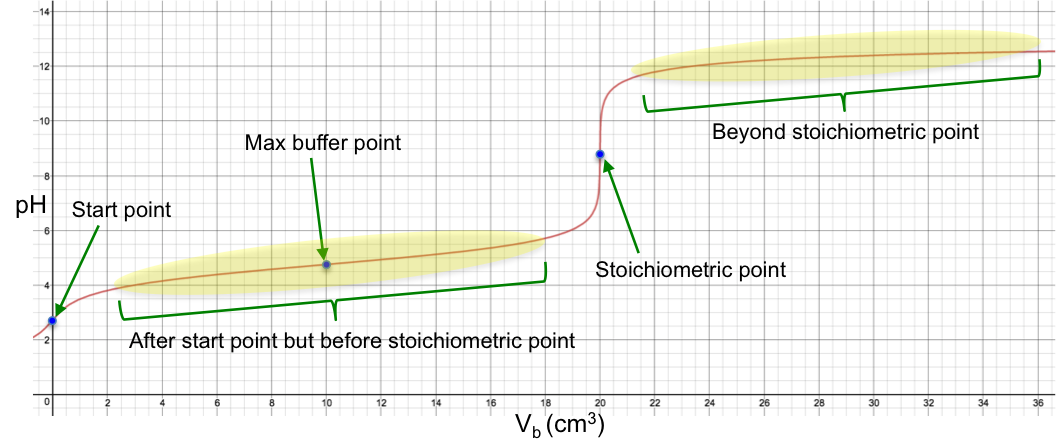
In summary, the pH curve of a strong base to weak acid titration can be described by the following simplified equations in place of a complex complete pH titration equation:

Start point pH=\frac{pK_a-log[HA]_{ud}}{2}\; \; \; \; \; \; \; \; (1)
After start point but before stoichiometric point pH=pK_a+log\frac{[A^-]_s}{[HA]_r}\; \; \; \; \; \; \; \; (2)
Maximum buffer capacity point pH=pK_a\; \; \; \; \; \; \; \; (3)
Stoichiometric point pH=\frac{pK_w+pK_a+log[A^-]}{2}\; \; \; \; \; \; \; \; (4)
Beyond stoichiometric point pH=pK_w+log[OH^-]_{ex}\; \; \; \; \; \; \; \; (5)

The diagram below shows the plot of the above equations on a single graph for the titration of 10 cm3 of 0.200 M of CH3COOH (Ka = 1.75 x 10⁻⁵) with 0.100 M of NaOH:

A complementary set of equations can be derived using the same logic mentioned in the earlier articles to describe a strong acid to weak base titration.

next article: Improved Henderson-Hasselbalch equation
Previous article: Beyond stoichiometric point of titration
Content page of strong base to weak acid titration curve
Content page of intermediate chemistry
Main content page

pH indicators: overview

A pH indicator is usually a large, weak organic acid that is soluble in water or alcohol.

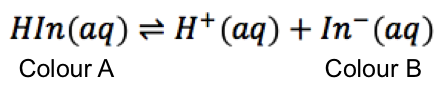
\begin{matrix} HIn(aq)\\colourA \end{matrix}\rightleftharpoons H^+(aq)+\begin{matrix} In^-(aq)\\colourB \end{matrix}

The acid HIn absorbs a certain range of wavelengths of visible light and reflects the rest (complementary range of wavelengths) into our eyes, which perceive the complementary wavelengths as Colour A. The conjugate base In absorbs a different range of wavelengths of visible light and reflects a dissimilar complementary range into our eyes, which perceive it as Colour B.

The acid may be a neutral or charged molecule, for example, the acid form of the indicator bromocresol green is monoanionic (yellow), while its conjugate base is dianionic (blue).


Next article: The pH range of an indicator
Content page of ph indicators
Content page of Intermediate chemistry
Main content page

After start point and before stoichiometric point of titration

How can we mathematically describe the titration curve of a weak monoprotic acid versus a strong monoprotic base, after the start point and before the stoichiometric point?

To do so, we will make the following assumptions:

    • [H+] from water is negligible, i.e. H+ in the flask containing the weak acid comes solely from the acid, [H+]a, as water dissociation is suppressed at this stage. This is because Ka ≫ Kw, which shifts the equilibrium H2O ⇌ H+ + OH– to the left.
    • For a weak acid, [HA] is approximately equal to the concentration of the undissociated acid[HA]ud, i.e. the weak acid HA dissociates only slightly, with the remaining concentration of HA after the addition of base approximated as [HA][HA]ud – [A]s, where [A]s is concentration of the salt formed. This implies that:
    • [A] is approximately equal to the concentration of the salt, [A]s, in the solution. In other words, Ais completely attributed to the salt formed, with no contribution from the further dissociation of HA.
    • Hydrolysis of the salt is suppressed at this stage of the titration due to the overwhelming presence of HA, which shifts the hydrolysis equilibrium A+ H2O ⇌ HA + OH to the left.

The equation for the dissociation of a weak monoprotic acid is

HA(aq)\rightleftharpoons H^+(aq)+A^-(aq)

Using the assumptions, the equilibrium constant after start point and before stoichiometric point is:

K_a=\frac{[H^+]_a[A^-]_s}{[HA]_r}

Taking the logarithm on both sides and apply the definitions of pH and pKa,

pH=pK_a+log\frac{[A^-]_s}{[HA]_r}\; \; \; \; \; \; \; \; (2)

Eq2 is known as the Henderson-Hasselbalch equation, which is a good approximation of the pH curve after the start point and before the stoichiometric point for a strong base to weak acid titration with Ka 10-3 (or a strong acid to weak base titration with Kb  10-3).


Question

Rewrite eq2 to include the volume of acid Va and the volume of base Vb.

Answer

pH=pK_a+log\left ( \frac{[B]V_b}{V_a+V_b}/\frac{[A]V_a-[B]V_b}{V_a+V_b} \right )

pH=pK_a+log\left ( \frac{[B]V_b}{[A]V_a-[B]V_b} \right )\; \; \; \; \; \; \; \; (2a)

where [A] = [HA]ud , and [B] is the initial concentration of the monoprotic base.

When eq2a is plotted as pH versus Vb, a titration curve is obtained (see diagram below).


The diagram below is the superimposition of a green curve (the Henderson-Hasselbalch equation, eq2a) on a blue curve (the complete pH titration curve, which disregards all assumptions above), for the titration of 10 cm3 of 0.200 M of CH3COOH (Ka = 1.75 x 10⁻⁵) with 0.100 M of NaOH.

Even though the two curves appear to fit perfectly (apart from the initial bit before 1.00 cm3 and after the stoichiometric point), they do not actually coalesce and are still two separate curves (discernible when the axes of the plot are scaled to a very high resolution). However, for practical purposes, the Henderson-Hasselbalch equation is a very good approximation of a pH curve for the region after the start point and before the stoichiometric point for a strong base to weak acid titration.

When [A]s = [HA]r , eq2 becomes

pH=pK_a\; \; \; \; \; \; \; \; (3)

Eq3 occurs when the amount of salt formed equals to [HA]ud/2, i.e. when half of the acid is neutralised. This stoichiometric relation corresponds to the curve’s inflexion point, which is also called the maximum buffer capacity point.


Question

Why does the solution have maximum buffer capacity when half of the acid is neutralised, i.e. at the half-way volume point between the start point and the stoichiometric point?

Answer

For the buffer to be most effective, it has to resist to the greatest extent the change in pH versus the change in volume of base added. This means that the maximum buffer capacity corresponds to the point where the gradient of the function of eq2a is a minimum, i.e. at the inflexion point (see above diagram). 

Taking the 2nd derivative of eq2a with respect to Vb and letting \frac{d^2pH}{dV_b^2}=0 gives

\frac{n_b}{n_a}=\frac{1}{2}

where n_b=\left [ B \right ]V_b  and n_a=\left [ A \right ]V_a.

Therefore, the inflection point occurs when the moles of added base equal half the moles of the undissociated acid, corresponding to half the total volume of base required for complete neutralisation.

If you want a full mathematical description of the maximum buffer capacity of a weak acidic buffer, read this article in the advanced section. 


For a strong acid to weak base titration, we have the following weak base equilibrium:

BOH(aq)\rightleftharpoons B^+(aq)+OH^-(aq)

K_b=\frac{[B^+][OH^-]}{[BOH]}

Taking the logarithm on both sides of the above equation and rearranging,

pOH=pK_b+log\frac{[B^+]}{[BOH]}\; \; \; \; \; \; \; \; (3a)

Eq3a is the basic form of the Henderson-Hasselbalch equation.

With reference to eq2 (or eq3a), the pKa (or pKb) of the weak acid (or weak base) can be determined from the pH of a strong base to weak acid titration (or knowing the pOH of a strong acid to weak base titration) at the half-way volume point, where the logarithmic term becomes zero.


Question

Show that pKa + pKb = 14.

Answer

HA(aq)+H_2O(l)\rightleftharpoons A^-(aq)+H_3O^+(aq)

A^-(aq)+H_2O(l)\rightleftharpoons HA(aq)+OH^-(aq)

K_a=\frac{[A^-][H_3O^+]}{[HA]}\; \; \; \; \; \; \; \; K_b=\frac{[HA][OH^-]}{[A^-]}

pK_a+pK_b=-log\frac{[A^-][H_3O^+]}{[HA]}-log\frac{[HA][OH^-]}{[A^-]}

=-log[H_3O^+][OH^-]=-logK_w=14


next article: stoichiometric point of titration
Previous article: start point of titration
Content page of strong base to weak acid titration curve
Content page of intermediate chemistry
Main content page
Mono Quiz