Fermions are subatomic particles with half-integer spin that obey the Pauli exclusion principle, while bosons have integer spin and can occupy the same quantum state.
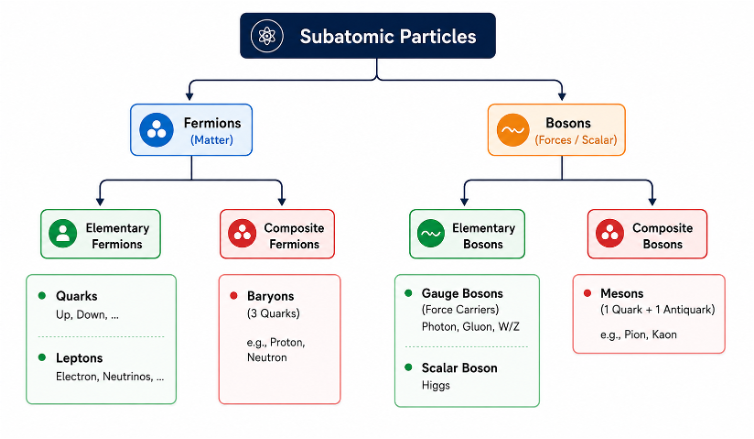
Although both types of particles are essential to the structure of matter and the forces of nature, they behave in very different ways. Fermions include particles such as electrons, protons, neutrons and quarks. They have half-integer spin and obey Fermi–Dirac statistics, named after physicists Enrico Fermi and Paul Dirac. These statistics incorporate the Pauli exclusion principle, which states that two identical fermions cannot occupy the same quantum state. Such a restriction plays an important role in the structure of atoms and matter, helping to explain why electrons occupy different energy levels and why ordinary matter takes up space.
Bosons, on the other hand, include particles such as photons, gluons and the Higgs boson. They have integer spin and obey Bose–Einstein statistics, named after physicists Satyendra Nath Bose and Albert Einstein. Unlike fermions, identical bosons can occupy the same quantum state in any number. As a result, bosons can exhibit collective quantum behaviour, such as the coherent light produced by lasers and the formation of Bose–Einstein condensates at extremely low temperatures.
The distinction between fermions and bosons is closely connected to their intrinsic angular momentum, or spin. In quantum mechanics, the allowed values of the spin quantum number are restricted to integer or half-integer values: 0,1/2,1, 3/2, 2, …. Thus, particles can have either integer spin, such as 0 or 1, or half-integer spin, such as 1/2 or 3/2. The spin–statistics theorem further establishes a fundamental connection between these two classes of spin and quantum statistics, providing the basis for the two fundamental categories into which ordinary subatomic particles fall.
This connection also determines how the quantum states of identical particles behave under exchange. Bosons have wavefunctions that are symmetric under the exchange of two identical particles, whereas fermions have wavefunctions that are antisymmetric. The antisymmetry of fermionic states leads directly to the Pauli exclusion principle, while the symmetry of bosonic states allows identical bosons to occupy the same quantum state.
Together, fermions and bosons form the foundation of the Standard Model of particle physics. Fermions constitute matter, while bosons include particles that mediate fundamental interactions. Their contrasting quantum statistics are therefore central to understanding both the microscopic structure of matter and many of the remarkable collective phenomena observed in the quantum world.