Hadrons are composite particles made up of quarks that participate in the strong interaction, whereas leptons are elementary particles that do not participate in the strong interaction. These two broad classes of subatomic particles therefore differ fundamentally in their internal structure and interactions.
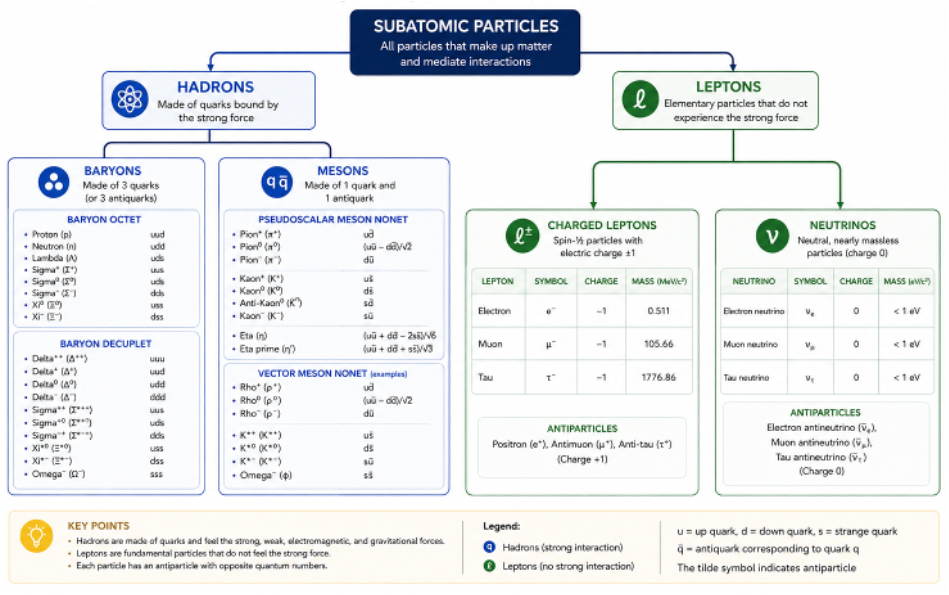
Hadrons can be either fermions or bosons, depending on their total spin. They are broadly classified into two groups: baryons, which are composed of three quarks and have half-integer spin angular momentum quantum number, and mesons, which consist of a quark and an antiquark and have integer spin (see above diagram). Thus, baryons are fermionic hadrons, while mesons are bosonic hadrons. Baryons, such as protons and neutrons, are especially important because they form atomic nuclei and account for most of the mass of ordinary matter. Mesons, on the other hand, are generally unstable particles that decay rapidly into lighter particles. Although they do not make up ordinary matter, mesons play an important role in the study of the strong interaction and nuclear physics. For example, pions, the lightest mesons, contribute to the residual strong force that binds protons and neutrons within atomic nuclei.
The existence of a particle with approximately the pion’s properties was theoretically anticipated by Hideki Yukawa in 1935. At the time, scientists knew that protons and neutrons were held together by a strong, short-range nuclear force that became negligible beyond nuclear distances of roughly 10-15 m. Yukawa proposed that this force could be explained in terms of the exchange of a particle, analogous to the way electromagnetic interactions can be described in terms of the exchange of photons.
In photon exchange, one particle emits a photon and the other absorbs it. The photon is called a virtual particle because it exists only as an intermediate part of the interaction and cannot be detected as a free photon. The word “exchange“ therefore describes the quantum-mechanical process connecting the interacting particles, rather than the literal transfer of an observable particle between them. Yukawa proposed that a similar process could account for the nuclear force, with a nucleon emitting a virtual particle that is subsequently absorbed by another nucleon:
Using the energy-time uncertainty principle, he suggested that a virtual particle can be exchanged over a characteristic time determined approximately by . Taking the energy associated with the virtual particle to be approximately its rest energy,
, gives
. If the virtual particle travels at approximately the speed of light during this time, the corresponding range of the interaction is
, or equivalently,
. Using
MeV fm, and
fm,
MeV.
Yukawa therefore predicted a particle with a mass of approximately 140 MeV/c2, roughly 275 times the electron mass. This prediction was remarkably close to the mass scale of the pion, which was subsequently identified as the lightest meson. The discovery and study of the pion therefore provided an important early connection between Yukawa’s theoretical description of the short-range nuclear force and the experimentally observed spectrum of hadrons.
Unlike hadrons, all leptons are fermions because they have half-integer spin. The charged leptons, including electrons, muons and taus, participate in the electromagnetic and weak interactions, while neutrinos interact primarily through the weak interaction. Of these particles, the electron plays a central role in ordinary matter, forming part of atoms and governing many of their chemical and electromagnetic properties. Muons and taus are much heavier and unstable, while neutrinos are electrically neutral and have extremely small masses.
The neutrino was predicted by Wolfgang Pauli before it was experimentally detected. In 1930, Pauli proposed the existence of an additional neutral particle to explain the continuous energy spectrum observed in nuclear beta decay, which appeared to violate the conservation of momentum and energy if the decay involved only the emitted electron and the recoiling nucleus. In a two-body decay of a stationary nucleus, conservation of momentum requires the daughter nucleus and electron to recoil back-to-back with fixed momenta, resulting in a fixed electron energy. However, experiments showed a continuous electron-energy spectrum. This suggested that another particle was carrying away some of the momentum and energy. Pauli therefore proposed the existence of a neutral particle, later identified in 1956 by Cowan and Reines as the electron antineutrino:
Together, hadrons and leptons encompass the particles that make up much of the visible matter in the universe. Hadrons include the protons and neutrons found in atomic nuclei, while leptons such as electrons form the surrounding electron clouds. Understanding the distinction between these two classes, as well as their corresponding quantum numbers and conservation laws, is therefore essential to understanding the composition and behaviour of matter at the subatomic level.