The Eightfold Way is a classification scheme proposed by Murray Gell-Mann and Yuval Ne’eman that organises hadrons into groups based on their shared properties and underlying symmetries.
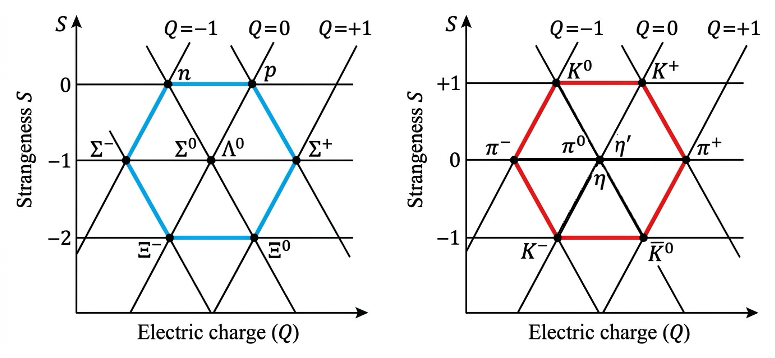
Using this scheme, hadrons discovered before 1970 can be arranged into geometric patterns according to properties such as electric charge and strangeness. One example is the group of eight lightest spin-½ baryons, including the proton, neutron, and several strange particles such as the ,
and
. These particles can be organised into a baryon octet on a strangeness-charge diagram, with electric charge represented along a sloping axis (see diagram above). Similarly, nine spin-0 mesons, including the pions, kaons and etas mesons, form an octet together with an additional singlet state, producing a similar pattern on a strangeness-charge diagram.
These patterns revealed that seemingly different particles were related by an underlying symmetry and suggested that they were not fundamental particles themselves, but rather combinations of more basic constituents. In particular, Gell-Mann found that the eightfold way classification of the baryons and mesons could be explained using the SU(3) symmetry group. This idea ultimately led to the quark model, in which baryons are composed of three quarks and mesons are composed of a quark and an antiquark.