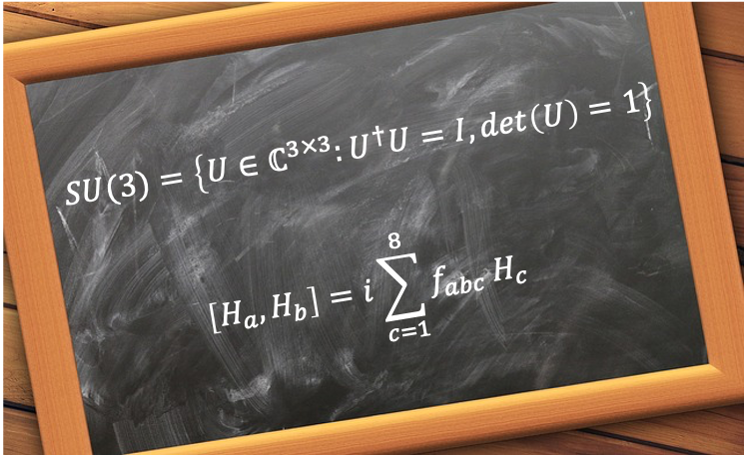
The SU(3) group, or special unitary group of degree 3, is defined by its fundamental representation of unitary matrices
with determinant 1, with the generators
of all its
representations satisfying the commutation relation
.
An element of SU(3) can be expressed as
where and each entry is a complex number.
Since each complex element contains two real variables, the matrix initially contains eighteen real variables. The unitarity condition imposes nine independent real constraints, while the condition
removes one further degree of freedom. Consequently, every element of SU(3) depends on eight independent real parameters. In other words, the matrices of SU(3) describe an eight-dimensional manifold.

Question
Show that imposes nine independent real constraints.
Answer
becomes
Carrying out the multiplication gives three equations corresponding to diagonal entries
and six equations corresponding to the off-diagonal entries
Therefore, these nine simultaneous equations impose nine independent real constraints.
As with SU(2), every element of SU(3) can be generated by exponentiating a linear combination of the group’s generators. However, instead of the three 2×2 Pauli matrices, SU(3) requires the generators to be 3×3 Hermitian matrices, each with zero trace. Futhermore, the number of independent real parameters specifying a group element must equal the number of generator matrices (see this article for details), resulting in eight linearly independent 3×3 generator matrices with the following general form:
Another important observation is that the SU(3) rotation operator transforms the basis vectors
, which span the three-dimensional complex vector space, into linear combinations of the basis vectors. The simplest of such a transformation mixes a pair of basis vectors; that is, it transforms each vector in the pair into a linear combination of the two while leaving the third basis vector unchanged:
Consequently, it is natural to choose generators that mix the three pairs of basis vectors, ,
and
. The most basic traceless Hermitian generator matrix that mixes
is
To see how this symmetric generator matrix is related to an SU(3) transformation, we rewrite it as
where is one of three Pauli matrices.
The Taylor expansion of the rotation operator is
Since every power of has the same block structure
, every term in the Taylor series acts only on the first two components a basis vector, leaving the third component unchanged. Furthermore, the identity matrix is
. Therefore, the SU(3) rotation operator becomes
From eq129, where , we have the one-parameter subgroup of SU(3):
demonstrating how is related to an SU(3) transformation.
Question
What is the geometric interpretation of the transformation ?
Answer
In general, an element of SU(3), which is an 8-dimensional manifold, can be described locally by eight independent real parameters:
where .
If and
, then
. As
varies,
traces out a one-dimensional curve within the 8-dimensional manifold.
Another basic traceless Hermitian generator matrix that mixes is
which is the antisymmetric counterpart of .
Notably, contains the Pauli matrix
, in the same way that
contains
. In the early 1960s, Murray Gell-Mann introduced a particularly convenient set of SU(3) generators known as the Gell-Mann matrices. The first three generators contain the Pauli matrices in their upper left blocks, producing SU(3) transformations that mix
:
It follows that the corresponding symmetric and antisymmetric generators that mix and
are
and
respectively.
All generators must be mutually orthogonal with respect to the Frobenius inner product , where
is a scaling constant, to satisfy
. The first seven generators are conveniently chosen to meet this criterion. The final matrix
is then scaled to be orthogonal to the first seven such that . These eight linearly independent Hermitian generators are known as the Gell-Mann matrices:
Notably, these matrices satisfy the commutation relation , where
, and
are the structure constants of SU(3), whose values are determined by the specific combination of indices
(see this article for details).
The significance of the Gell-Mann matrices extends beyond providing a mathematical basis for SU(3). In particle physics, the same SU(3) symmetry appears as the flavour symmetry of quarks and the colour symmetry of the strong interaction.