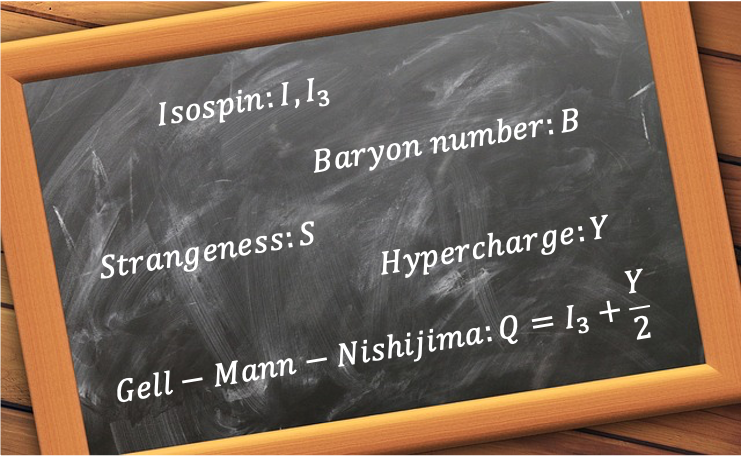
Quantum Numbers and Conservation Laws of Hadrons and Leptons refers to the properties used to classify hadrons and leptons and the rules governing which of these properties remain conserved during particle interactions.
Hadrons
The behaviour of hadrons in particle interactions is governed by several important conservation laws, which are established through observations of particle interactions. For example, since a proton is heavier than the combined masses of a positron and a neutral pion, nothing based solely on the principle of energy conservation prevents a proton from decaying as
Yet, despite extensive searches, scientists have never observed a proton decay. To account for this apparent prohibition, a quantum number known as baryon number, , is introduced. Every baryon is assigned a value of
, every antibaryon a value of
, and particles that are neither baryons nor antibaryons a value of
. The proposed decay would therefore change the total baryon number from
to
, and is consequently forbidden by baryon-number conservation.
In contrast, proton-proton fusion provides a classic example of a reaction that satisfies baryon-number conservation. It is the first step of the fusion process that powers the Sun:
Here, the initial state has a total baryon number of , since each proton has
. The deuteron (
) also has
, as it consists of one proton and one neutron, while the positron and electron neutrino have
. Thus, the total baryon number is conserved in the reaction.
Another quantum number that governs how particles interact is the isospin . When protons collide with protons,
, the particles experience both the repulsive Coulomb force and the strong nuclear force. In proton-neutron collisions,
, the interaction is dominated by the strong nuclear force because the neutron has no net electric charge.
In the early 1930s, scattering experiments comparing proton–proton and proton–neutron interactions measured how the number of particles scattered varied with scattering angle. The proton and neutron have very similar masses and, consequently, very similar kinematic properties in nuclear collisions. After accounting for the Coulomb interaction in proton–proton scattering, the angular distributions of the scattered particles were found to be remarkably similar. Together, the similar masses and scattering behaviour suggested that protons and neutrons have closely related properties under the strong interaction, providing evidence that the strong nuclear force acts on them in almost the same way. This led Heisenberg to propose that the proton and neutron might not be fundamentally different kinds of particle, but rather two different states of the same underlying particle, which he called the nucleon.
To describe these two states, Heisenberg exploited the same mathematical framework used for angular momentum, in which the number of possible states is . Since the nucleon
has two states, its isospin is
. The proton
and the neutron
then correspond to the two possible projections of the nucleon’s isospin,
and
(where the subscript 3 denotes the third axis). As
and
have the same mathematical form as the spin–
states of an electron, they transform under the SU(2) group.
It follows that a component of the isospin operator acts on a basis eigenstate of a particle to give an eigenvalue corresponding to a component of the particle’s isospin. For the nucleon, the three components of the isospin operator are represented in the two-dimensional SU(2) isospin space by , where
denotes one of the three Pauli matrices. For example, using
, where
, we obtain
Since the Pauli matrices satisfy the commutation relations , where
and
is the Levi-Civita symbol, the isospin operators likewise satisfy:
We can also define, just as in quantum angular momentum, the isospin ladder operators , where
and
. Explicitly,
Consequently,
This is consistent with the ladder operators raising or lowering the eigenvalue of a basis state by one unit. Specifically,
In other words, the raising operator transforms
into an eigenvector (
) of
with an eigenvalue that is one unit higher than
. Similarly, the lowering operator
transforms
into an eigenvector (
) of
with an eigenvalue that is one unit lower than
. These operators are important for understanding the quark model.
If the strong interaction cannot distinguish between the proton and neutron states, then changing a nucleon from its proton state to its neutron state does not change the strong-interaction physics. This approximate symmetry is called isospin symmetry, and the corresponding isospin quantum numbers are conserved in strong interactions. Just as the proton and neutron form an isospin doublet with , other hadrons with similar masses and related strong-interaction properties can form isospin multiplets. For example, the three pions
form an isospin triplet with
and
,
,
. Therefore, isospin conservation in strong interactions allows reactions such as:
However, isospin is not conserved in weak interactions. Unlike the strong interaction, the weak interaction can distinguish between the proton and neutron states and can transform one into the other. For example, in beta decay, a neutron can decay into a proton through the weak interaction:
In terms of isospin, the nucleon changes from to
. This suggests that the proton and neutron may not be fundamental particles, but are instead composed of more elementary particles whose properties determine how they interact through the strong and weak interactions.

Question
Can decay occur through the strong and electromagnetic interactions, instead of the weak interaction?
Answer
Yes. For example, is a strong decay, while
is an electromagnetic decay.
The conservation of baryon number and isospin, however, is not sufficient to explain all the patterns observed in hadronic interactions. Consider the reaction
At first glance, there is nothing unusual about this reaction: the total electric charge, baryon number and isospin are conserved. However, experiments revealed that the and
exhibited unusual production and decay patterns. They could be produced rapidly through the strong interaction, yet their subsequent decays (e.g.
) were much slower than typical strong decays. Since particle decays can occur through the strong interaction, this raised an important question: why could these particles be produced through the strong interaction but not undergo equally rapid strong decays?
To account for this unusual behaviour, Murray Gell-Mann and Kazuhiko Nishijima proposed that these particles carried an additional quantum number that was conserved in strong interactions but could be violated by the weak interaction. This new quantum number was called strangeness, denoted by .
The and
were were assigned opposite strangeness quantum numbers,
and
, while the non-strange particles
and
were assigned
and
. Thus, strangeness is conserved in the strong-interaction reaction
. It follows that the decay
is forbidden by the strong interaction and instead proceed through the weak interaction because the strangeness changes from
to
, with
, explaining its much longer lifetime.
The introduction of strangeness provides a useful way to distinguish particles that otherwise have similar properties, but it also suggests a deeper relationship between the quantum numbers used to classify hadrons. In particular, Gell-Mann and Nishijima noticed that hadrons could be systematically expressed in terms of their baryon number and strangeness. They introduced a new quantum number called hypercharge, denoted by , which is defined as
For the non-strange particles in the reaction , the pion has
and
, giving
, while the proton has
and
, giving
. For the strange particles, the
has
and
, so
, whereas the
has
and
, giving
. Thus, hypercharge is also conserved in this strong-interaction reaction.
Furthermore, Gell-Mann and Nishijima found that the electric charges of hadrons could be expressed in terms of hypercharge and the third component of isospin through the empirical relation known as the Gell-Mann–Nishijima formula:
where is the electric charge in units of the elementary charge.
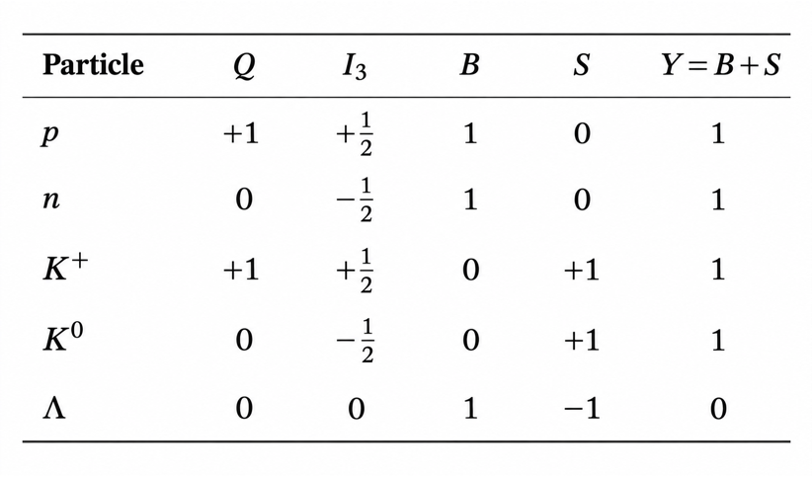
This relation provides a systematic connection between electric charge, isospin, baryon number and strangeness, and provides a unified framework for classifying the growing number of hadrons discovered in experiments. For example,
Leptons
The behaviour of leptons in particle interactions is also governed by important conservation laws. For example, consider the decay of a muon,
This decay is allowed by energy and electric-charge conservation. However, it has never been observed. To describe the observed patterns of lepton interactions, a quantum number known as lepton number, , is introduced. Every lepton is assigned a value of
, every antilepton a value of
, and particles that are neither leptons nor antileptons a value of
. Thus, total lepton number is conserved in processes such as muon decay,
However, the conservation of total lepton number alone does not explain why the decay is not observed. To account for this, the lepton number of each lepton family
,
and
is required to be conserved in a reaction. The decay
would therefore change the individual lepton-family numbers, with
and
, and is consequently forbidden.
Finally, leptons do not participate in the strong interaction, so they have zero baryon number and strangeness. The strong isospin and hadronic hypercharge used to classify hadrons are therefore not applicable to leptons in the same sense.