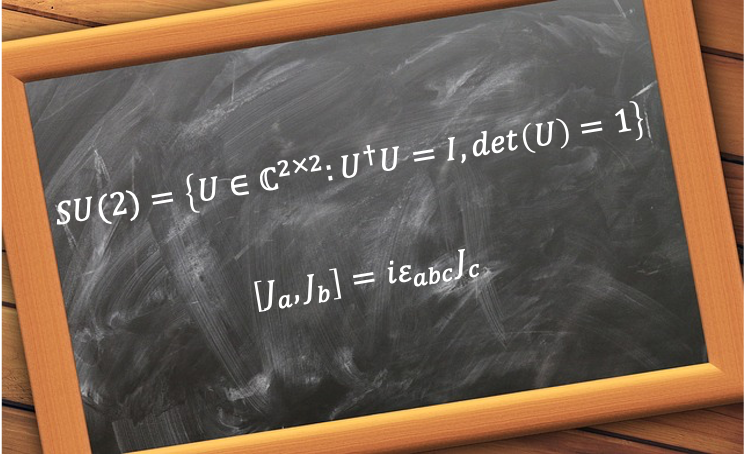
The SU(2) group, or special unitary group of degree 2, is defined by its fundamental representation of unitary matrices
with determinant 1, with the generators
of all its
representations satisfying the commutation relation
.

Question
Why is and why is SU(2) called a special group?
Answer
In general, SO(n) is the subgroup of SU(n) formed by the elements of SU(n) whose matrices entries are real. Under this restriction, the unit-determinant condition is preserved, requiring , consistent with the defining condition of SO(n). For example, When the SU(3) transformations are restricted to real matrices, the symmetry descends from SU(3) to SO(3).
Since the determinant of a complex matrix is a complex number, let . Then,
From , we have
. Using
(see Property 6 of this article for the proof),
Therefore, , which implies that
because
is the modulus (distance from the origin) and is non-negative. It follows that
and SU(n) is the special case where , corresponding to
, where
.
To derive an element of an SU(2) fundamental representation, we begin with , where each entry is a complex number. Using the matrix identity
where
is the cofactor of
(see Property 11 of this article for the proof), we have
since
. Furthermore,
(see this article for proof), which means
. We can therefore express a general SU(2) matrix as:
.
Although , which corresponds to a linear operator
, initially contains four real variables because
and
, the condition
gives
, or equivalently,
This results in three independent variables (or three degrees of freedom), which means that every element of SU(2) can be specified by three independent real parameters. For example, an element representing a rotation operation can be parameterised by three angles , where
is rotation angle, while
and
are the spherical coordinates specifying the orientation of the unit rotation axis
. This unit axis can also be expressed as
, which contains only two independent variables because
.
Question
Explain why the two-dimensional complex vector space of SU(2) does not contradict the requirement of having three independent real variables in the matrices.
Answer
Consider rotations in a plane, which is a two-dimensional vector space. Although the vectors being rotated have two components, every rotation is completely specified by a single parameter: the angle of rotation. The dimension of the vector space describes the space on which the transformations act, whereas the number of parameters describes the independent ways of specifying a transformation. These are different concepts.
A similar idea appears in geometry. The surface of a sphere is embedded in three-dimensional space, yet only two parameters (for example, latitude and longitude) are needed to specify a point on the surface. Although the sphere is curved globally, each small region looks approximately like a flat plane. Such an object is called a manifold.
Likewise, the set of all SU(2) matrices, each with three degrees of freedom, forms a three-dimensional manifold. A general 2×2 complex matrix contains eight real parameters, but the conditions of unitarity and unit determinant constrain the allowed matrices so that only three independent real parameters remain. Thus, the two-dimensional complex vector space refers to the vectors on which SU(2) acts, while the three independent real parameters describe the manifold of allowed SU(2) transformations.
To illustrate the action of such SU(2) transformations, consider a rotation of the electron spin states and
, with the rotation operator (see this article for derivation) given by
where is the spin angular momentum operator.
Since (see this article for derivation), where
, with the Pauli matrices given by
the rotation operator becomes
where , with
being the infinitesimal generators of a representation of the SU(2) group.
Notably, the Pauli matrices satisfy the commutation relations , where
. Moreover, the number of independent real parameters specifying a group element must equal the number of generator matrices so that the dot product in the exponential is well defined (see this article for details).
Question
Show that the generators of SU(n) are traceless.
Answer
The transformation applies to all unitary groups, and every element of SU(n) can be written as
, where
is an
Hermitian matrix. Using the identity
(see property 15 of this article for the proof),
Since every SU(n) matrix must satisfy , we require
, which implies that
.
Expanding the exponential as a Taylor series gives:
Using the Pauli matrix identity , we have
,
,
and so on. Therefore,
Since and
,
Thus, if is Hermitian,
must also be Hermitian.
Substituting into the above equation results in the general form of the matrices that form an irreducible representation of SU(2):
with and
being the basis states that transform according to the representation.
It is important to recognise that the irreducible representation contains an infinite number of elements because the parameter is a continuous variable. In spherical coordinates,
,
and
(see this article for details). Substituting these equations into
and simplifying gives:
satisfies the conditions
and
, which can be easily verified. If we let
act on either
or
, the resulting state is a linear combination of the two spin states. For example,
where and
.
This is expected because the rotated basis vector is another vector in the two-dimensional complex vector space, and every vector in this space can be expressed as a linear combination of the basis vectors. In quantum mechanics, and
are eigenstates of
. After the rotation, the transformed state is generally no longer an eigenstate of
, since the spin has been rotated to point along a different direction in space. Consequently, a measurement of the spin component along the
-axis yields the outcomes spin-up and spin-down with probabilities
and
respectively.
If we restrict to real entries,
(in eq129) to eliminate their imaginary coefficients. This forces the unit rotation axis to point along the
-axis, resulting in
. Hence,
where .
Here, represents matrices that form a representation of SO(2), describing 2D rotations in the
-plane.
As mentioned earlier, each group element in the fundamental representation of SU(2) is represented by an unitary matrix
where
. More broadly, a representation assigns each element of a group to an invertible square matrix in a way that preserves the group’s structure, such as the generator commutation relations
. Therefore, besides the fundamental representation, SU(2) also has a one-dimensional
trivial representation and higher-dimensional
representations.
To derive these representations, we substitute the spin angular momentum operator in
with the orbital angular momentum operator
to give:
It can be easily shown, by using the commutation relations of orbital angular momentum operators, that the generators satisfy
, where
.
Consider a rotation by an angle around the
-axis, with
, and where the eigenfunctions of
are the spherical harmonics
, satisfying
. Using the relation
(see Property 15 of this article for proof), where
, the action of the rotation operator on
is
. Therefore, the transformation can be expressed as
For , this gives a
identity rotation matrix, corresponding to the trivial representation of SU(2). For
and
, the representations have dimensions 3 and 5 respectively. These illustrate that irreducible representations of SU(2) can have dimensions other than the two-dimensional fundamental representation
In conclusion, SU(2) is deeply embedded in any system involving quantum spins, rotations, or two-state dynamics. It describes quantum angular momentum and spin operators, and plays an essential role in the Standard Model, which explains three of the four known fundamental interactions. For example, isospin uses SU(2) symmetry to treat protons and neutrons as two states of the same particle, the nucleon, under the strong nuclear interaction, while neglecting their small electromagnetic differences. These examples illustrate how symmetry can reveal deep connections between physical states that might otherwise appear distinct.