pH indicators: overview

A pH indicator is usually a large, weak organic acid that is soluble in water or alcohol.

\begin{matrix} HIn(aq)\\colourA \end{matrix}\rightleftharpoons H^+(aq)+\begin{matrix} In^-(aq)\\colourB \end{matrix}

The acid HIn absorbs a certain range of wavelengths of visible light and reflects the rest (complementary range of wavelengths) into our eyes, which perceive the complementary wavelengths as Colour A. The conjugate base In absorbs a different range of wavelengths of visible light and reflects a dissimilar complementary range into our eyes, which perceive it as Colour B.

The acid may be a neutral or charged molecule, for example, the acid form of the indicator bromocresol green is monoanionic (yellow), while its conjugate base is dianionic (blue).


Next article: The pH range of an indicator
Content page of ph indicators
Content page of Intermediate chemistry
Main content page

After start point and before stoichiometric point of titration

How can we mathematically describe the titration curve of a weak monoprotic acid versus a strong monoprotic base, after the start point and before the stoichiometric point?

To do so, we will make the following assumptions:

    • [H+] from water is negligible, i.e. H+ in the flask containing the weak acid comes solely from the acid, [H+]a, as water dissociation is suppressed at this stage. This is because Ka ≫ Kw, which shifts the equilibrium H2O ⇌ H+ + OH– to the left.
    • For a weak acid, [HA] is approximately equal to the concentration of the undissociated acid[HA]ud, i.e. the weak acid HA dissociates only slightly, with the remaining concentration of HA after the addition of base approximated as [HA][HA]ud – [A]s, where [A]s is concentration of the salt formed. This implies that:
    • [A] is approximately equal to the concentration of the salt, [A]s, in the solution. In other words, Ais completely attributed to the salt formed, with no contribution from the further dissociation of HA.
    • Hydrolysis of the salt is suppressed at this stage of the titration due to the overwhelming presence of HA, which shifts the hydrolysis equilibrium A+ H2O ⇌ HA + OH to the left.

The equation for the dissociation of a weak monoprotic acid is

HA(aq)\rightleftharpoons H^+(aq)+A^-(aq)

Using the assumptions, the equilibrium constant after start point and before stoichiometric point is:

K_a=\frac{[H^+]_a[A^-]_s}{[HA]_r}

Taking the logarithm on both sides and apply the definitions of pH and pKa,

pH=pK_a+log\frac{[A^-]_s}{[HA]_r}\; \; \; \; \; \; \; \; (2)

Eq2 is known as the Henderson-Hasselbalch equation, which is a good approximation of the pH curve after the start point and before the stoichiometric point for a strong base to weak acid titration with Ka 10-3 (or a strong acid to weak base titration with Kb  10-3).


Question

Rewrite eq2 to include the volume of acid Va and the volume of base Vb.

Answer

pH=pK_a+log\left ( \frac{[B]V_b}{V_a+V_b}/\frac{[A]V_a-[B]V_b}{V_a+V_b} \right )

pH=pK_a+log\left ( \frac{[B]V_b}{[A]V_a-[B]V_b} \right )\; \; \; \; \; \; \; \; (2a)

where [A] = [HA]ud , and [B] is the initial concentration of the monoprotic base.

When eq2a is plotted as pH versus Vb, a titration curve is obtained (see diagram below).


The diagram below is the superimposition of a green curve (the Henderson-Hasselbalch equation, eq2a) on a blue curve (the complete pH titration curve, which disregards all assumptions above), for the titration of 10 cm3 of 0.200 M of CH3COOH (Ka = 1.75 x 10⁻⁵) with 0.100 M of NaOH.
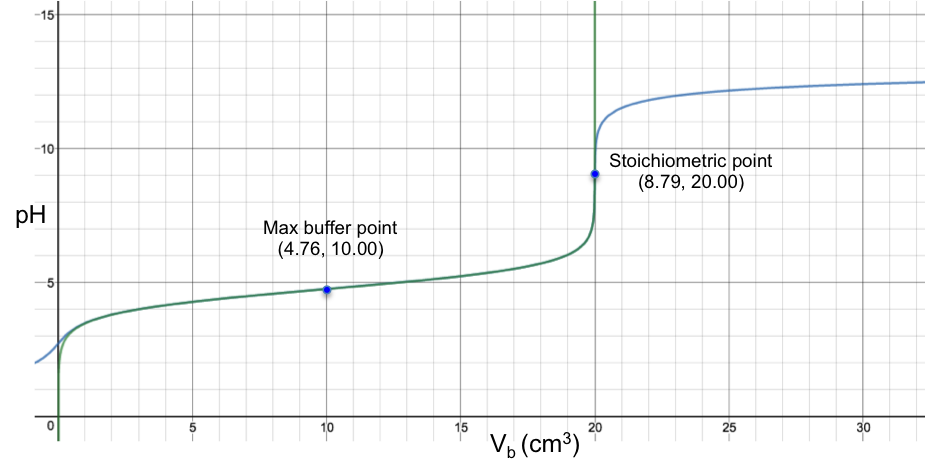
Even though the two curves appear to fit perfectly (apart from the initial bit before 1.00 cm3 and after the stoichiometric point), they do not actually coalesce and are still two separate curves (discernible when the axes of the plot are scaled to a very high resolution). However, for practical purposes, the Henderson-Hasselbalch equation is a very good approximation of a pH curve for the region after the start point and before the stoichiometric point for a strong base to weak acid titration.

When [A]s = [HA]r , eq2 becomes

pH=pK_a\; \; \; \; \; \; \; \; (3)

Eq3 occurs when the amount of salt formed equals to [HA]ud/2, i.e. when half of the acid is neutralised. This stoichiometric relation corresponds to the curve’s inflexion point, which is also called the maximum buffer capacity point.


Question

Why does the solution have maximum buffer capacity when half of the acid is neutralised, i.e. at the half-way volume point between the start point and the stoichiometric point?

Answer

For the buffer to be most effective, it has to resist to the greatest extent the change in pH versus the change in volume of base added. This means that the maximum buffer capacity corresponds to the point where the gradient of the function of eq2a is a minimum, i.e. at the inflexion point (see above diagram). 

Taking the 2nd derivative of eq2a with respect to Vb and letting \frac{d^2pH}{dV_b^2}=0 gives

\frac{n_b}{n_a}=\frac{1}{2}

where n_b=\left [ B \right ]V_b  and n_a=\left [ A \right ]V_a.

Therefore, the inflection point occurs when the moles of added base equal half the moles of the undissociated acid, corresponding to half the total volume of base required for complete neutralisation.

If you want a full mathematical description of the maximum buffer capacity of a weak acidic buffer, read this article in the advanced section. 


For a strong acid to weak base titration, we have the following weak base equilibrium:

BOH(aq)\rightleftharpoons B^+(aq)+OH^-(aq)

K_b=\frac{[B^+][OH^-]}{[BOH]}

Taking the logarithm on both sides of the above equation and rearranging,

pOH=pK_b+log\frac{[B^+]}{[BOH]}\; \; \; \; \; \; \; \; (3a)

Eq3a is the basic form of the Henderson-Hasselbalch equation.

With reference to eq2 (or eq3a), the pKa (or pKb) of the weak acid (or weak base) can be determined from the pH of a strong base to weak acid titration (or knowing the pOH of a strong acid to weak base titration) at the half-way volume point, where the logarithmic term becomes zero.


Question

Show that pKa + pKb = 14.

Answer

HA(aq)+H_2O(l)\rightleftharpoons A^-(aq)+H_3O^+(aq)

A^-(aq)+H_2O(l)\rightleftharpoons HA(aq)+OH^-(aq)

K_a=\frac{[A^-][H_3O^+]}{[HA]}\; \; \; \; \; \; \; \; K_b=\frac{[HA][OH^-]}{[A^-]}

pK_a+pK_b=-log\frac{[A^-][H_3O^+]}{[HA]}-log\frac{[HA][OH^-]}{[A^-]}

=-log[H_3O^+][OH^-]=-logK_w=14


next article: stoichiometric point of titration
Previous article: start point of titration
Content page of strong base to weak acid titration curve
Content page of intermediate chemistry
Main content page

Classical atomic theory

The classical atomic theory is an early scientific interpretation of the atom.

Niels Bohr, a Danish physicist, introduced a model in 1911 to explain the hydrogen spectrum, which he used to derive the Rydberg formula.

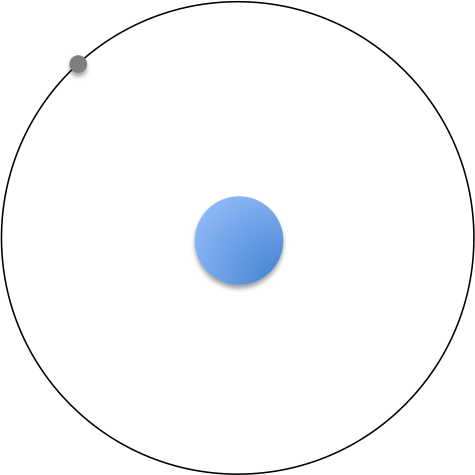
He proposed that the electron of a hydrogen atom orbits around the fixed massive nucleus (see diagram below), with the coulombic force of interaction between the electron and the nucleus being balanced by the centrifugal force; that is:

\frac{e^2}{4\pi \varepsilon _0r^2}=\frac{m_ev^2}{r}\; \; \; \; \; \; \; \; 1

where e is the charge on the electron, εis permittivity of free space, r is the radius of the orbit, me is the mass of the electron, and v is the speed of the electron.

Bohr further proposed that, for an orbit to remain stable, the angular momentum of the electron must be an integer multiple of \hbar=h/2\pi:

m_evr=n\frac{h}{2\pi}\; \; \; \; \; \; \; \; 2

where  h  is the Planck constant.

Combining eq1 and eq2 and eliminating v yields

r=\frac{\varepsilon _0n^2h^2}{\pi m_ee^2}\; \; \; \; \; \; \; \; 3

Substituting eq3 back in eq2 gives

v=\frac{e^2}{2\varepsilon _0nh}\; \; \; \; \; \; \; \; 4


Question

What is angular momentum and how did Bohr arrive at the assumption for eq2?

Answer 

Angular momentum is the rotational analogue of linear momentum. While the momentum of a body travelling in a straight line is proportional to its mass and velocity (p = mv),  the momentum of a body revolving around a point is proportional to its mass, tangential velocity, and the perpendicular distance from its tangential velocity to the point (L = mvr). According to Bohr, electrons orbit the nucleus at distinct radii and, consequently, have discrete values of angular momentum. He proposed that these radii are such that the angular momentum are integer multiples of h/2\pi.

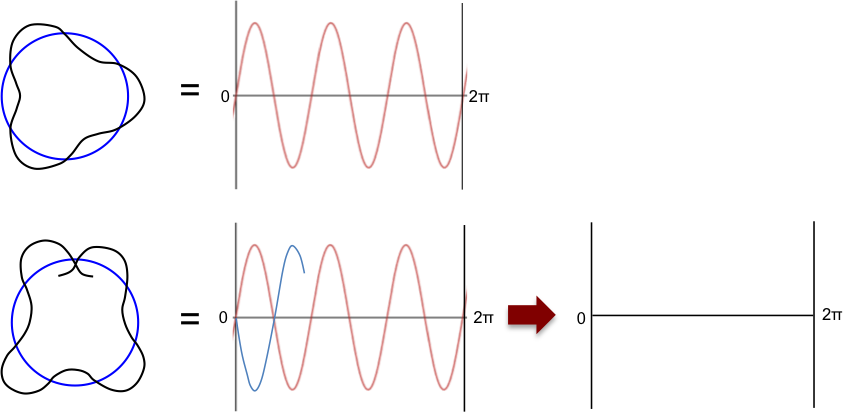
Louis de Broglie, a French physicist, subsequently reinterpreted Bohr’s model by treating electrons as waves. He proposed that an integral number of the electron’s wavelength \lambda must fit the orbit’s circumference for the orbit to be stable, i.e. 2\pi r=n\lambda, where n\in \mathbb{Z}. Otherwise, the orbiting wave will disappear due to destructive interference (see diagram below).

Substituting de Broglie’s formula of p = h/λ into 2πr = nλ gives

p=\frac{nh}{2\pi r}\; \; \; \Rightarrow \; \; \; v=\frac{nh}{2\pi rm_e}\; \; \; and\; \; \; r=\frac{nh}{2\pi vm_e}\; \; \; \; \; \; \; (5)

Substituting eq5 in eq1 yields

v=\frac{e^2}{2\varepsilon _0nh}\; \; \; and\; \; \; r=\frac{\varepsilon _0 n^2h^2}{\pi m_ee^2}\; \; \; \; \; \; \; (6)

which is the same as eq4 and eq3, respectively.


The total energy of the electron is:

E_n=KE+V=\frac{1}{2}m_ev^2-\frac{e^2}{4\pi \varepsilon _0r}\; \; \; \; \; \; \; (7)

Substituting eq3 and eq4 in eq7 results in

E_n=-\frac{m_ee^4}{8{\varepsilon _{0}}^{2}n^2h^2}\; \; \; \; \; \; \; (8)

The transition energy between two states is:

\Delta E=E_2-E_1=\frac{m_ee^4}{8{\varepsilon _{0}}^{2}h^2}(\frac{1}{{n_{1}}^{2}}-\frac{1}{{n_{2}}^{2}})\; \; \; \; \; \; \; (9)

At this point, Bohr assumed that an allowed transition between two states involves an electron falling from a higher energy state to a lower energy state, with the emission of a photon of energy given by the Planck relation E= hv ΔE. Therefore, eq9 becomes:

hv=hc\tilde{v}=\frac{m_ee^4}{8{\varepsilon _{0}}^{2}h^2}(\frac{1}{{n_{1}}^{2}}-\frac{1}{{n_{2}}^{2}})

\tilde{v}=\frac{m_ee^4}{8{\varepsilon _{0}}^{2}ch^3}(\frac{1}{{n_{1}}^{2}}-\frac{1}{{n_{2}}^{2}})\; \; \; \; \; \; \; (10)

where \tilde{v}=\frac{1}{\lambda} is the wavenumber of the photon.

When n= 1 and n= ∞,

\tilde{v}=\frac{m_ee^4}{8{\varepsilon _{0}}^{2}ch^3}=R_H\;\; or\; \; R_\infty \; \; \; \; \; \; \; (11)

where Ror R∞ is the Rydberg constant.

Even though the Bohr model has certain shortcomings – specifically, that an electron orbiting around the nucleus would constantly radiate electromagnetic energy and eventually crash into the nucleus – eq10 and eq11 were proven to be mathematically sound for the hydrogen atom using quantum mechanics (see this article for the quantum-mechanical derivation of eq8).

From eq11,

m_e=\frac{8{\varepsilon _{0}}^{2}ch^3R_\infty }{e^4}=\frac{2hR_\infty }{c\alpha ^2}\; \; \; \; \; \; \; (12)

where \alpha =\frac{e^2}{2\varepsilon _0hc}\; \; or\; \; \frac{e^2}{4\pi \varepsilon_0\hbar c}\; \; \; \; \; \; \; \; (\hbar=\frac{h}{2\pi})

\alpha is known as the fine-structure constant.


Question

Show that the molar mass of carbon-12, M(12C), is:

M(^{12}C)=\frac{24hR_\infty N_A}{c\alpha ^2A_r(e)}

Answer 

\frac{molar\; mass\; of\; ^{12}C}{molar\; mass\; of\; electron}=\frac{relative\; mass\;of\; ^{12}C}{relative \; mass\; of\; electron}

Since the relative mass of 12C is 12 unified atomic mass units,

\frac{M(^{12}C)}{M(e)}=\frac{12}{A_r(e)}

From eq12, M(e)=\frac{2hR_\infty }{c\alpha ^2}N_A. Therefore,

M(^{12}C)=\frac{24hR_\infty N_A}{c\alpha ^2A_r(e)}


Next article: modern atomic structure
Content page of intermediate quantum chemistry
Content page of intermediate chemistry
Main content page

Link between unified atomic mass and inertia mass

What is the link between unified atomic mass unit and inertia mass?

Jean Perrin’s and other scientists’ experiments in the early 1900s to determine the Avogadro constant were based on a gramme-molecule, which is the mass of a gas that occupies the same volume as two grammes of hydrogen gas at the same temperature and pressure. Their experiments produced a range of values for the constant when different gases are used. This variation occurs because different real gases with the same number of particles have different volumes.

A better definition of the mole was therefore needed and was established in 1967 as follows:

The amount of substance of a system that contains as many elementary entities as there are atoms in 0.012 kilogram of carbon-12.

The choice to base the Avogadro constant on carbon-12 may seem arbitrary. However, it is this definition that enables us to link the unified atomic mass unit scale to the inertia mass scale. So,

1^{12}C=12u

\frac{0.012\; kgmol^{-1}}{N_{A}\; mol^{-1}}=12u\; \; \; \; \; \; \; (1)

1u=1.660539\times 10^{-27}\; kg\; \; \; \; \; \; \; (2)

We can rewrite eq1 as

1u=\frac{M_{u}}{N_{A}}g

where Mu is the molar mass constant and is equal to 1 gmol-1.

Even though the definition of the mole was changed to ‘a mole is the amount of substance of a system that contains exactly 6.02214076 x 10²³ elementary entities’ in Nov 2018, the peg of 112C to 12 u remains. However, the exact value of the Avogadro constant leads to the molar mass of carbon-12 having a relative uncertainty in the order of 10-10. It is no longer exactly 0.012 kgmol-1 and is given by the formula (see the article on ‘Bohr model‘ for derivation):

M(^{12}C)=\frac{24hR_{\infty }N_{A}}{c\alpha^{2}A_{r}(e)}\; \; \; \; \; \; \; \; (3)

where

h   is the Planck constant

R_{\infty }   is the Rydberg constant

c   is the speed of light

\alpha   is the fine-structure constant

A_{r}(e)   is the ‘relative atomic mass’ of an electron

The uncertainty in the value of 0.012 kgmol-1, which will be determined in future experiments, is primarily due to the uncertainty in the fine-structure constant.

Similarly, the molar mass constant , which was a constant with the value 1 gmol-1, is now described by the formula:

M_{u}=\frac{2hR_{\infty}N_{A}}{c\alpha ^{2}A_{r}(e)}

By the same logic, the unified atomic mass unit has the formula:

u=\frac{2hR_{\infty }}{c\alpha^{2}A_{r}(e)}


next article: how to ‘weigh’ an atom?
previous article: unified atomic mass unit
Content page of mass in chemistry
Content page of intermediate chemistry
Main content page

Millikan’s oil drop experiment: overview

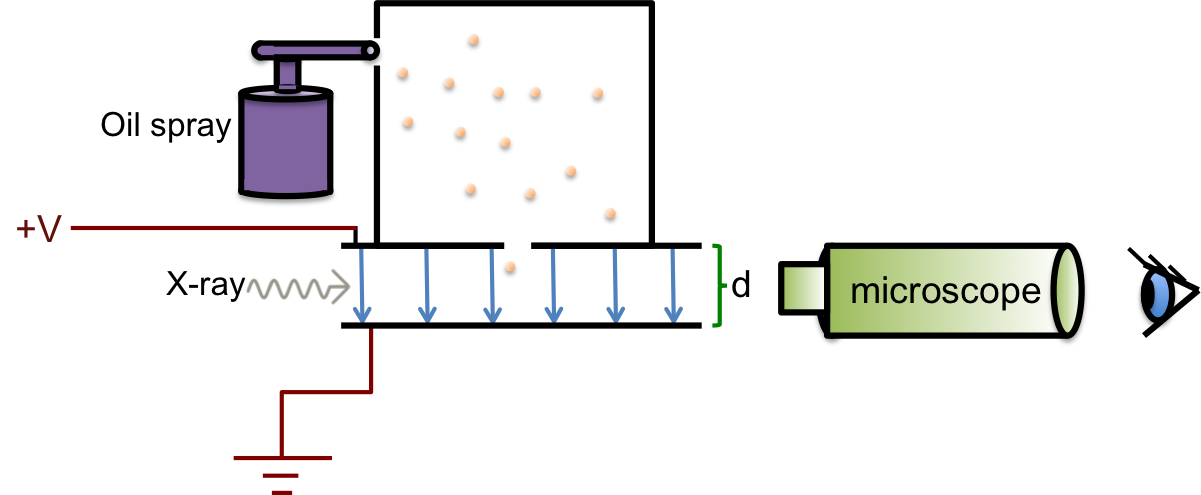
Robert Millikan conducted an experiment in 1909 to measure the charge of an electron. He devised an apparatus to observe electrically-charged droplets of oil between two horizontal plates that had a potential difference of several thousand volts applied across them.

The oil droplets were sprayed from an atomiser into an upper chamber. In the space between the plates, the air were ionised by X-rays, causing the oil droplets to acquire electrons and become negatively charged as they fell and traversed through the air between the plates. Millikan then performed a few tasks and observed the motion of the oil droplets through a microscope.


Next ArTicle: Task 1
Content page of millikan’s oil drop experiment
Content page of intermediate chemistry
Main content page

Millikan’s oil drop experiment: task 1

Millikan’s oil drop experiment consists of a few tasks.

For a start, the power supply to the plates is cut off (V = 0). The oil-droplets falling between the plates accelerate due to the effect of gravitational force and then continue downwards at terminal velocity as they encounter increasing air resistance. The three forces acting on an oil droplet are:

Gravitational force,

Fg

The force of attraction between the mass of the earth and that of the oil droplet.
Upthrust (buoyant),

Fu

The force exerted by a liquid or a gas on a body when the body displaces some weight of the liquid or gas. It is due to the pressure difference between the top and bottom of the object (as a result of the collision of liquid or gas molecules with the body from the top and bottom) and equal to the weight of the liquid or gas displaced.
Drag (viscous),

Fd

The force caused by relative motion (friction) between an object and a liquid or gas. It is proportional to the velocity of the object, the radius of the object and the viscosity of the liquid or gas.


At terminal velocity,

F_{g}=F_{d}+F_{u}\; \; \; \; \; \; \; (1)

The oil droplet is assumed to be spherical. So, Fg, the weight of the oil droplet, is:

F_{g}=mg=\frac{4\pi }{3}r^{3}\rho g\; \; \; \; \; \; \; (2)

where mρ and r are the mass, density and radius of the oil droplet, respectively.

The equation of the drag force acting on the oil droplet can be expressed using Stokes’ law:

F_{d}=6\pi r\eta v_{1}\; \; \; \; \; \; \; (3)

where v1, is the terminal velocity of the falling oil droplet and η is the viscosity of air.

Through the microscope, Millikan recorded the distance travelled by the falling oil droplet over a period of time and calculated the terminal velocity v1.

For a perfectly spherical oil droplet the upthrust acting on it is:

F_{u}=mg=\frac{4\pi }{3}r^{3}\rho _{air}g\; \; \; \; \; \; \; (4)

where ρair is the density of the air.

Substituting eq2, eq3 and eq4 in eq1 yields

6\pi r\eta v_{1}=\frac{4\pi }{3}r^{3}(\rho -\rho _{air})g\; \; \; \; \; \; \; (5)

r=\sqrt{\frac{9\eta v_{1}}{2g(\rho -\rho _{air})}}\; \; \; \; \; \; \; (6)

NEXT ARTICLE: TASK 2
Previous article: Overview
Content page of millikan’s oil drop experiment
Content page of intermediate chemistry
Main content page

Millikan’s oil drop experiment: task 2

The power supply to the plates is turned back on and the electric force acting on the oil droplet is:

F_{e}=qE\; \; \; \; \; \; \; (7)

where q is the charge on the oil droplet and E is the electric field between the plates.

For parallel plates,

E=\frac{V}{d}\; \; \; \; \; \; \; (8)

where V is the potential difference across the plates and d is the distance between the plates.

Combining eq7 and eq8,

q=\frac{F_{e}\: d}{V}\; \; \; \; \; \; \; (9)

If V is adjusted until the oil droplet remained stationary,

F_{e}=mg\; \; \; \; \; \; \; (10)

Combining eq9 and eq10,

q=\frac{mgd}{V}

Our objective is to determine the value of q, but it is difficult to accurately measure m. Therefore, we have to carry out another task.


NEXT ARTICLE: TASK 3
Previous article: task 1
Content page of millikan’s oil drop experiment
Content page of intermediate chemistry
Main content page

Millikan’s oil drop experiment: task 3

Next, V is turned up slightly so that the oil droplet rises with a new terminal velocity v2.

We have:

F_{e}+F_{u}=F_{d}+F_{g}\; \; \; \; \; \; \; (11)

Note that the electric force is acting upwards (since the oil droplet is rising); upthrust is also acting upwards (because the pressure is still greater below the object than above it due to the exponential distribution of air); drag is now acting downwards because the oil droplet is rising, and weight continues to act downwards due to the effect of gravitational force. Substituting eq2, eq3 (with v2 instead of v1), eq4 and eq7 in eq 11 yields

qE+\frac{4\pi }{3}r^{3}\rho _{air}g=6\pi \eta rv_{2}+\frac{4\pi }{3}r^{3}\rho g

qE-\frac{4\pi }{3}r^3(\rho -\rho _{air})g=6\pi \eta rv_{2}\; \; \; \; \; \; \; (12)

Substituting eq5 in eq12 gives

qE-6\pi r\eta v_{1}=6\pi \eta rv_{2}\; \; \; \; \; \; \; (13)

Substituting eq8 in eq13 and rearranging results in

q=\frac{6\pi r\eta (v_{1}+v_{2})d}{V}\; \; \; \; \; \; \; (14)

Once again, Millikan recorded the distance travelled by the rising oil droplet over a period of time and calculated the new terminal velocity, v2.

Substituting the values of v1v2 and the calculated value of r (from eq6) in eq14, Millikan determined a value for q. He repeated the experiment multiple times, each time varying the strength of X-rays ionizing the air, resulting in a varying number of electrons attaching to the oil droplet. He then obtained various values of q and found them to be multiples of 1.5924 x 10⁻¹⁹ C. Millikan concluded that the value of 1.5924 x 10⁻¹⁹ C is equal to the charge of a single electron. Subsequent determinations refined that value to 1.602176487 x 10⁻¹⁹ C.

Using the Faraday constant and the value of the charge of a single electron that he determined, Millikan calculated the Avogadro constant and proved that one Faraday is the quantity of charge for one mole of electrons.


Previous article: task 2
Content page of millikan’s oil drop experiment
Content page of intermediate chemistry
Main content page

Mass spectrometry: the mechanics

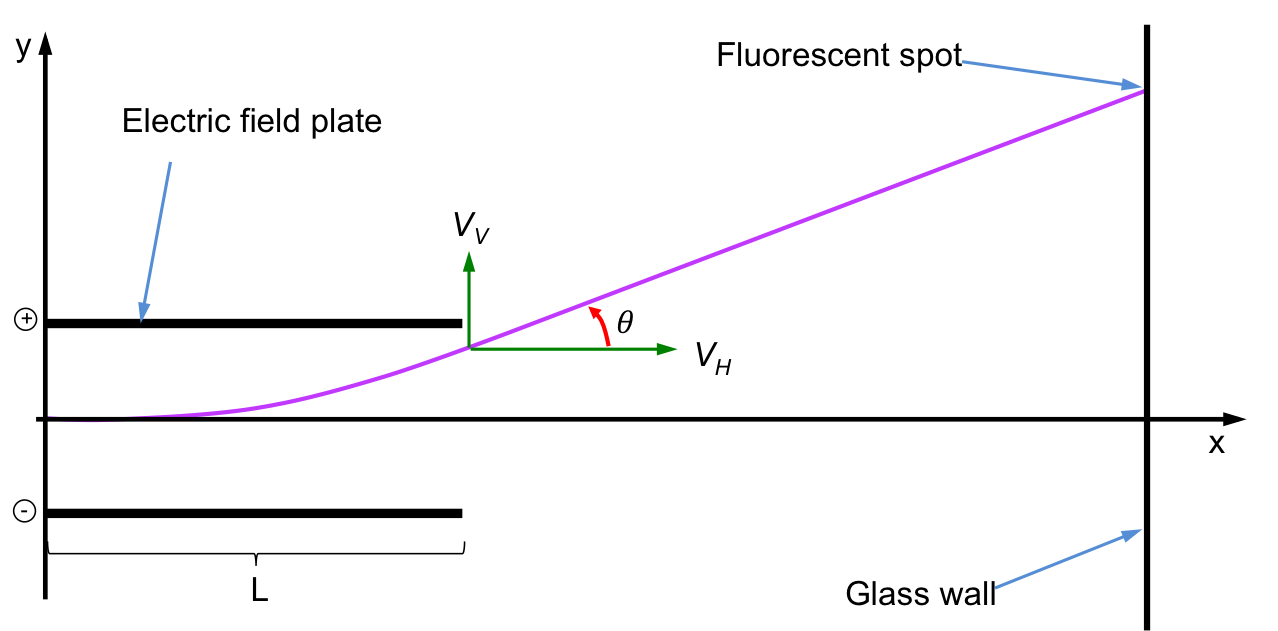
Mass spectrometry in the early days focuses on determining the charge-to-mass ratio, e/m, of an electron. This involves a few steps, beginning with the electric field turned on and the magnetic field turned off. The diagram below shows the mechanics of the electrons as they pass through the electric field plates.

An electric force, Fe, acts on an electron with charge, e, passing through the electric field, E, in the x-direction where

F_{e}=eE\; \; \; \; \; \; \; (1)

and gives the electron with mass, m, an acceleration, a:

F_{e}=ma\; \; \; \; \; \; \; (2)

Combining eq1 and eq2,

a=\frac{eE}{m}\; \; \; \; \; \; \; (3)

As the electric force acts only in the y-direction, the velocity of the electron in the x-direction remains constant at vH. The velocity of the electron in the y-direction, vV, is zero at the point where it enters the electric field and increases to a maximum value at the point where the electron leaves the electric field. This maximum value of vremains constant after the electron exits the electric field and is given by:

v_{V}=\frac{dS}{dt}=\frac{d(ut+\frac{1}{2}at^{2})}{dt}=at

where S is the displacement of the electron in the y-direction, u is the initial velocity of the electron in the y-direction before entering the electric field (i.e. u = 0) and t is the time during which the electric force acts on the electron.

In other words, t is the time taken for the electron to travel the length of the electric field plate, L. Therefore,

v_{V}=at=(\frac{eE}{m})(\frac{L}{v_{H}})\; \; \; \; \; \; \; (4)

The trigonometric relationship between vH and vV after the electron leaves the electric field is:

tan\theta =\frac{v_{V}}{v_{H}}=\frac{eEL}{{v_{H}}^{2}m}\; \; \; \; \; \; \; (5)

The electric field strength is adjusted so that the angle of deflection is small. Therefore, tanθ ≈ θ and eq5 becomes,

\theta =\frac{eEL}{{v_{H}}^{2}m}\; \; \; \; \; \; \; (6)

The value of θ is recorded, leaving v as the only unknown variable (in eq6) for the calculation of e/m. To determine vH , the magnetic field, B, is turned on while the electric field is still on. Using Fleming’s left hand rule, the magnetic force, FB, acts on the electron (at the point when the electron just enters the magnetic field from the left side) and deflects it in the negative y-direction:

F_B=ev_HB\; \; \; \; \; \; \; \; (7)

The magnetic field is then adjusted to the extent that the angle of deflection of the cathode ray is zero, meaning F= FB. Substituting eq1 and eq7 in F= FB, we have:

v_{H}=\frac{E}{B}\; \; \; \; \; \; \; (8)

Substitute eq8 in eq6

\frac{e}{m}=\frac{E\theta }{B^{2}L}\; \; \; \; \; \; \; (9)

The values of all the variables on the right hand side of eq9 are now known and the charge-to-mass ratio e/m of the electron can be determined. The magnitude of e/m that Thomson obtained ranged from 0.7 x 10¹¹ C/kg to 2 x 10¹¹ C/kg. The currently accepted value is 1.758820024 x 10¹¹ C/kg.

Finally, in 1909, when Robert Millikan determined the charge of an electron via his famous oil drop experiment, the estimated mass of an electron was calculated.


next article: application, relative isotopic mass
Previous ArTicle: J.J. thomson’s cathode ray experiment
Content page of mass spectrometry
Content page of intermediate chemistry
Main content page

Application of mass spectrometry: relative isotopic mass

A mass spectrometer measures the mass of an isotope relative to that of carbon-12 by analysing the ratio of the ionised isotope’s deflection to the ionised carbon-12’s deflection.

From eq9, we have:

\frac{e_{isotope}}{m_{isotope}}=\frac{E\theta _{isotope}}{B^{2}L}\; \; \; \; \; \; \; (10)

\frac{e_{^{12}C}}{m_{^{12}C}}=\frac{E\theta _{^{12}C}}{B^{2}L}\; \; \; \; \; \; \; (11)

Assume both ions are univalent so that e_{^{12}C}=e_{isotope} and divide eq11 by eq10:

\frac{m_{isotope}}{m_{^{12}C}}=\frac{\theta _{^{12}C}}{\theta _{isotope}}\; \; \; \; \; \; \; (12)

Therefore,

mass\; of\; isotope=\frac{\theta _{^{12}C}}{\theta _{isotope}}m_{^{12}C}\; \; \; \; \; \; \; (13)

We can also represent eq13 in the form

mass\; of\; isotope=\frac{m_{isotope}/z_{isotope}}{m_{^{12}C}/z_{^{12}C}}m_{^{12}C}\; \; \; \; \; \; \; (14)

where we have replaced e with the notation z. The output of eq14 is a value with unit of unified atomic mass unit, u, since the ratio is unit-less while m_{^{12}C}=12u.

Finally, we divide the output of eq14 by 1u to obtain the relative isotopic mass, which is a dimensionless quantity that is defined as the ratio of the mass of an isotope in unified atomic mass unit to one unified atomic mass unit.


Question

Is it possible to accurately measure the mass of an atom in kg using eq9 without a reference isotope?

Answer

No. Due to the limits of precision engineering, measurements of the mass of an atom in kg by directly applying eq9 differ from one mass spectrometer to another. We therefore need a reference ‘flight path’ that we can compare with, i.e. using eq14. Since the value of m_{^{12}C} is accurately defined in u, the output of eq19 must be in unified atomic mass unit. The value in kg is then obtained by the following conversion:

1u = 1.660539 x 10-27 kg


Next ArTicle: Modern mass spectrometer design
Previous ArTicle: the mechanics
Content page of Mass spectrometry
Content page of intermediate chemistry
Main content page
Mono Quiz