A particle accelerator is a machine that uses electric and magnetic fields to propel charged particles, such as electrons or protons, to extremely high speeds and energies.
Particle accelerators are among the most important tools in modern physics. By accelerating particles and directing them into targets or into collisions with one another, scientists can study the fundamental building blocks of matter and the forces that govern them.
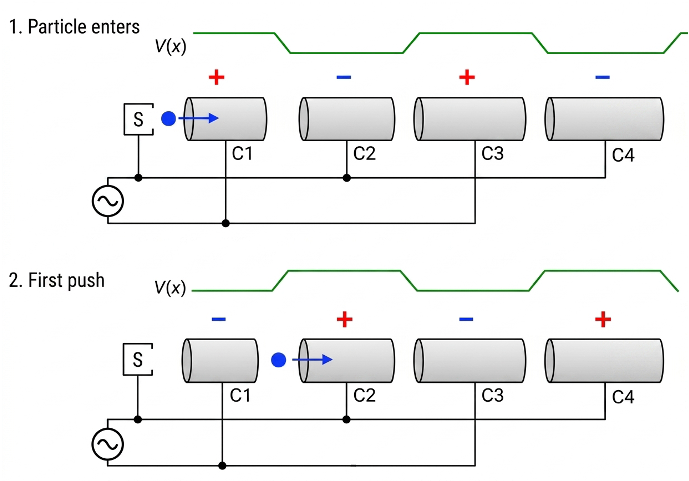
There are two major types of particle accelerators: linear accelerators (linacs) and circular accelerators. In a linear accelerator, particles travel along a straight path through a series of accelerating sections. Alternating electric fields are carefully timed so that each section gives the particles another push, increasing their energy as they move forward (see diagram below). Magnetic fields can also be used to focus and steer the beam, keeping the particles traveling along the desired path.
Circular accelerators work differently: particles travel repeatedly around a circular or nearly circular track, passing through accelerating structures each time they complete a circuit (refer to the storage ring in the diagram below). Powerful dipole magnets bend the particles’ paths and keep the beam focused. As relativistic particles travel around curves, they emit energy in the form of radiation, which is directed along beamlines and subsequently used as a radiation source for experiments. To replenish the kinetic energy lost through radiation, radio-frequency accelerating cavities (RF cavities), which contain electric fields oscillating at radio frequencies, are placed around the track to increase the particles’ energy with each successive pass.
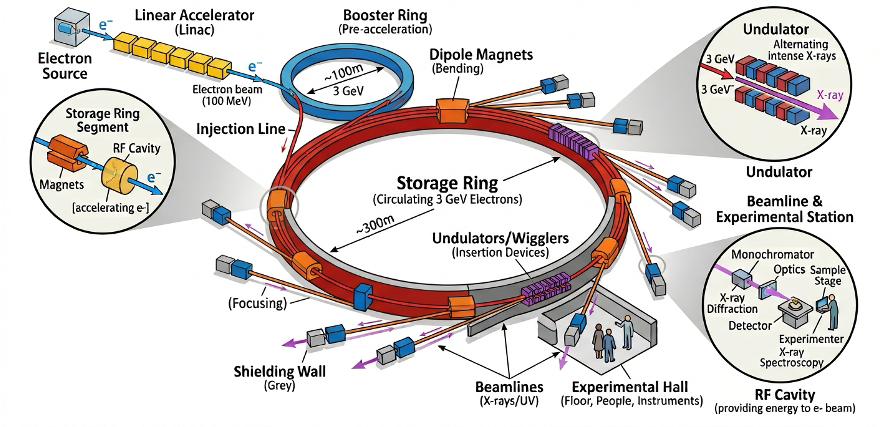
A synchrotron is a specialised accelerator that combines the principles of linear and circular acceleration (see diagram above). Source particles initially pass through a linear accelerator before entering the circular accelerator known as a storage ring. The strength of the magnetic fields and the timing of the accelerating electric fields in the ring are synchronised with the particles as their energy increases. This allows particles to remain on the same circular path in the storage ring even as they approach extremely high energies. Additionally, undulators and wigglers (collectively known as insertion devices) are placed in the straight sections of the storage ring. They use an array of alternating magnetic poles (North-South-North-South) to force the travelling charged particles into a periodic “wiggling” path, causing them to emit intensely bright, highly focused synchrotron radiation. This radiation is particularly useful for studying the structure, chemical composition and physical properties of materials at the atomic and molecular levels.
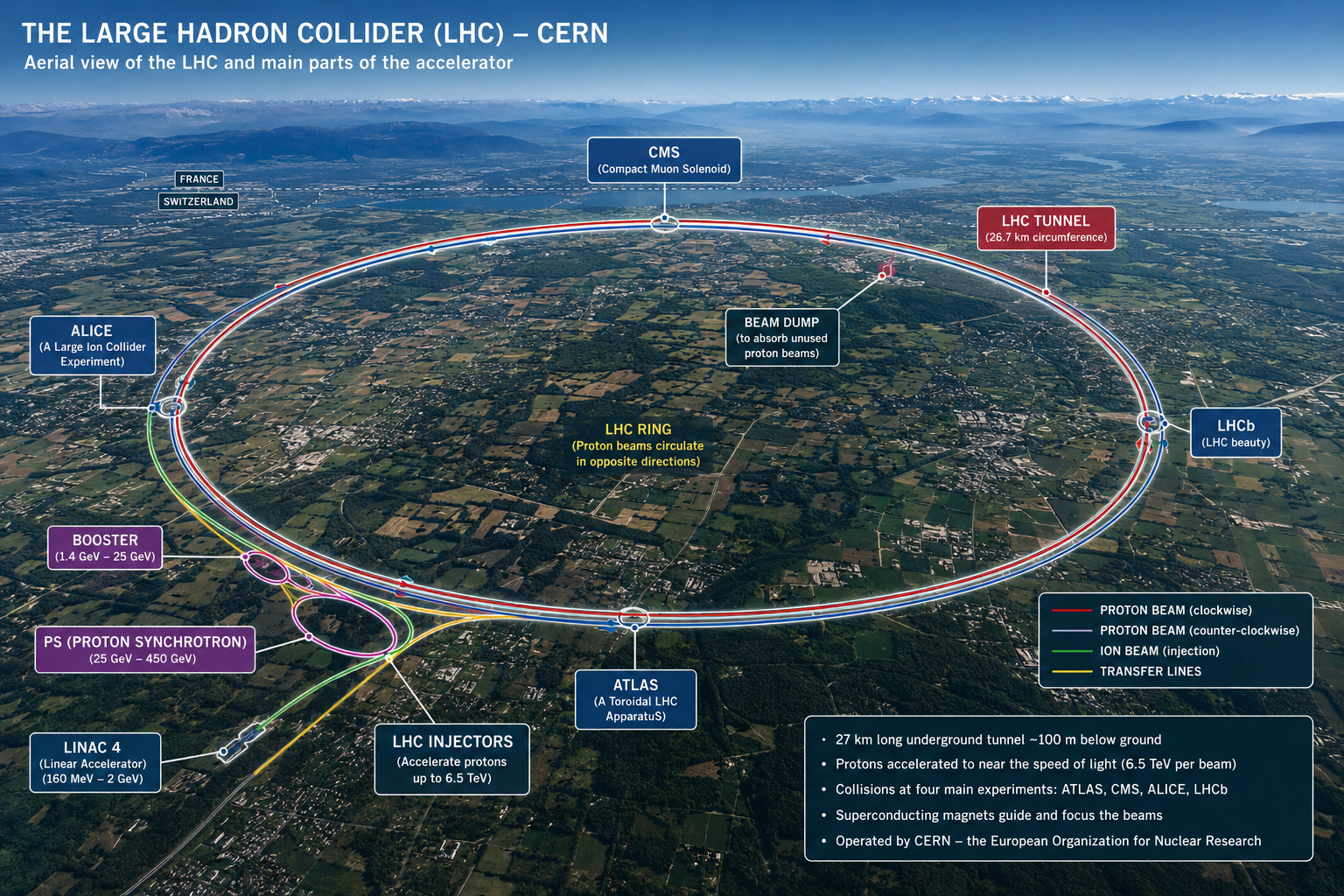
The Large Hadron Collider (LHC) is a famous example of a synchrotron and the world’s largest and most powerful particle accelerator (see diagram below). Located at CERN near Geneva, Switzerland, it uses powerful superconducting magnets to guide two beams of protons around a 27-kilometre circular tunnel in opposite directions (see diagram below). When the beams reach their target energies, magnets steer them into collisions at specific points around the accelerator. Scientists study the particles produced in these collisions using large detectors, allowing them to investigate fundamental questions about matter and the forces of nature. One of the LHC’s most significant achievements was the discovery of the Higgs boson in 2012, providing experimental confirmation of a particle predicted by the Standard Model of particle physics.
A particularly striking example of what can happen in a particle accelerator is the collision between a proton and an antiproton. A proton is made up of three quarks, while an antiproton is made up of three antiquarks. When the two particles collide at sufficiently high energy, their matter and antimatter constituents can annihilate, converting their energy into other particles. This does not mean that all the energy simply disappears. Instead, according to Einstein’s famous equation , the energy carried by the colliding particles can be transformed into the mass and kinetic energy of newly created particles. For example, when a proton and an antiproton collide at high energy, their energy can be converted into short-lived particles such as pions, kaons, or heavier particles, depending on the energy and the interaction that takes place (see diagram below for an example). These particles may then decay into other particles, like muons and neutrinos.
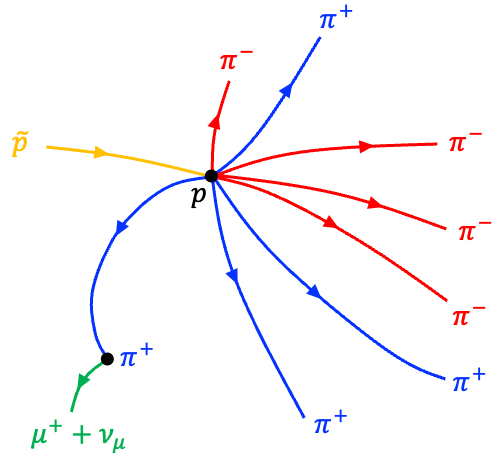
Typically, the collision occurs inside a chamber exposed to a uniform magnetic field and containing many layers of highly sensitive sensors. As the newly produced particles travel outwards from the collision point, they pass through these sensors and leave tiny signals at different locations. Computers collect these signals and use the pattern of sensor readings to reconstruct the trajectories of the particles.
For example, the diagram above shows the negatively and positively charged particles produced in the annihilation being deflected clockwise and anticlockwise respectively in a uniform magnetic field directed out of the page. By measuring the radii of curvature of their tracks, we can calculate their momenta and, hence, determine their masses. This allows physicists to reconstruct what happened during the collision and learn about the fundamental interactions between matter and antimatter.
Finally, such technologies are not limited to fundamental research. Particle accelerators are also used in medicine, industry, and scientific research. In cancer treatment, for example, accelerators can produce beams used in radiation therapy to destroy cancer cells. They can also help manufacture specialised materials, inspect industrial components, and produce radioactive isotopes used in medical diagnosis.