Subatomic particles are particles smaller than atoms, while elementary particles are fundamental particles that are not known to be made of smaller constituents.
Although atoms were once considered the smallest indivisible units of matter, scientific discoveries have shown that atoms themselves have a complex internal structure. An atom consists of a small, dense nucleus containing protons and neutrons, surrounded by electrons. Further investigation revealed that protons and neutrons are themselves composed of even smaller particles called quarks. This discovery led to a deeper understanding of matter and gave rise to the modern field of particle physics.
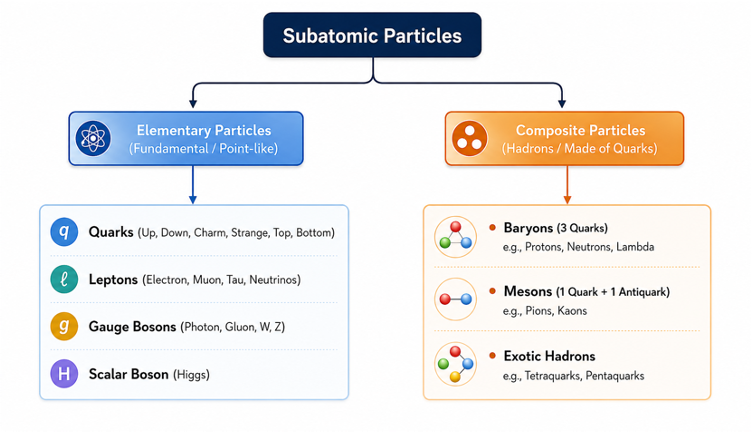
Subatomic particles can broadly be divided into composite particles, meaning they are made of smaller constituents, and elementary particles, which are currently regarded as fundamental (see above diagram). Protons and neutrons, for example, are composite particles made of quarks held together by the strong nuclear force. Electrons, on the other hand, are considered elementary particles because no smaller internal structure has been observed within them. Other elementary particles include quarks, neutrinos, photons, gluons and the particles associated with the Higgs field. There are a total of 61 elementary particles and over 300 composite particles.
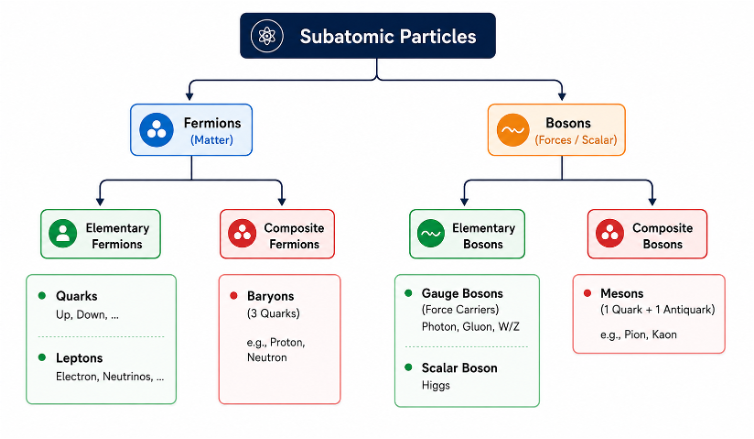
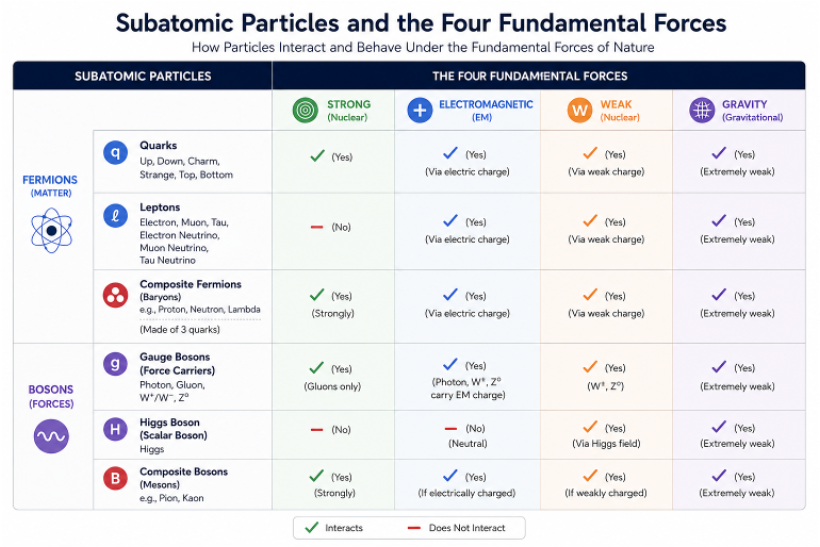
These particles differ greatly in their properties, including mass and electric charge. They are also associated with different spin quantum numbers, which determine whether they are fermions or bosons and, consequently, whether they follow Fermi–Dirac or Bose–Einstein statistics, respectively (see above diagram). Furthermore, their varied properties influence how they interact and behave under the four fundamental forces: gravitational, electromagnetic, strong nuclear, and weak nuclear. Therefore, subatomic particles are also commonly classified according to the fundamental forces with which they interact (see diagram below).
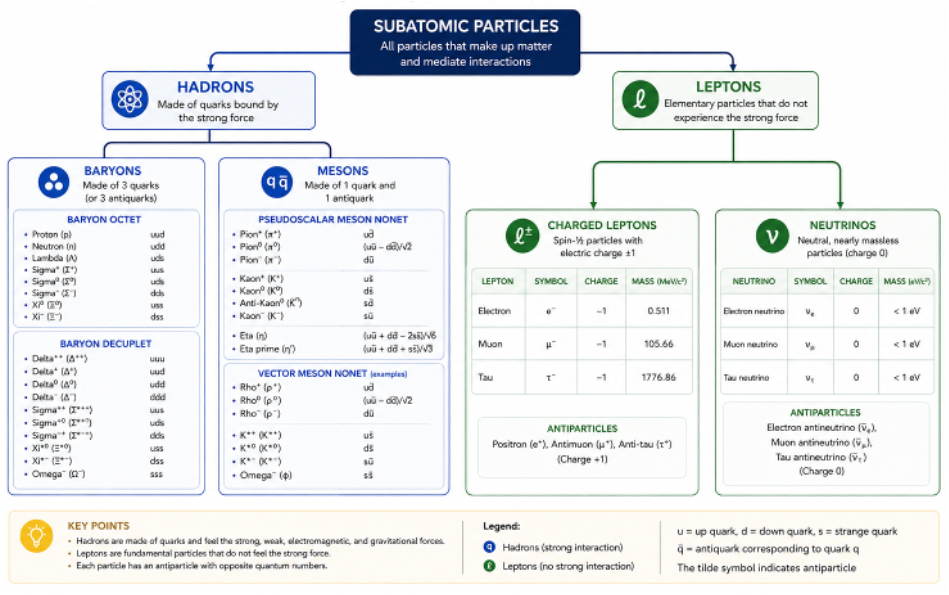
Additionally, subatomic particles can be distinguished based on both their internal structure and their interactions with the strong nuclear force. Hadrons are composite particles made up of quarks that participate in the strong interaction, whereas leptons are elementary particles that do not participate in the strong interaction.
In essence, the study of subatomic and elementary particles provides insight into the structure of matter. This is achieved using particle accelerators to produce short-lived particles, revealing how matter is constituted, how particles interact, and the fundamental laws governing the universe.