The Beer-Lambert law

The Beer-Lambert Law states that the absorbance of a solution is directly proportional to the path length of the sample and the concentration of the absorbing species in the solution.

Consider a beam of electromagnetic radiation with a narrow range of wavelengths passing through a sample of molar concentration and length . Let  be the number of photons striking on the sample per unit time, and be the number of photons absorbed by the sample. The probability of the number of photons absorbed by the sample is dependent on the length of sample  and the concentration of the sample. Therefore, we have

where is a proportionality constant.

As spectroscopy involves the absorption of radiation intensity at different wavelengths, we need to express the above equation in terms of intensity.

The intensity of the radiation is proportional to the number of photons  striking per unit area of the sample per unit time. Let the intensity of radiation that is incident on the sample and the outgoing intensity of the radiation be and  respectively. It follows that, the greater the number of incident photons, the higher the outgoing intensity will be, i.e. . Furthermore, if is the change in intensity after the radiation passes through the sample, then , which implies that . So, we have

where is another proportionality constant.

Integrating the above equation throughout the length of the sample, we have , which gives or equivalently,

where and .

Eq1 is the Beer-Lambert law. is the sample’s absorbance and is known as the molar absorption coefficient, which represents the nature of the sample. Conventionally, the units of and are and respectively. Moreover, is expressed in , and so, is unitless. The Beer-Lambert law is applicable to UV, visible and IR spectroscopy.


Next article: UV and visible spectroscopy
Previous article: Introduction to spectroscopy
Content page of UV-vis and IR spectroscopy
Content page of intermediate chemistry

Introduction to spectroscopy

Spectroscopy is the scientific study of the absorption and emission of electromagnetic radiation by matter.

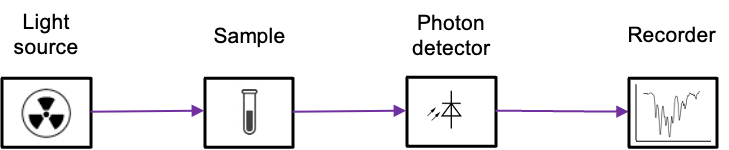
The instrument used for analysing these interactions is known as a spectrometer. A typical spectrometer consists of a light source that produces a beam with a range of electromagnetic frequencies (see diagram below). This beam passes through the sample, where it may be absorbed. The remaining transmitted radiation is detected and recorded, forming an absorption spectrum.

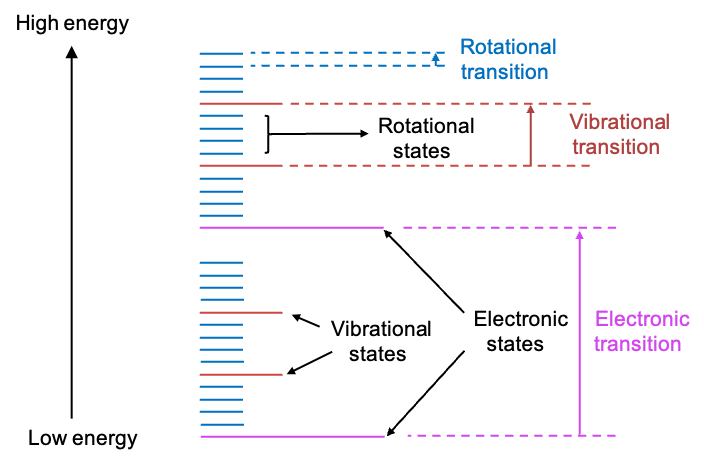
The absorption of a photon of energy causes a chemical species to undergo a transition from a lower energy state to a higher energy state . Different magnitudes of elicit various transitions. These transitions can occur between rotational states, vibrational states, electronic states, and even nuclear spin states of a chemical species (see diagram below).

A variety of spectroscopic methods are used to analyse these transitions. For example, infrared (IR) spectroscopy focuses on transitions between vibrational states, rotational spectroscopy analyses transitions between rotational states, Raman spectroscopy also studies transitions between both vibrational and rotational states, and nuclear magnetic resonance (NMR) spectroscopy studies transitions between different nuclear spin states.


Next article: The Beer-Lambert Law
Content page of UV-vis and IR spectroscopy
Content page of intermediate chemistry

Derivation of the root mean square speed of a gas

The root mean square speed of a gas provides a measure of the average molecular speed in the gas.

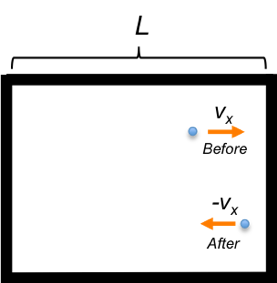
Consider a gas particle of mass moving in a container to the right with velocity (see diagram below). The change in momentum of the particle in the -coordinate before and after colliding elastically with a surface of the container is

with the particle colliding the same surface every

The force acting on the particle at collision is

By Newton’s third law, the force acting on the surface of the container by the particle is

The total force exerted on the surface by particles is

where .

Comparing and the definition of root mean square speed, we have , i.e. the square of the root mean square speed of the gas in the -direction.


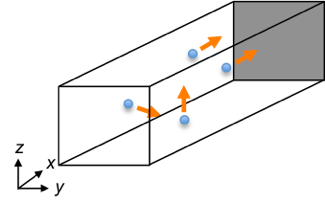
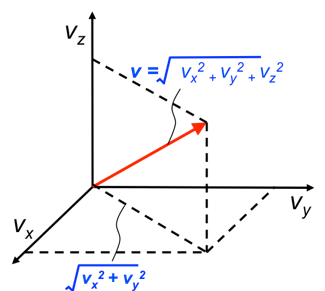
If the container is three-dimensional (see above diagram), the velocity vector for a particle in Cartesian coordinates in three dimensions is:

Even though a particle has three velocity components in space, the force exerted on the shaded wall is dependent only on the -component velocity of the particle.

To express the root mean square speed for particles, let’s begin by summing the squares of the velocity vectors of all particles:

Next, group the velocity components and divide the equation throughout by ,

The velocity components of the particles in the container are assumed to be random, with the particles evenly distributed in the container at any time. , like and , can be positive or negative, but their squares,, and , are always positive. If the velocity components of the particles in the container are random, and the number of particles is very large,

Otherwise, there is a preference of direction in a particular axis and the particles’ movement is no longer random (you can convince yourself the validity of eq8 by summing the squares of three sets of randomly generated numbers in a spreadsheet and finding their averages; the larger the number of elements in each set, the closer the average values are to each other). Hence, we can rewrite eq7 as:

Substituting eq9 in eq5 gives

The pressure (not to be confused with momentum) exerted by particles on the shaded wall is

where is the volume of the container.

Hence,

Substituting the ideal gas law in eq11 yields

Since (see this article for derivation ) and ,

Since and the root mean square speed is , we have . Therefore,

where is the molar mass of the gas.

Previous article: Root mean square speed of a gas
Content page of kinetic theory of gases
Content page of intermediate chemistry
Main content page

Root mean square speed of a gas

The root mean square speed of a gas is a statistical measure of the average speed of each particle in the gas.

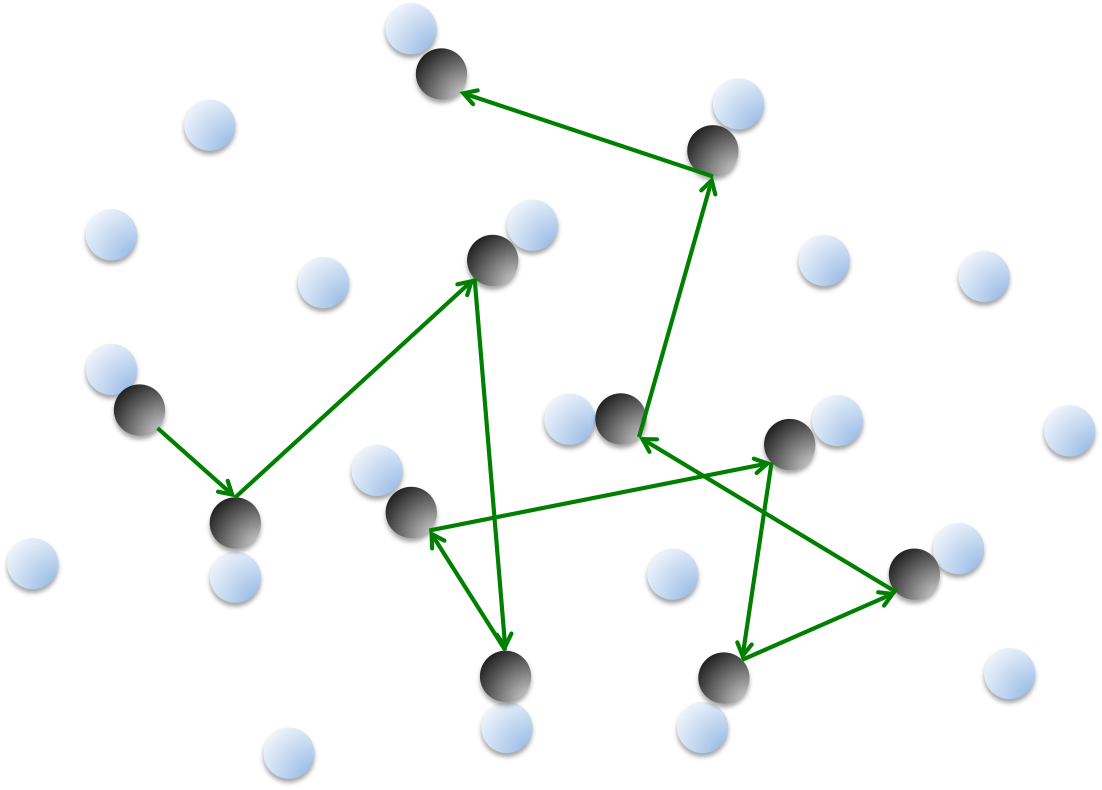
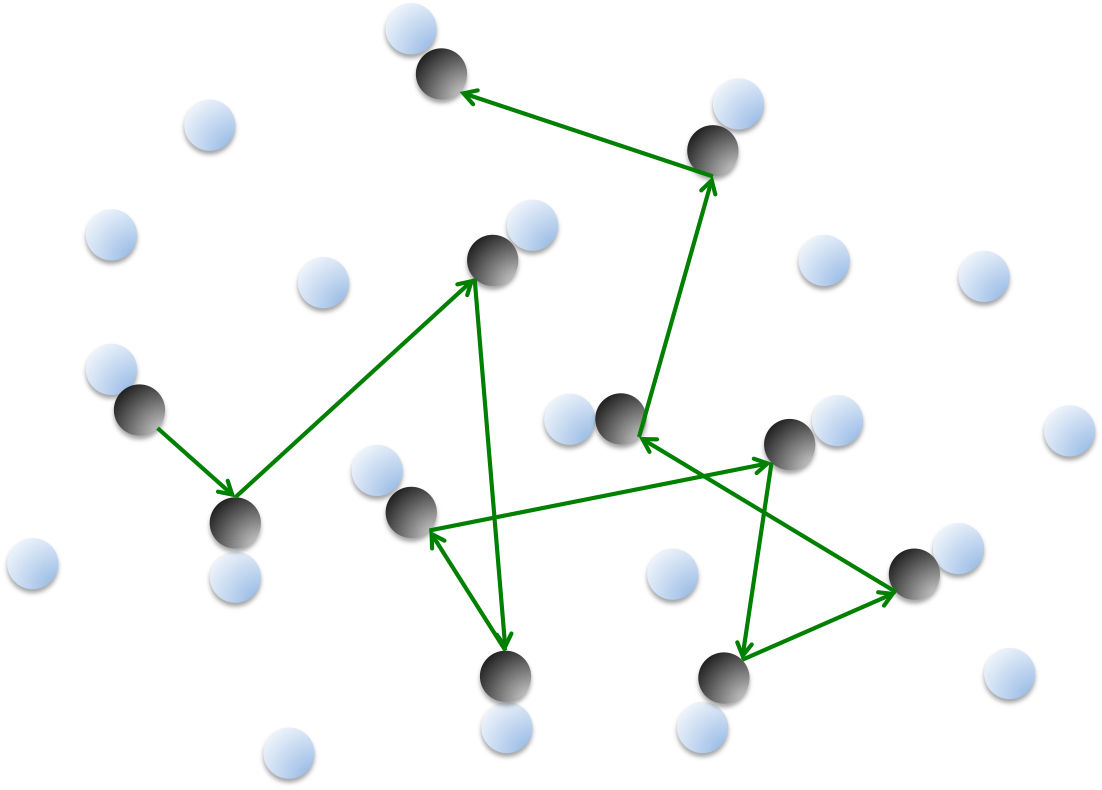
As mentioned in an earlier article, a gas in a container is made up of point masses that are moving randomly and colliding elastically with each other. The velocity of a gas particle is a vector with both magnitude and direction. With every elastic collision, the magnitude of a gas particle’s velocity is unchanged but its direction changes. The particles remain evenly distributed because the sum of the velocity vectors of all particles in the container at any time is zero (a non-zero net velocity implies that the particles are moving in a particular direction and are no longer in random motion).

We cannot determine the individual velocity of a gas particle and have to rely on an average value, which is zero as explained above. This poses a problem and we need to devise a different way to average the velocities of the particles. This new averaging method, which is described in the previous article, is called the root mean square speed and is given by

In the ideal case where the magnitudes of the velocities of all the particles are the same, is the same as taking the average of the absolute values of the velocities of the particles.


Previous article: Standard deviation
Next article: Derivation of the root mean square speed of a gas
Content page of kinetic theory of gases
Content page of intermediate chemistry
Main content page

Standard deviation

The standard deviation of a set of numbers is the measure of the dispersion of the numbers with respect to the mean.

Consider the following sets of numbers:

-2, -2, 2, 2 with a mean of 0

-3, -1, 0, 4 with a mean of 0

The two sets of numbers have the same mean, , or average value. However, the numbers in the first set are clearly less dispersed from the central value of 0 than those in the second set. Therefore, we need an averaging indicator that can tell us the deviation or spread of the numbers about the mean. Suppose we find the average of the absolute values of the numbers:

We end up with the same value with no information regarding the respective spreads. If we try this approach,

we have a reasonable distinction between the spreads.

What we have done for each set in the above computation is that we have:

  1. Taken the difference between an element in the set and the mean.
  2. Squared the difference and repeat step 1 and step 2 for the rest of the elements in the set.
  3. Summed all the squared differences.
  4. Divided the sum with the number of elements in the set.
  5. Computed the square root of the result in step 4.

This method of measure is called standard deviation . In general,

If the mean of the set of numbers is zero,

We call the standard deviation for this special case, the root mean square value of the set. Notice that the results obtained from the absolute value method and the standard deviation method (or root mean square) are the same if the magnitudes of all the elements in the set are the same.


Previous article: Kinetic theory of gases (overview)
Next article: Root mean square speed of a gas
Content page of kinetic theory of gases
Content page of intermediate chemistry
Main content page

Kinetic theory of gases (overview)

The kinetic theory of gases describes the macroscopic properties of gases by analysing gaseous behaviour at the molecular level.

The theory assumes that a gas is composed of point masses moving randomly with different velocities in straight lines within a container. As they move, they may collide elastically with each other or with the walls of the container. The first important concept of the kinetic theory of gases is the root mean square speed of a gas.


Next article: Standard deviation
Content page of kinetic theory of gases
Content page of intermediate chemistry
Main content page

Spin-spin coupling (nuclear-magnetic resonance)

Spin-spin coupling in nuclear magnetic resonance spectroscopy refers to the magnetic interactions between neighbouring nuclei that are not equivalent, leading to a change in resonance frequencies of the nuclei. As mentioned in an earlier article, the nucleus of an atom possesses a magnetic moment that generates a small magnetic field. If two NMR-active atoms (I ≠ 0) are in vicinity of each other, e.g. protons in the moiety HC-CH, the magnetic field of one 1H can shield or deshield the magnetic field of the other 1H, thereby slightly changing its shielding constant and therefore changing its resonance frequency.

In general, we refer to the following rules to determine the extent of nuclear spin-spin coupling:

    1. Spin-spin coupling occurs in all NMR-active nuclei. However, the coupling between two or more equivalent nuclei results in the same resonance energy of transition and therefore has no effect on the chemical shifts of the nuclei.
    2. Spin-spin coupling is negligible between nuclei separated by four or more bonds, e.g. the protons in HC-CH are separated by 3 bonds and consequently display coupling effects.
    3. The changes in chemical shifts of spin-coupled nuclei are usually much smaller than the difference in chemical shifts between the nuclei.

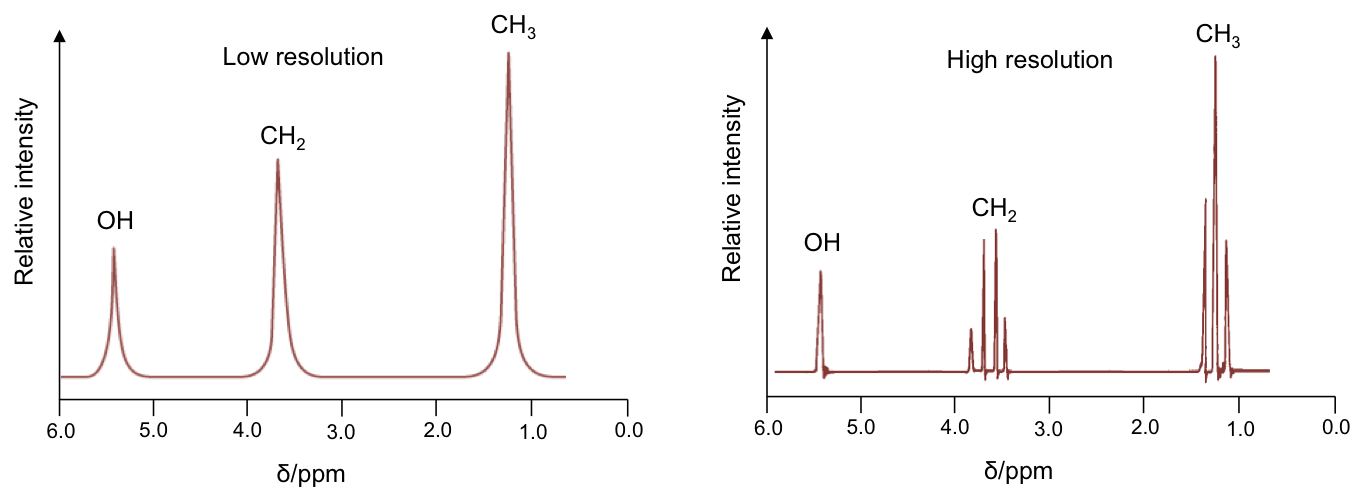
The effects of spin-spin coupling are visible on a high resolution NMR spectrum. An example is the spectrum of ethanol, CH3CH2OH:

Effects of spin-spin coupling on CH3 protons

According to rule 1, the three 1Hs in the CH3 moiety are equivalent and spin-couple one another without affecting the position and shape of the CH3 peak in the spectrum. However, they are not equivalent to the two protons in CH2, which have the following possible spin orientations:

The percentages represent the statistical occurrences of the paired orientations in a sample of ethanol molecules, with MI = ΣmI , i.e. the total nuclear spin magnetic number. Depending on the spin orientation of a proton in the CH3 moiety, the paired orientations of MI = +1 or MI = -1 of protons in CH2 either shield or deshield that proton, while the paired orientations of MI = 0 in CH2 does not affect the proton’s magnetic field. The result is a splitting of the single CH3 peak into a triplet, with the middle peak retaining the same chemical shift as CH3 without spin-spin coupling effect, and an equal up and down shift for the left and right peaks. The relative intensity of the left:middle:right peaks is 1:2:1 (see high resolution diagram above).

CH3 protons are separated from the hydroxyl 1H by four bonds. So, according to rule 2, any coupling effect is negligible.


Effects of spin-spin coupling on CH2 protons

Using the same logic, the possible spin orientations of the three 1Hs in the CH3 moiety are:

The four MI values split the single CH2 peak into a quartet, with the distribution of four peaks along a vertical line of reflection that intersects the original chemical shift of CH2 without spin-spin coupling effect. The relative intensity of the peaks is 1:3:3:1 (see high resolution diagram above).


Question

Why is the OH peak not a triplet and why is there no coupling effect between the hydroxyl 1H and the CH2 protons?

Answer

The presence of H3O+ or OH in the sample, even in minute amounts, catalyses the exchange of hydroxyl protons between ethanol molecules. This exchange is fast enough to negate the spin-spin coupling effect between the hydroxyl proton and the CH2 protons. The hydroxyl protons can also be swapped with protons from H3O+, which is why the OH peak may disappear when D2O is added to the ethanol sample (ID = 0).


Finally, in cases where rule 3 fails, i.e. the changes in chemical shifts of spin-coupled nuclei are comparable to the difference in chemical shifts between the nuclei, the spectrum can become complex.


Question

Why are all peaks in a 13C NMR spectrum singlets?

Answer

13C, like 1H, has a nuclear spin of I = ½ and is expected to experience spin-spin coupling with neighbouring 13C and 1H nuclei. The natural abundance of 13C is only 1.1% and therefore the probability of a molecule having 13C adjacent nuclides is almost zero. However, 13C1H spin-spin coupling is ubiquitous. To avoid a complicated 13C spectrum, a technique called proton decoupling is used, where protons of molecules in a sample are irradiated with a secondary radiofrequency wave. The protons undergo rapid spin reorientations that result in their net MI being zero.


Question

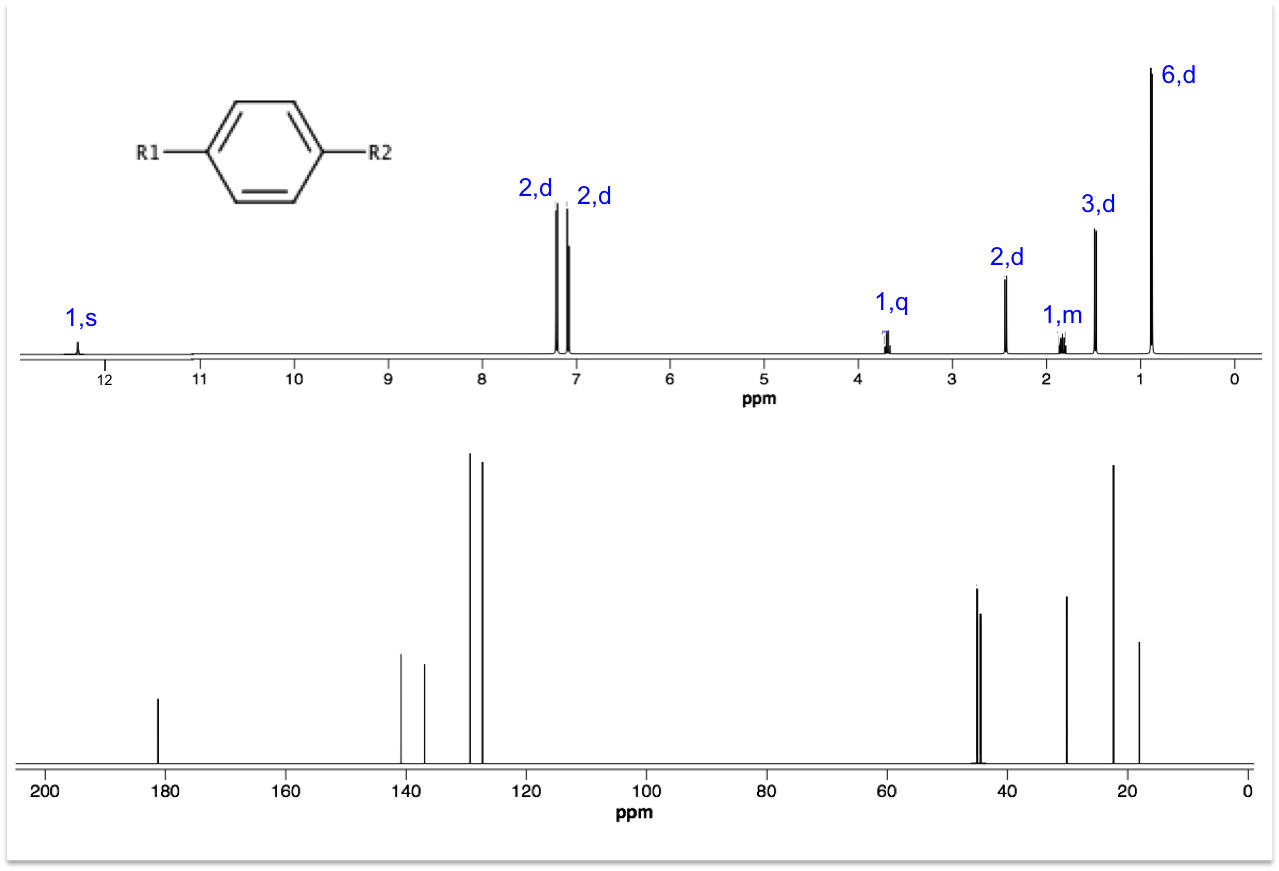
Deduce the structures for R1 and R2 using the 1H and 13C spectra below. Hint: Ar13C 45 ppm.

Answer

Even though 13C peak areas are not a reliable indicator of the relative number of carbons, we can make a guess of the carbon numbers by comparing the peak heights. Let’s assume the three taller peaks represent two carbons each, which gives a total of 13 carbons in the molecule.

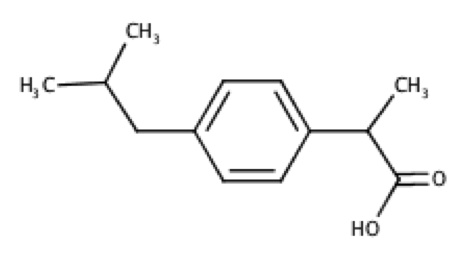
The peak at 0.90 ppm of the top spectrum is a doublet of 6 protons, which suggests an isopropyl group. The doublet of 3 protons at 1.50 ppm is mostly likely a methyl group. The singlet at 12.34 ppm is characteristic of a carboxyl proton. A pair of doublets at 7.08-7.22 ppm, each with two protons, refers to protons on the benzene ring. That leaves us with 2 carbons associated with the quartet at 3.69 ppm and the doublet at 2.45 ppm. These two carbons have almost the same chemical shift of 45 ppm in the 13C spectrum, which according to the hint are carbons adjacent to the benzene ring. Putting everything together, we have the following structure (ibuprofen):


Previous article: Chemical shift
Content page of nuclear magnetic resonance
Content page of intermediate chemistry
Main content page

Chemical shift (nuclear magnetic resonance)

The chemical shift δ in nuclear magnetic resonance spectroscopy is a measure of the spin transition frequency of a nuclide with respect to a standard nuclide. It is dependent on the identity of the nuclide and the chemical environment of the nuclide. From the previous article, we learned that the concept of nuclear magnetic resonance involves analysing resonance signals of nuclides by varying an alternating electromagnetic frequency v at a constant external magnetic field B, or by varying an alternating B at a constant v. According to Lenz’s law, a changing B induces an opposite magnetic field in an electron-filled system like an atom. The magnitude of the induced magnetic field is dependent on the atom’s electron density, which is influenced by neighbouring atoms. Since this induced magnetic field is directionally opposite to the external magnetic field, the effective external magnetic field felt by the nucleus is:

B_{eff}=B-\sigma B\; \; \; \; \; \; \; \; 3

where σ is a constant called the shielding constant, which varies according to the chemical environment of an atom.

For example, 1H in the aldehyde functional group RCHO experiences a larger Beff than 1H in CH4. This is because the electropositive carbonyl carbon reduces the electron density around the hydrogen nucleus (deshield), resulting in a lower induced magnetic field when the 1H nucleus is exposed to an external magnetic field. We say that the shielding constant of 1H in the aldehyde functional group of RCHO is smaller than that of 1H in CH4, or that 1H in the aldehyde functional group of RCHO is relatively more deshielded than 1H in CH4 (note that all 1Hs in CH4 are chemically equivalent).

Substituting eq3 and the Planck relation in eq2 of a previous article, we have

v=\frac{\gamma B}{2\pi}\left ( 1-\sigma \right )\; \; \; \; \; \; \; \; 4

Eq4 shows that if B is fixed (or if v is fixed), the radiofrequency v (or the external magnetic field B) needed to stimulate a nuclear spin transition is dependent on the gyromagnetic ratio of the nuclide and the shielding constant. The remaining task is to set up a convenient measure, i.e. a scale, to represent the resonance frequencies for different nuclides. This scale, known as the chemical shift δ, is:

\delta=\frac{v-v^o}{v^o}\times 10^6\; \; \; \; \; \; \; \; 5

where vo is the resonance frequency of a reference nuclide — tetramethylsilane (TMS) with the molecular formula Si(CH3)4 is commonly used as a reference in 1H-NMR.

The reason why the fractional change term is multiplied by 106 is that the numerator is expressed in hertz, while the denominator is in megahertz. For example, the resonance frequency of 1H in TMS at a particular fixed B is 300 MHz, and that the resonance frequency of a 1H in a sample that we are investigating is 300.0003 MHz at the same B. We would expect 2 peaks in the NMR spectrum, one for the chemically equivalent 1Hs in TMS at δ = 0 (substituting v = vo in eq5), and the second peak for 1H-sample at:

\delta=\frac{300\, Hz}{300\, MHz}\times10^6=1

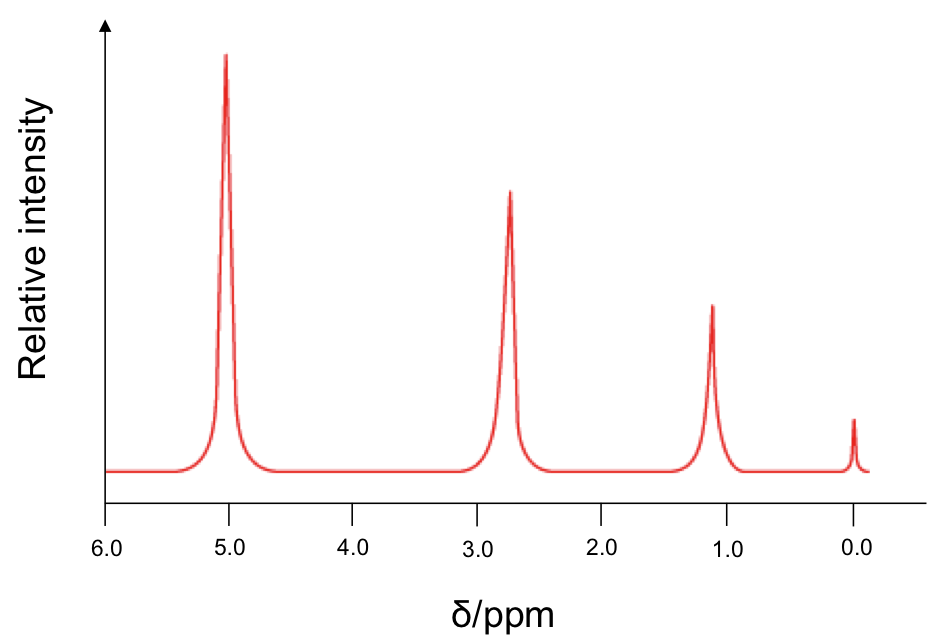
Since \frac{Hz}{MHz} is 1 part per million, the units for δ is ppm. Therefore, instead of plotting the horizontal axis of the NMR spectrum in Hz or MHz, we plot it in δ, which has a simpler value. A typical low-resolution spectrum looks like this:

The horizontal axis is plotted such that the more heavily shielded nuclei appear to the right of the spectrum. The small peak at 0.0 ppm corresponds to 1H from TMS. The areas under the peaks reflect the relative number of chemically equivalent 1H for the respective chemical shift.

Some common chemical shifts of 1H nuclides are as follows:

1H nuclides δ/ ppm
TMS 0.0
RCH3 0.7 – 1.2
RCH2R 1.1 – 1.5
R3CH 1.6 – 2.0
ArCH3, ArCH2R, ArCHR2 2.3 – 2.7
CH3COR 2.0 – 3.0
-OCH3, -OCH2R, -OCHR2 3.0 – 4.0
RaCHbX   where a = 0,1,2   b = 1,2,3     X = Cl, Br 3.0 – 4.2
RNH2 1.0 – 4.8
ROH 1.0 – 6.0
ArH 6.5 – 9.0
RCHO 9.5 – 10.5
RCO2H 10.0 – 13.0

13C also has a nuclear spin of ½ and is NMR active. However, a large sample is needed for analysis, as its natural abundance is about 1.1%. The typical resonance frequency of a 13C nuclide is a quarter of that of a 1H nuclide, which allows 13C spectra to be generated separately from 1H spectra. The chemical shift of 13C ranges from 0 ppm to 220 ppm. Unlike a 1H spectrum, the areas under peaks in a 13C spectrum are not a reliable indication of the relative number of carbons. This is because some carbon signals, e.g. carbonyl carbons, are weaker than other carbon signals, e.g. methyl carbons.


Question

Do the protons on the marked carbon have the same chemical shift?

Answer

The two protons, Ha and Hb, have different chemical shifts, as they are not equivalent (see the Newman projection below):


Next article: Spin-spin coupling
Previous article: Instrumentation
Content page of nuclear magnetic resonance
Content page of intermediate chemistry
Main content page

Instrumentation (nuclear magnetic resonance)

A simple version of a nuclear magnetic resonance (NMR) spectrometer consists of the following:

    1. A strong magnet to provide a uniform magnetic field B (e.g. 2.35 T) to split the energy levels of nuclides in a sample.
    2. The sample in a glass tube that is rotated to allow uniform exposure to B.
    3. A coil (blue lines) connected to a radiofrequency transmitter with a varying AC voltage. The AC voltage is gradually increased during the experiment to generate electromagnetic waves of increasing frequencies.
    4. A coil wound round the sample tube and connected to a radiofrequency detector. The flipping of nuclear spins, when nuclides are excited at the appropriate electromagnetic frequencies, results in a change in magnetic dipole moment of the nuclides. This change in magnetic dipole moment induces a current in this coil, which is recorded and analysed by a computer.

Such an NMR spectrometer design, where the external magnetic field strength B is fixed while the electromagnetic radiation frequency v is varied, is called a continuous wave NMR (CW-NMR). An alternate design of a CW-NMR has a varying B and a constant v. In this design, a varying-AC coil is wound round the magnet, while a second coil with a fixed AC voltage is wrapped round the sample tube. Measurements are made for the changes in impedance (resistance of an AC circuit) of the second coil when nuclear spin transitions occur. Finally, a more sophisticated NMR spectrometer design exposes the sample to a short and intense burst of radiofrequency radiation called an electromagnetic pulse, and subsequently analyses the data using the mathematical concept of Fourier transform.


Next article: Chemical shift
Previous article: Nuclear magnetic dipole moment in an external magnetic field
Content page of nuclear magnetic resonance
Content page of intermediate chemistry
Main content page

Nuclear magnetic dipole moment in an external magnetic field

We have mentioned in a quantum chemistry article that the nucleus of an atom (e.g. 1H and 13C) possesses an intrinsic angular momentum called spin I and therefore a magnetic dipole moment μ, which tends to align parallel to an external magnetic field B in two possible directions (see diagram below).

Like tiny magnets, we would expect all dipoles of a sample of nuclei to align in the direction of an external field to achieve a lower energy state. However, at room temperature, the dipoles are constantly exchanging between the two forms, to the extent that at equilibrium, there is a slight excess of nuclei with dipoles that are aligned in the direction of the field. This behaviour of nuclear magnetic dipole moments in the presence of an external magnetic field at room temperature splits the energy of nuclei EN into two levels (see diagram below).

It is found that the energy gap between the two levels ΔE is proportional to the external magnetic field:

\Delta E=\hbar \gamma B\; \; \; \; \; \; \; \; 1

where \hbar \gamma is proportionality constant, with \gamma being the gyromagnetic ratio, whose value is dependent on the identity of the nucleus.

Due to the slight excess of nuclei at the lower level at room temperature when B > 0, a net upward spin transition occurs when the nuclei are excited with radiation corresponding to ΔE. As the gyromagnetic ratio is nuclide-specific, ΔE varies for different nuclide at a fixed value of B. Furthermore, the effective external magnetic field Beff experienced by a nucleus is dependent on the magnetic environment of the nucleus, which changes eq1 to:

\Delta E=\hbar \gamma B_{eff}\; \; \; \; \; \; \; \; 2

Eq2 is the heart of the analytical technique of nuclear magnetic resonance, where the identity and location of an unknown nuclide is determined by exposing the nuclide to a constant magnetic field and subsequently detecting its transition frequency.


Question

What are the typical frequencies for nuclear spin transitions? Why are nuclei with I = 0 not NMR active?

Answer

The frequencies needed for nuclear spin transitions, called resonance frequencies, are in the radiofrequency range. For example, γ for 1H that is exposed to an external magnetic field of 9.4 T is 26.75 x 10⁷ T-1s-1. Substituting these values and the Planck relation ΔE = hv in eq1, we have v = 400.2 MHz.

The formula for the change in energy of a nuclear magnetic dipole moment in the presence of a magnetic field is:

E_\pm =-m_I\hbar \gamma B

A nuclide with spin I = 0 is associated with the nuclear magnetic spin number of mI = 0, resulting in E_\pm = 0. However, a nuclide with spin I = ½ has the nuclear magnetic spin numbers of mI = +½ and mI = -½, which gives:


Next article: Instrumentation
Content page of nuclear magnetic resonance
Content page of intermediate chemistry
Main content page
Mono Quiz