The non-crossing rule in quantum chemistry states that distinct eigenvalues of two eigenstates with the same symmetry cannot become equal as a function of an external perturbation parameter.
Consider a system with two orthogonal eigenstates \(\psi_1\) and \(\psi_2\) of the unperturbed Hamiltonian \(H^{(0)}\), with distinct eigenvalues of \(E_1\) and \(E_2\), respectively. In the presence of a weak ligand field, the unperturbed Schrodinger equation \(H^{(0)}\psi_m=E_m\psi_m\), becomes
$$H\Psi_m=U_m\Psi_m\;\;\;\;\;\;\;\;281j$$
where \(H=H^{(0)}+H^{\prime}\), \(H^{\prime}\) is the perturbed Hamiltonian, and \(U_m\) is the eigenvalue corresponding to the perturbed eigenstate \(\Psi_m=c_1\psi_1+c_2\psi_2\), which is assumed to be a linear combination of the unperturbed eigenstates.
Substituting \(\Psi_m=c_1\psi_1+c_2\psi_2\) in eq281j gives
$$c_1(H-U_m)\psi_1+c_2(H-U_m)\psi_2\;\;\;\;\;\;\;\;281k$$
Multiplying eq281k from the left by \(\psi^*_1\) and \(\psi^*_2\) in turn, and integrating over all space yields the following two equations:
$$c_1(H_{11}-U_m)+c_2H_{12}=0$$
$$c_1H_{21}+c_2(H_{22}-U_m)=0$$
where \(H_{ij}=\langle\psi_i\vert H\vert\psi_j\rangle\).
In matrix form, the pair of equations can be expressed as
$$\begin{pmatrix}H_{11}-U_m & H_{12}\\H_{21} & H_{22}-U_m\end{pmatrix}\begin{pmatrix}c_1\\c_2\end{pmatrix}=0\;\;\;\;\;\;\;\;281l$$
where \(I\) is the identity matrix.
Eq281l is a linear homogeneous equation, which has non-trivial solutions if
$$\begin{vmatrix}H_{11}-U_m & H_{12}\\H_{21} & H_{22}-U_m\end{vmatrix}=0\;\;\;\;\;\;\;\;281m$$
Expanding the determinant results in
$$U^2_m-(H_{11}+H_{22})U_m+H_{11}H_{22}-H_{12}H_{21}=0$$
whose roots are
$$U_{m\pm}=\frac{1}{2}(H_{11}+H_{22})\pm \frac{1}{2}\sqrt{(H_{11}-H_{22})^2+4H_{12}H_{21}}\;\;\;\;\;\;\;\;281n$$
The unperturbed Hamiltonian is invariant to all symmetry operations of a point group and transforms according to the fully symmetric representation of the group. In the context of a metal ion subject to a ligand field, the perturbed Hamiltonian \(H^{\prime}\) is a summation of potentials between \(n\) metal valence electrons and \(m\) ligand valence electrons:
$$H^{\prime}=\sum_{j=1}^m\sum_{i=1}^n\frac{e^2}{4\pi\varepsilon_0r_{ij}}$$
\(H^{\prime}\) is also totally symmetric, as the distances between metal and ligand valence electrons \(r_{ij}\) are invariant to all symmetry operations of a point group. If we assume that both \(H^{(0)}\) and \(H^{\prime}\) have a complete set of orthogonal eigenfunctions that are associated with real eigenvalues, \(H^{(0)}\) and \(H^{\prime}\) are Hermitian. This implies that \(H\) is also Hermitian. Using eq35, eq281n becomes
$$U_{m\pm}=\frac{1}{2}(H_{11}+H_{22})\pm \frac{1}{2}\sqrt{(H_{11}-H_{22})^2+4\vert H_{12}\vert^2}\;\;\;\;\;\;\;\;281o$$
The term \((H_{11}-H_{22})^2\) is positive and varies with the ligand field strength. If \(\psi_1\) and \(\psi_2\) have the same symmetry, then \(H_{12}\) is generally non-zero according to the vanishing integral principle. It follows that \(U_{m+}\) and \(U_{m-}\) are always distinct regardless of ligand field strength. This is known as the non-crossing rule.
On the other hand, if \(\psi_1\) and \(\psi_2\) have different symmetry, then \(H_{12}\) is necessarily zero. Consequently, the eigenvalues of the two states may be the same at a certain ligand field strength where \(H_{11}=H_{22}\).
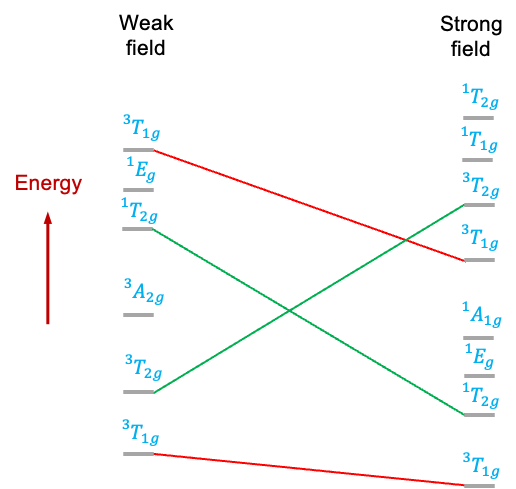
For example, the diagram below depicts some states of the \(d^2\) configuration of a metal ion in an octahedral ligand field. The \(^{3}T_{1g}\) states, which have the same symmetry, do not cross as the ligand field strength varies, while \(^{3}T_{2g}\) and \(^{1}T_{2g}\), which have different symmetries, do.