Symmetry and degeneracy are related as a result of the non-relativistic Hamiltonian \(\hat{H}\) being invariant under symmetry operations.
Consider the stationary state of a quantum mechanical system that is described by a set of linearly independent wavefunctions \(W=\{\psi_i\}\), which satisfies the time-independent Schrodinger equation \(\hat{H}\psi_i=E_i\psi_i\). Subjecting both sides of the equation to the symmetry operation \(R_{\alpha}\), where \(R_{\alpha}\) are elements of a group \(G\), we have \(R_{\alpha}\hat{H}\psi_i=R_{\alpha}E_i\psi_i\). Using eq53 and noting that \(E_i\) is a scalar, we obtain
$$\hat{H}R_{\alpha}\psi_i=E_iR_{\alpha}\psi_i\;\;\;\;\;\;\;\;54$$
which implies that \(R_{\alpha}\psi_i\) is an eigenfunction of \(\hat{H}\), i.e. \(R_{\alpha}\psi_i\in W\).
We say that the set of symmetry operations form the group of the Hamiltonian. If \(E_i\) is \(k\)-fold degenerate, any linear combination of the subset of wavefunctions \(\psi_1,\psi_2,\cdots,\psi_k\in U\) associated with the degenerate eigenvalue will be a solution of eq54. We can then write:
$$\begin{matrix}R_{\alpha}\psi_j=\sum_{m=1}^ka_{mj}\psi_m&55\\\\R_{\beta}\psi_l=\sum_{j=1}^kb_{jl}\psi_j&56\\\vdots\\R_{\delta}\psi_l=\sum_{m=1}^kd_{ml}\psi_m&57\\\vdots\end{matrix}$$
According to the closure property of \(G\),
$$R_{\delta}=R_{\alpha}R_{\beta}\;\;\;\;\;\;\;\;58$$
So,
$$R_{\delta}\psi_l=R_{\alpha}R_{\beta}\psi_l=R_{\alpha}\sum_{j=1}^kb_{jl}\psi_j$$
Since \(R\) is a linear operator,
$$R_{\delta}\psi_l=\sum_{j=1}^kb_{jl}R_{\alpha}\psi_j=\sum_{j=1}^k\sum_{m=1}^ka_{mj}b_{jl}\psi_m\;\;\;\;\;\;\;\;59$$
Subtracting eq59 from eq57, we have \(\sum_{m=1}^k\biggr(d_{ml}-\sum_{j=1}^ka_{mj}b_{jl}\biggr)\psi_m=0\). If the wavefunctions are linearly independent, all coefficients of \(\psi_m\) must be zero, i.e.
$$d_{ml}=\sum_{j=1}^ka_{mj}b_{jl}\;\;\;\;\;\;\;\;60$$
With reference to eq55 through eq57, \(m,j\) and \(l\) range from \(1\) to \(k\). Thus, eq60 implies that \(d_{ml},a_{mj}\) and \(b_{jl}\) are entries of the square matrices \(D,A\) and \(B\) respectively, i.e.
$$D=AB\;\;\;\;\;\;\;\;61$$
Comparing eq61 with eq58, the matrices \(D,A\) and \(B\) multiply the same way as the symmetry operations \(R_{\delta},R_{\alpha}\) and \(R_{\beta}\) and therefore form a representation \(\Gamma_{degen}\) of \(G\). Such a representation has a dimension equal to \(k\) and may be reducible or irreducible. However, the following analysis shows that it is irreducible, assuming that there is no accidental degeneracy, which happens when two eigenvalues are the same even though their corresponding eigenfunctions transform differently under the symmetry operations of \(G\).

Question
What is an example of accidental degeneracy?
Answer
The hydrogenic wavefunctions \(\psi_{l=0}\) and \(\psi_{l=1}\), which describe the \(s\)-orbital and \(p\)-orbitals respectively, obviously have different symmetry and may transform according to different irreducible representations, e.g. the \(s\)-orbital transforms according to the totally symmetric irreducible representation, while the \(p\)-orbitals may not. Therefore, they may have different energies. However, \(\psi_{l=0}\) and \(\psi_{l=1}\) are degenerate wavefunctions for a particular value of \(n\). In fact, the number of degenerate energy levels of the hydrogen atom is \(n^2\) instead of \(2l+1\), which is expected from a non-relativistic Hamiltonian with a central potential. This implies that spin-orbit coupling is not considered when deriving the hydrogenic wavefunctions. The degeneracy is lifted once spin-orbit coupling is included.
To show that \(\Gamma_{degen}\) is irreducible, we express eq55 as
$$\begin{pmatrix}R_{\alpha}\psi_1&R_{\alpha}\psi_2&\cdots&R_{\alpha}\psi_k\end{pmatrix}=\begin{pmatrix}\psi_1&\psi_2&\cdots&\psi_k\end{pmatrix}A\;\;\;\;\;\;\;\;61a$$
where \(A=\begin{pmatrix}a_{11}&a_{12}&\cdots&a_{1k}\\a_{21}&a_{22}&\cdots&a_{2k}\\\vdots&\vdots&\ddots&\vdots\\a_{k1}&a_{k2}&\cdots&a_{kk}\end{pmatrix}\).
If \(A\) is reducible, then it may be in block-diagonal form. For example, if \(k=5\),
$$A=\begin{pmatrix}a_{11}&a_{12}&0&0&0\\a_{21}&a_{22}&0&0&0\\0&0&a_{33}&a_{34}&a_{35}\\0&0&a_{43}&a_{44}&a_{45}\\0&0&a_{53}&a_{54}&a_{55}\end{pmatrix}\;\;\;\;\;\;\;\;61b$$
Substituting eq61b in eq61a, \(R_{\alpha}\psi_1\) and \(R_{\alpha}\psi_2\) are linear combinations of the subset with elements \(\psi_1\) and \(\psi_2\), while \(R_{\alpha}\psi_3,R_{\alpha}\psi_4\) and \(R_{\alpha}\psi_5\) are linear combinations of the subset with elements \(\psi_3,\psi_4\) and \(\psi_5\). If so, the eigenvalues corresponding to the different subsets could be different (e.g. when one subset is one-dimensional and the other is two-dimensional), which would contradict our original assumption that \(E_i\) is \(k\)-fold degenerate.
If \(A\) is not initially in block-diagonal form, it can be converted into a block-diagonal matrix \(A^{\prime}\) via a similarity transformation, where \(A^{\prime}=P^{-1}AP\). We can then rewrite eq61a as
$$\begin{pmatrix}R_{\alpha}\psi_1^{\prime}&R_{\alpha}\psi_2^{\prime}&\cdots&R_{\alpha}\psi_k^{\prime}\end{pmatrix}=\begin{pmatrix}\psi_1^{\prime}&\psi_2^{\prime}&\cdots&\psi_k^{\prime}\end{pmatrix}A^{\prime}\;\;\;\;\;\;\;\;61c$$
where \(\psi_j^{\prime}\) is the basis for the transformed representation.
Since \(A^{\prime}\) is in block-diagonal form, we arrive at the same conclusion as before. Therefore, assuming that there is no accidental degeneracy, a representation that is generated by a set of orthogonal degenerate wavefunctions is irreducible and we called the set of wavefunctions \(U\), basis wavefunctions of \(\Gamma_{degen}\).
Question
1) Why is the number of basis functions needed to generate \(\Gamma_{degen}\) equal to the dimension of \(\Gamma_{degen}\)?
2) Can any set of functions, other than eigenfunctions of the Hamiltonian, be a set of basis functions for a representation of \(G\)?
3) Show that if \(\boldsymbol{f_1,f_2,\cdots,f_i}\) is a basis of a representation \(\boldsymbol{\Gamma}\) of a group, then any linear combination of \(\boldsymbol{f_1,f_2,\cdots,f_i}\) is a basis of a representation \(\boldsymbol{\Gamma^{\prime}}\) that is equivalent to \(\boldsymbol{\Gamma}\).
Answer
1) Each \(j\) in \(\psi_j\) of eq55 creates a column of matrix entries \(a_{mj}\) (see Q&A below for an illustration). So, the \(k\times k\) matrix \(A\) is generated by \(k\) number of \(\psi_j\). The same logic applies to matrices \(D\) and \(B\). This implies that the number of linearly independent basis functions of a representation corresponds to the dimension of the representation. This set of linearly independent basis functions can be made orthogonal to one another using the Gram-Schmidt process. Therefore, the number of orthogonal basis functions of a representation corresponds to the dimension of the representation.
2) By inspecting eq55 through eq61, any set of linearly independent functions \(F=\{f_1,f_2,\cdots,f_i\}\), not necessary eigenfunctions of the Hamiltonian, is a set of basis functions for a representation of \(G\) if \(f_k\in F\) is transformed by a symmetry operation into a linear combination of \(f_i\). The converse is obviously also true, i.e. if \(\boldsymbol{F=\{f_1,f_2,\cdots,f_i\}\) is a set of basis functions for a representation of \(\boldsymbol{G\), then \(\boldsymbol{R_{\alpha}f_{j}=\sum_{m=1}^ka_{mj}f_{m}\). In this case, there is no requirement that the functions are degenerate and hence the representation generated can be either reducible or irreducible.
3) Since matrix multiplication is distributive,
$$R_{\alpha}\sum_{m=1}^ka_{mj}f_{m}=a_{1j}R_{\alpha}f_1+a_{2j}R_{\alpha}f_2+\cdots+a_{kj}R_{\alpha}f_k$$
Let’s rewrite eq55 as \(R_{\alpha}f_j=\sum_{p=1}^kb_{pj}f_p\). Substituting this expression in the above equation and rearranging, gives
$$R_{\alpha}\sum_{m=1}^ka_{mj}f_{m}=\sum_{m=1}^kc_{mj}f_m$$
where \(c_{mj}=\sum_{q=1}^ka_{qj}b_{mq}\).
Using eq61d and repeating the steps from eq55 through eq61, \(\sum_{m=1}^ka_{mj}f_{m}\) is also basis of a representation \(\Gamma^{\prime}\) of the group.
To Show that \(\Gamma^{\prime}\) is equivalent to \(\Gamma\), let \(g_l=\sum_{j=1}^kc_{jl}f_j\), which can be written as the following matrix equation:
$$\begin{pmatrix}g_1&\cdots&g_k\end{pmatrix}=\begin{pmatrix}f_1&\cdots&f_k\end{pmatrix}C\;\;\;\;\;\;\;\;61e$$
where \(C=\begin{pmatrix}c_{11}&c_{12}&\cdots&c_{1k}\\c_{21}&c_{22}&\cdots&c_{2k}\\\vdots&\vdots&\ddots&\vdots\\c_{k1}&c_{k2}&\cdots&c_{kk}\end{pmatrix}\).
Using eq55 with \(f\) in place of \(\psi\), we have \(R_{\alpha}g_l=\sum_{j=1}^kc_{jl}R_{\alpha}f_j=\sum_{m=1}^k\sum_{j=1}^ka_{mj}c_{jl}f_m\), whose matrix equation is
$$\begin{pmatrix}R_{\alpha}g_1&\cdots&R_{\alpha}g_k\end{pmatrix}=\begin{pmatrix}f_1&\cdots&f_k\end{pmatrix}AC\;\;\;\;\;\;\;\;61f$$
where \(A=\begin{pmatrix}a_{11}&a_{12}&\cdots&a_{1k}\\a_{21}&a_{22}&\cdots&a_{2k}\\\vdots&\vdots&\ddots&\vdots\\a_{k1}&a_{k2}&\cdots&a_{kk}\end{pmatrix}\).
Multiplying eq61e by \(C^{-1}\) on the right, we have \(\begin{pmatrix}g_1&\cdots&g_k\end{pmatrix}C^{-1}=\begin{pmatrix}f_1&\cdots&f_k\end{pmatrix}\), which when substituted in eq61f gives
$$\begin{pmatrix}R_{\alpha}g_1&\cdots&R_{\alpha}g_k\end{pmatrix}=\begin{pmatrix}g_1&\cdots&g_k\end{pmatrix}C^{-1}AC\;\;\;\;\;\;\;\;61g$$
The matrix equation of eq55 with \(f\) in place of \(\psi\) is
$$\begin{pmatrix}R_{\alpha}f_1&\cdots&R_{\alpha}f_k\end{pmatrix}=\begin{pmatrix}f_1&\cdots&f_k\end{pmatrix}A\;\;\;\;\;\;\;\;61h$$
Comparing eq61g with eq61h, \(\Gamma^{\prime}(\alpha)\) is related to \(\Gamma(\alpha)\) by a similarity transformation. This implies that \(\Gamma^{\prime}\) is equivalent to \(\Gamma\).
If \(E_i\) is non-degenerate, the only eigenfunctions satisfying eq54 are \(c\psi_i\), where \(c\) is a constant. Therefore, \(R_{\alpha}\psi_i=c\psi_i\). Normalising \(c\psi_i\), we get \(c^2\int\vert\psi_i\vert^2d\tau=1\implies c=\pm1\), which means that \(R_{\alpha}\psi_i=\pm1\psi_i\). Consequently, the wavefunctions \(\psi_i\) associated with non-degenerate eigenvalues transform according to one-dimensional irreducible representations with characters of +1 or -1.
Question
If \(k=2\), show how eq55 is related to the matrix representation \(\Gamma(R_{\alpha})\).
Answer
The two degenerate wavefunctions are \(\psi_1\) and \(\psi_2\). We have
$$R_{\alpha}\psi_1=a_{11}\psi_1+a_{21}\psi_2$$
$$R_{\alpha}\psi_2=a_{12}\psi_1+a_{22}\psi_2$$
$$\Gamma(R_{\alpha})=\begin{pmatrix}a_{11}&a_{12}\\a_{21}&a_{22}\end{pmatrix}$$
We can conclude from the above analysis that irreducible representations with dimension of one are called non-degenerate representations, while those with dimensions of more than one are known as degenerate representations.
Question
With regard to the \(C_3\) symmetry operation of the \(C_{3v}\) point group, show that \(\psi_{p_x}\) and \(\psi_{p_y}\) transform together according to the two-dimensional irreducible representation \(E\).
Answer
With respect to the green line in the below diagram depicting the spherical coordinate system, \(\theta\) and \(f(r)\) are invariant to the \(C_3\) symmetry operation of the \(C_{3v}\) point group.
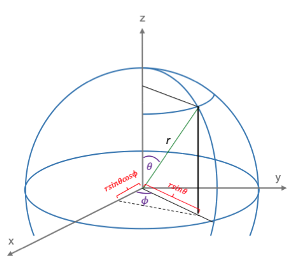
The \(p_x\) and \(p_y\) wavefunctions in spherical coordinates are \(\psi_{p_x}=sin\theta cos\phi f(r)\) and \(\psi_{p_y}=sin\theta sin\phi f(r)\) (see this article for derivation).
$$\begin{align*}\hat{C}_3\psi_{p_x}&=\hat{C}_3sin\theta cos\phi f(r)=sin\theta cos\biggr(\phi +\frac{2\pi}{3}\biggr)f(r)\\&=sin\theta\biggr(cos\phi cos\frac{2\pi}{3}-sin\phi sin\frac{2\pi}{3}\biggr)f(r)\\&=\biggr(-\frac{1}{2}sin\theta cos\phi -\frac{\sqrt{3}}{2}sin\theta sin\phi \biggr)f(r)\\&=-\frac{1}{2}\psi_{p_x}-\frac{\sqrt{3}}{2}\psi_{p_y}\;\;\;\;\;\;\;\;62\end{align*}$$
In other words, the symmetry operation \(\hat{C}_3\) transforms \(\psi_{p_x}\) into a linear combination of \(\psi_{p_x}\) and \(\psi_{p_y}\) (c.f. eq55). Similarly,
$$\hat{C}_3\psi_{p_y}=\frac{\sqrt{3}}{2}\psi_{p_x}-\frac{1}{2}\psi_{p_y}\;\;\;\;\;\;\;\;63$$
Therefore, \(\psi_{p_x}\) and \(\psi_{p_y}\) transform together according to the two-dimensional irreducible representation \(E\), with the coefficients of the basis functions \(\psi_{p_x}\) and \(\psi_{p_y}\) in eq62 and eq63 being the entries of the matrix \(\Gamma_E(C_3)\).
Repeating the same procedure shown in the Q&A above for the rest of the symmetry operations of the \(C_{3v}\) point group, we have
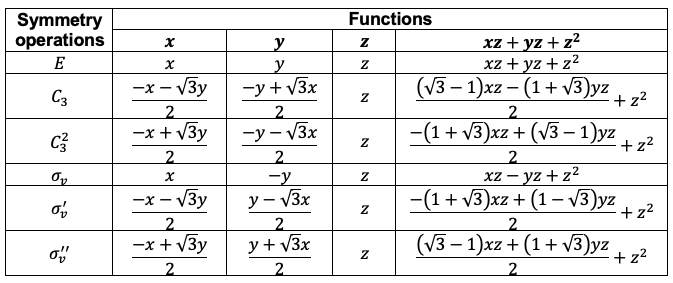
The transformation of the function \(xz+yz+z^2\) is determined by summing the separate transformations of the \(d\)-orbitals \(xz,yz\) and \(z^2\).