Overlap integral

The overlap integral  is a measure of the extent of overlap of an orbital  of an atom with the orbital of another atom .

The diagram above depicts the graphs of  and  for points along the internuclear axis  of two orbitals. With regard to the two graphs of , is the continuous sum of the product of the wavefunctions and at each .

if the wavefunctions overlap and  if the wavefunctions do not overlap. This implies that if , bonding does not occur between the atoms because the orbitals of the two atoms are too far apart. Therefore,  not only provides a quantitative measure of the extent of overlap of an orbital  of an atom  with the orbital  of another atom , but an indication of whether bonding is possible.

Group theory is often employed to determine if the overlap integral between two wavefunctions is necessarily zero without having to compute the integral algebraically.

Next article: Central force problem
Previous article: Secular equations in the variational method
Content page of quantum mechanics
Content page of advanced chemistry
Main content page

Time-dependent perturbation theory

The time-dependent perturbation theory is a method for finding an approximate solution to a problem that is characterised by the time-varying properties of a quantum mechanical system. For example, the electronic state of a molecule exposed to electromagnetic radiation is constantly perturbed by the oscillating electromagnetic field. Time-dependent perturbation theory is key to finding solutions to such problems, and is used to calculate transition probabilities in spectroscopy.

Consider the unperturbed eigenvalue equation  given by eq262, where is the unperturbed Hamiltonian, is a complete set of orthonormal eigenfunctions of in a Hilbert space, and represents the exact eigenvalue solutions. Furthermore, let’s rewrite eq57 as

where

is the solution of the time-dependent Schrodinger equation. If it describes a stationary state, then

Otherwise, can be expressed generally as the linear combination , which is also a solution of eq281a.

In the presence of radiation, we add a correction term to the Hamiltonian in eq281a:

where is the perturbed wavefunction.

Since belong to the same Hilbert space, which is spanned by , we can express as

where the coefficient is now a function of time because we expect , which is the probability that a measurement of a system will yield an eigenvalue associated with , to change with time since the Hamiltonian is now time-dependent.

Question

Show that .

Answer

Using ,


If we assume that the perturbation was turned on at time , then the system before is characterised by a stationary state. Substituting in eq281d, we have , which must be equal to eq281b at . This implies that

Substituting eq281d in eq281c and using the unperturbed eigenvalue equation, we get

Multiplying the above equation by , integrating over all space and using , we have

Assuming that the variation of  is insignificant because the perturbation is small and over a short time from to , then . Substituting eq281e in eq281f, we have

Integrating the above equation from to and using eq281e,

Eq281g, when substituted in eq281d, gives the approximate perturbed wavefunction  at :

where is the probability that a measurement of a system will yield an eigenvalue associated with  after perturbation at .

Let’s suppose the perturbation on an atom or molecule is caused by a plane-polarised electromagnetic wave with an electric component  oscillating in the -direction. According to classical physics, the force on a charge on the atom or molecule is . It is also the negative gradient of potential energy  of interaction between the field and the charge, i.e. . Therefore, , whose integrated form is , which is consistent with the classical interaction energy between the electric field and a charged particle. If we consider multiple charges and an oscillating electric field, the perturbation can be expressed approximately as

where is the maximum amplitude of the electric field in the -direction, is the angular frequency of the electric field and is the operator for the -component of the atom or molecule’s electric dipole moment, i.e. .

Question

Why did we not consider the magnetic component of the electromagnetic wave?

Answer

This is because interaction between the magnetic component of the electromagnetic wave and the charges of an atom or molecule is more than a hundred times weaker than interaction between the electric component of the electromagnetic wave and the charges of the atom or molecule.


Substituting eq281h, and in eq281g for ,

Since is a function of time and not position, it is a constant with regard to the integral with respect to position and we have

When , we have , which implies that corresponds to the transition frequency of an atom or molecule from state to . Therefore, is the probability that a measurement of a system will yield an eigenvalue associated with after perturbation at from the state at (see Q&A below for how to evaluate  when ,). In other words, the transition probability from state to of an atom or molecule irradiated by an electromagnetic wave oscillating in the -direction is proportional to , which is denoted by .

Question

Evaluate when .

Answer

Let , with . As , we have .  Using L’Hopital‘s rule,

So, and grows linearly with .

For , where , the magnitude of the numerator is:

Therefore, the magnitude of the numerator is always between 0 and 2, which makes .


For an electromagnetic wave that is not plane-polarised, and . We called the transition dipole moment. In general, transitions are allowed when , while transitions are forbidden when .


Next article: Non-crossing rule
Previous article: Degenerate Perturbation theory (An example)
Content page of quantum mechanics
Content page of advanced chemistry
Main content page

Absolute entropy

The absolute entropy of a system at a given temperature is its entropy at that temperature relative to its entropy at absolute zero.

The consequence of eq300 is that we can calculate the absolute entropies of substances at any temperature. From eq119,

For a system at constant volume, (see Q&A below for derivation), so

For ideal and real gases, is a function of temperature and is proportional to at low temperatures according to the Debye formula. At higher temperatures, can be approximated as a function described by eq43, where . Assuming that the gas solidifies into a perfect crystal, , eq301 becomes

Having computed eq302, we can use the value to calculate the absolute entropy of the same substance at other temperatures, for instance,

Using the same logic, a system at constant pressure is given by

If eq301 or eq304 has a temperature range that includes phase transitions, which result in points of discontinuity in  or (see diagram above), we have to modify the equation (e.g. eq304) as follows:

Finally, just as the change of standard reaction enthalpy is , the change of standard reaction entropy is:


Question

Show that and for an isobaric process.

Answer

The change in enthalpy for an isobaric process that involves only pV work is given by

For an isobaric process, , so or . Hence, .

The change in entropy of a constant pressure system at a transition temperature is:

Both and are exact differentials, and therefore, .


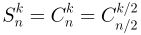
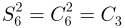
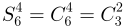
Next article: Permutation and combination
Previous article: Third law of thermodynamics
Content page of chemical thermodynamics
Content page of advanced chemistry
Main content page

Third law of thermodynamics

The third law of thermodynamics states that the entropy of a system in a perfect crystalline state is zero, as the temperature approaches zero Kelvin.

Molecular motion decreases with temperature, and a pure substance may form a crystal with an uninterrupted lattice structure as ; that is, a crystal with a unique configuration. If this configuration is such that every atom, ion or molecule is arranged in an orderly and repeating pattern with no defects, distortions or irregularities, it is called a perfect crystal.

The equation for statistical entropy is:

where is the number of ways to achieve the configuration of the system.

Since there is only one way to arrange the configuration of a perfect crystal,  and

While the scenario above involves a perfect crystalline state, the law still holds even when the structure at very low temperatures is not flawless, provided the system reaches a unique ground state configuration, meaning


Previous article: Chemical potential
Next article: Absolute entropy
Content page of chemical thermodynamics
Content page of advanced chemistry
Main content page

Chemical potential

The chemical potential of a species is the change in Gibbs energy with respect to the change in the number of moles of the species, with temperature, pressure and the amount of other substances held constant. It is a measure of the potential of a species for change.

In the previous article, we derived eq143 and eq148 for a closed system that does only pV work. These equations are not applicable to open or closed systems with composition changes or open systems that interchange matter with their surroundings. We now derive equations that apply to such systems.

Consider a one-phase system containing a single chemical species (i.e. a pure substance) in a container that is in thermal equilibrium. The container may be open or closed. The Gibbs energy of the system is represented by the function:

The total differential of for this system is:

where is defined as the chemical potential of the pure substance.

Substituting the definition of molar Gibbs energy  in :

Since is an intensive quantity for a pure substance,

Hence, for a pure substance, its chemical potential is equal to its molar Gibbs energy and we can write eq149 as

Comparing eq150 with the total differential of for a closed system, is the chemical potential due to the exchange of material between the system and its surroundings for an open system.

Question

Does eq150 only apply to a single-component (pure substance), single-phase system?

Answer

Yes. If the pure substance undergoes molecular rearrangment (e.g. cis-trans isomerisation), dissociation (e.g. ) or melting, eq150 does not apply. Systems involving cis-trans isomerisation and dissociation reactions are considered multi-component, whereas a pure substance undergoing melting is treated as a single-component, two-phase system.


If the one-phase system contains different chemical species (e.g. cis-trans isomerisation or dissociation reaction), its Gibbs energy is represented by the function:

where  is the number of moles of the -th species in the system.

The corresponding total differential of for a multi-component, single-phase system is:


where the subscripts refers to maintaining the composition of all species constant, while means keeping the composition of all species constant except .

Substituting eq148a and eq148b into eq151 yields

where is the chemical potential of the -th species in the system.

We now have a Gibbs energy equation that is applicable to a ‘one-phase, multi-species’ system that is either open or closed. If the system is closed and involves a reaction,  in eq152 refers to composition changes within the system. For an open system,  may be attributed to either composition changes within the system or material exchange with the surroundings or both, depending on the specified conditions. Eq152 reduces to eq149 if there is only one component in the summation. Note that  in a ‘one-phase, multi-species’ system may not be equal to of the pure species .

Consider a one-phase closed system containing two species that react reversibly (note that reversibility here refers to the reaction having a forward component and backward component, and not in terms of a reversible thermodynamic process) as follows:

If the reaction is occurring at constant pressure and constant temperature, eq152 becomes

Suppose the forward reaction is spontaneous. From eq145,  and hence, , i.e.

Let  and ,

As , we have or

Similarly, in the event that the reverse reaction is spontaneous,  and ,  and , which gives

The spontaneity of a reaction due to the difference in the chemical potentials of the reaction species is analogous to the tendency of the gravitational potential energy of a body to change from a higher value to a lower value. In other words, the term ‘chemical potential’ relates to the potential energy of the system to effect a change.

With reference to eq154 and eq155, the remaining scenario is

When both substances have the same chemical potential, they have equal tendency to change. This means that the reaction is at equilibrium.

We can also express the change in chemical potential of the reaction in a closed system is a different way. Let’s rewrite the equation as and define

where is the stoichiometric number of the -th species in the reversible reaction and is the amount of substance that is being changed in the reaction, i.e. a proportionality constant that measures how much reaction has occurred. is dimensionless, while is called the extent of a reaction and has units of amount in moles. This proportionality constant is the same for all species. By convention, the stoichiometric number for reactants and products in a reversible reaction are negative and positive respectively with respect to the forward reaction.

From eq157,

Since the Gibbs energy of a reaction system decreases for a spontaneous reaction until equilibrium is achieved,

For example, for the reaction  with no initially, mole, with moles and mole, assuming all is consumed. If the reaction is at equilibrium when mole, we have mole and mole. At this point, there are 1 mole of and 0.5 mole of in the system. When the extent of the reaction reaches mole (point R), there are 0.8 mole of and 1.2 moles of in the system. Let’s now analyse the reverse reaction from point R to the equilibrium point. , with and . Therefore, in a reversible reaction is always positive for the forward reaction and negative for the reverse reaction.

Substituting eq157 in eq153, we have

For a spontaneous forward reaction,  and , which makes . When the reaction attains equilibrium, and hence . For a spontaneous reverse reaction, and , which makes . By denoting , we have a new indicator of the nature of a reversible chemical reaction, where

We call the indicator , the reaction Gibbs energy. A reaction where is known as an exergonic reaction (Greek for work producing), while a reaction where is an endergonic reaction (Greek for work consuming). The change in Gibbs energy with respect to the change in extent of a reaction for a reaction at constant and is shown in the diagram below.

We can also derive the first law of thermodynamics for a one-phase open system that involves pV work only, by substituting the definition of enthalpy in eq143 to give , whose differential form is:

Substituting eq152 in eq159

Similarly, the change in enthalpy for an open system is derived as follows:

Substitute eq159 and eq160 in the above equation,

Finally, the total differentials of for a single-component, multi-phase system (e.g. melting of ice), and a multi-component, multi-phase system (e.g. seawater in contact with air) are

and

respectively, where

Eq162 and eq163 can also be expressed, by combining with eq148, as:

and

respectively.

Consider a single component, two-phase system at constant pressure and temperature. At equilibrium, eq162 becomes . Since the net change of each component is zero at equilibrium, . This implies that , i.e. the chemical potentials a component in two coexisting phases are equal at equilibrium. It follows that the chemical potentials a component in three coexisting phases are also equal at equilibrium, because and , so and therefore . This has important applications in phase equilibria.


Previous article: Gibbs energy
Next article: Third law of thermodynamics
Content page of chemical thermodynamics
Content page of advanced chemistry
Main content page

Gibbs energy

Gibbs energy is a thermodynamic state function that is used to measure the spontaneity of a process at constant temperature and pressure.

As explained in an earlier article, the change in total entropy can help determine if a process in an isolated adiabatic system is spontaneous. However, most reactions proceed at constant pressure and temperature, which typically happens when the system is contained in a vessel with a movable piston and is in thermal contact with a temperature-controlled bath. In such cases, the system’s temperature is kept constant through the transfer of thermal energy from the bath, making the system no longer adiabatic.

Therefore, we need another state function to predict if such reactions are spontaneous or not. Consider a closed system that is in thermal equilibrium with a constant temperature bath. From eq139, . Let and substitute in the differential form of eq24 to give

If the system only does pV work,

Since and are constant and the change in enthalpy at constant pressure is defined as

Since , and are all state functions, we can define a new state function:

where is called the Gibbs energy.

Substituting eq143 in eq142,

Since we have derived eq144 using eq139, where the  equality identifies with irreversible processes and the relation, with reversible processes, the equality and relation in eq144 must also identify with the respective processes, where


Question

Why is an irreversible process a spontaneous process?

Answer

See this article for explanation.


As mentioned in the article on reversible and irreversible processes, a reversible process is an idealisation, which makes all real processes irreversible or spontaneous. Hence, the Gibbs energy of a system undergoing a real process at constant and decreases until such time when the process attains equilibrium.

Although all real processes are spontaneous, they may not occur within a finite timeframe. Whether a real process occurs is also dependent on chemical kinetics.

The integrated form of eq144 is:

where


Question

Is a state function?

Answer

Yes. , known as the Helmholtz energy, is a state function because , and are all state functions. The relation also indicates whether a process is spontaneous, but under conditions of constant temperature and volume.


A useful equation can be derived from eq143 as follows:

If the closed system only involves pV work, we can substitute eq121 in the above equation to give:

Eq148 becomes for a reversible process carried out at constant pressure and temperature, which is consistent with eq144. Eq148 also shows that the measure of the change in Gibbs energy of a process in general is not restricted to the process being carried out at constant pressure and constant temperature. However,  becomes a reflection of whether a process is reversible or irreversible if the process occurs at constant pressure and constant temperature.

Finally, Gibbs energy is previously called Gibbs free energy, where the term ‘free’ refers to energy that is “free to do non-pV work”. However in 1988, IUPAC dropped the term to avoid confusion.


Question

Show that

Answer

At constant , eq148 becomes . We can further impose the condition that the components of the system remain constant without any loss of generality, i.e.

Similarly, at constant , we have , and hence


Previous article: Clausius inequality
Next article: Chemical potential
Content page of chemical thermodynamics
Content page of advanced chemistry
Main content page

Clausius inequality

The Clausius inequality, mathematically expressed as ,  is an entropy change inequality applicable to all  heat transfer processes.

The motivation behind the derivation of the inequality can be perceived as the search for a less restrictive inequality given by eq130, which states that for any adiabatic process in an isolated system.

As we know, a system and its surroundings form the universe, with their entropies related by the following equations:

Since , and from eq133  for any process,

Let’s assume that the surroundings is an infinite heat reservoir with uniform heat capacity and temperature. In other words, equilibrium is always attained in the infinite heat reservoir and therefore, any process occuring in the surroundings is reversible. If so, we can write,

Since any transfer of energy to the surroundings  must come from the system, . So,

or

Eq139 is called the Clausius inequality. We have shown in eq119 that  for a reversible process, where . So the component of eq139 must be for a reversible process, which leaves the remaining component for an irreversible process:

We have therefore developed a change in entropy inequality (eq139) for a system that encompasses all processes.


Question

If entropy is a state function, why is there a difference in the change of entropy for reversible versus irreversible processes in eq139?

Answer

Entropy is a state function and the change in entropy of a system undergoing a reversible process from state A to B must be the same as that for an irreversible process between the same two states, i.e. .

With reference to eq132 and eq136, . Similarly, from eq131 and eq136, . Since , the change in entropy of the surroundings associated with a reversible process occurring in the system from A to B must be different from the change in entropy of the surroundings associated with an irreversible process occurring in the system between the same states. This is what the Clausius inequality is trying to convey.


Previous article: Entropy of the universe
Next article: Gibbs energy
Content page of chemical thermodynamics
Content page of advanced chemistry
Main content page

Entropy of the universe

The entropy of the universe tends to increase with time. To understand this statement, we need to study the change in entropy of adiabatic processes.

For a reversible adiabatic process in an isolated system, and from eq119, . Therefore,

For an irreversible adiabatic process AB with well-defined start and end states (see diagram above), we can set up two reversible paths, BC and CA, to create a cyclic process ABC, where BC is a reversible isochoric process and CA is a reversible adiabatic process. The change in entropy for the cycle is:

Since entropy is a state function, and because CA is a reversible adiabatic process, . So,

Since BC is a reversible process, we can substitute eq119 in  to give

From eq42, since BC is an isochoric process,

As  and , and therefore

Combining eq128 and eq129

If we regard our physical universe as an isolated system with any process occurring within it as adiabatic,

Since an irreversible process is a spontaneous process,

We can therefore also define reversibility and irreversibility (or spontaneity) in terms of entropy of the universe, where a process is reversible if there is no change in entropy of the universe, and where a process is irreversible (or spontaneous) if the change in entropy of the universe is positive. As mentioned in the article on reversible and irreversible processes, a reversible process is an idealisation, which makes all real processes irreversible (or spontaneous). Hence, the consequence of eq131 is that the entropy of the universe tends to increase with time. If there comes a time when no more irreversible process in the universe occurs, equilibrium is attained and . This hypothesis is known as the heat death of the universe.


Question

Show that for an isochoric process.

Answer

The change in internal energy for any process that involves only pV work is given by

For an isochoric process, , so or . Hence, .

Previous article: Spontaneous process
Next article: Clausius inequality
Content page of chemical thermodynamics
Content page of advanced chemistry
Main content page

Spontaneous process (thermodynamics)

A Spontaneous process is an irreversible process that occurs naturally under certain conditions in one direction, but requires continual external input in the reverse direction. An example is the flow of heat from a hot body to a cold body.

Consider a closed system with 1 mole of a monoatomic gas at that is brought into contact with another compartment, which contains the same amount of the same gas at (see diagram above). The green boundary is thermally insulating, while the blue divider is thermally conducting. If , heat will flow from the system to the compartment on the right. Such a process is an irreversible process because the thermodynamic properties of the initial and final states of the system, but not the intermediate states, are well-defined. For example, the temperature of the system near the divider will be different from the temperature of the system further away from the divider when the system is first brought into contact with the right compartment. When both compartments attain thermal equilibrium, the system can only be reversed to its initial state via a heat pump (continual external input).

Question

Why does heat always flow from a high temperature body to a low temperature body?

Answer

The heat content of a substance is the total energy of motion of particles making up that substance, while the temperature of a substance is a measure of the average energy of particle motion in that substance. An easy way to understand the flow of heat is to study the motion of a monoatomic perfect gas, which consists entirely of kinetic energy. Consider two compartments that are separated by a thermally insulating valve (see diagram above). The left compartment contains 1 mole of a monoatomic gas at , while the right compartment houses the same amount of the same gas at , with  i.e. . If the separator is removed, atoms move randomly in an enlarged volume, with those on the left moving to the right faster than those on the right moving to the left. Over time, an even distribution of atoms is achieved in the container, where the average kinetic energies per unit volume sampled from different parts of the container () are the same. Since , heat must have flowed from the left to the right.

If we consider energy transfer during collisions, i.e. we no longer have a perfect gas, we end up with the same conclusion. In the case of elastic collisions, the conservation of momentum and kinetic energy lead to:

Combining the two equations and letting , we have and . This means that any two colliding gas atoms exchange their initial velocities, resulting in an equal distribution of atomic velocities and the same average velocity in any sampled volume.


Another example of a spontaneous process is the irreversible expansion of a system consisting of a gas in an isolated vertical cylinder (see diagram below).

If the force exerted by the gas on the bottom surface of the frictionless piston is greater than the weight of the piston, the gas expands and pushes the piston up when the catches are removed. The piston moves over a distance  until the force exerted by the expanded gas on the bottom surface of the piston equals to the weight of the piston. This process is an irreversible one since there is only sufficient time for the gas to equilibrate at the start and at the end of the process. To return the system to its initial state, we need to push the piston down over the same distance (continual external input).


Previous article: Entropy
Next article: Entropy of the universe
Content page of chemical thermodynamics
Content page of advanced chemistry
Main content page

Entropy

Entropy is a state function , whose differential is expressed as .

With reference to eq98, for a reversible cycle. Dividing eq98 by gives:

Substituting the definition of from the first law of thermodynamics in eq116 yields:

We have shown in an earlier article that  is an exact differential for an ideal gas. Since the line integral of any exact differential involved in a cyclic process is zero,

The function appears to be the differential of a state function. If it is, we must prove that eq118 applies to any working substance, not just an ideal gas. The proof follows the same logic as the proof that eq98 is applicable to any working substance in a Carnot engine. This is accomplished by replacing  with  and repeating the steps from eq99 through eq105. We call this new state function, entropy, :


Question

Is eq119 applicable to irreversible processes? If not, is that in conflict with the fact that is a state function, in which its change is path-independent?

Answer

Eq119 is only applicable to reversible processes. It is often written as , or its integral form .  In other words, can only be calculated by integrating for a reversible process, even though is a state function. Furthermore, is only applicable to a reversible process in a closed system, as is poorly defined for an open system. However, we can still calculate for an irreversible process using eq119 if we can find a reversible process or a combination of reversible processes from point A to point B.


Note that in eq119 is the same for both the system and the reservoir (surroundings) for a reversible process. For a closed system undergoing reversible processes, we can substitute eq119 in the differential form of eq24 to give:

If only pV work is involved,

Similarly, we can compute for an irreversible process if we can find a reversible process or a combination of reversible processes from point A to point B. Eq121, which is the combination of the first and second laws of thermodynamics, is called the fundamental equation of thermodynamics.


Question

Under what circumstances is ?

Answer

From eq119, for a process occurring in the surroundings. If the surroundings is a constant pressure reservoir, , where is a constant. Since both and are state functions, we can express the integral form of as .


Question

Show that .

Answer

Rearranging eq121 gives:

Substituting the total differential into eq122 yields:

Comparing eq123 with the total differential results in:

Since is a state function, the order of differentiation does not matter:

Substituting eq124 into eq125 gives:

Carrying out the derivatives yields:

Multiplying eq126 throughout by and rearranging results in:


Previous article: Carnot’s theorem
Next article: Spontaneous process
Content page of chemical thermodynamics
Content page of advanced chemistry
Main content page
Mono Quiz