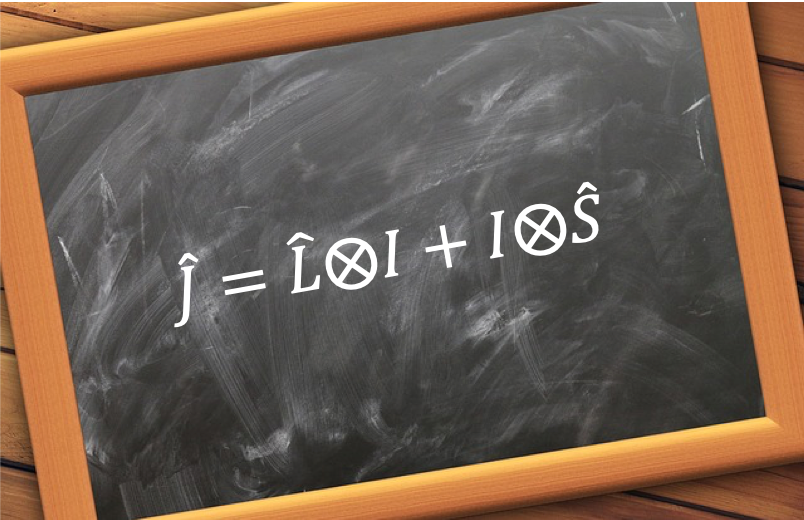
Eigenvalues of quantum orbital angular momentum operators

The eigenvalues of quantum orbital angular momentum operators are fundamental to understanding the quantisation of angular momentum in quantum mechanics, as they dictate the allowed energy levels and spatial distributions of particles in atomic and molecular systems.

As mentioned in an earlier article, if \small \left [ \hat{L}^{2},\hat{L}_z \right ]=0, a common complete set of eigenfunctions can be selected for the two operators. Let \small Y be the common set of normalised eigenfunctions with eigenvalues \small b and \small c for \small \hat{L}^{2} and \small \hat{L}_z respectively.

From eq75,

\small \hat{L}^{2}-\hat{L}_z^{\; 2} =\hat{L}_x^{\; 2}+\hat{L}_y^{\; 2}

Multiplying the above equation by \small Y on the right, \small Y^{*} on the left and integrating over all space, we have

\small \langle L^{2}\rangle-\langle L_z^{\; 2}\rangle=\langle L_x^{\; 2}\rangle+\langle L_y^{\; 2}\rangle

\small b-c^{2}=\langle L_x^{\; 2}\rangle+\langle L_y^{\; 2}\rangle

Even though \small Y is not an eigenfunction of \small \hat{L}_x^{\; 2}, we can still find the expectation value of \small \hat{L}_x^{\; 2}, which is

\small \langle L_x^{\; 2}\rangle=\int Y^{*}\hat{L}_x(\hat{L}_xY)d\tau=\int (\hat{L}_xY)(\hat{L}_xY)^{*}d\tau=\int \vert \hat{L}_xY\vert^{2}d\tau\geq 0

Note that we have used the fact that \small \hat{L}_x is Hermitian for the 2nd equality (see eq37). Similarly, \small \langle L_y^{\; 2}\rangle\geq 0. So,

\small b-c^{2}\geq 0\; \; \; \; \; or\; \; \; \; \; -\sqrt{b}\leq c\leq \sqrt{b}

Therefore, \small c has an upper bound and a lower bound. Since the eigenvalues of \small \hat{L}_z has an upper bound and a lower bound, from eq113 and eq114 we have

\small \hat{L}_zY_{max}=c_{max}Y_{max}\; \; \; \; \; \; \; \; 122

\small \hat{L}_zY_{min}=c_{min}Y_{min}\; \; \; \; \; \; \; \; 123

where \small Y_{max}=\hat{L}_+^{\; k_{max}}Y, \small c_{max}=c+k_{max}\hbar, \small Y_{min}=\hat{L}_-^{\; k_{min}}Y and \small c_{min}=c-k_{min}\hbar.

If we operate on eq122 with \small \hat{L}_+, we supposedly have

\small \hat{L}_z(\hat{L}_+Y_{max})=(c_{max}+\hbar)(\hat{L}_+Y_{max})

However, the above equation contradicts the upper bound eigenvalue of \small \hat{L}_z of \small c_{max}. This implies that we must truncate the ladder beyond eq122. Since \small c_{max}+\hbar\neq 0, we must have

\small \hat{L}_+Y_{max}=0\; \; \; \; \; \; \; \; 124

Using the same argument when operating on eq123 with \small \hat{L}_-, we have

\small \hat{L}_-Y_{min}=0 \; \; \; \; \; \; \; \; 125

If we further operate on eq124 with \small \hat{L}_-, we have

\small \hat{L}_-\hat{L}_+Y_{max}=0

Substitute eq116 in the above equation,

\small (\hat{L}^{2}-\hat{L}_z^{\; 2}-\hbar\hat{L}_z)Y_{max}=0

Using eq119 where \small k=k_{max}, and eq122,

\small (b-c_{max}^{\; \; \; \; \; \; 2}-\hbar c_{max})Y_{max}=0

Since \small Y_{max}\neq 0

\small b-c_{max}^{\; \; \; \; \; \; 2}-\hbar c_{max}=0 \; \; \; \; \; \; \; \; 126

Similarly, operating on eq125 with \small \hat{L}_+ and using eq115, eq119 and eq123, we have

\small b-c_{min}^{\; \; \; \; \; \; 2}+\hbar c_{min}=0 \; \; \; \; \; \; \; \; 127

Subtracting eq127 from eq126, we have \small (c_{max}+c_{min})(c_{min}-c_{max}-\hbar)=0. Since \small c_{max}> c_{min} and \small (c_{min}-c_{max}-\hbar)< 0, we have \small c_{max}+c_{min}=0 or

\small c_{max}=-c_{min}\; \; \; \; \; \; \; \; 128

As we know from eq122 and eq123, the value of \small c_{max}-c_{min} of a particular system is dependent on the number of consecutive operations on \small \hat{L}_zY by \small \hat{L}_+ or \small \hat{L}_-, with each operation raising or lowering the eigenvalue of \small \hat{L}_z by \small \hbar. Therefore,

\small c_{max}-c_{min}=0,\hbar,2\hbar,\cdots=2l\hbar\; \; \; \; \; \; \; \; 129

where \small l=0,\frac{1}{2},1,\frac{3}{2},\cdots

Substituting eq128 in eq129, we have \small c_{max}=l\hbar and \small c_{min}=-l\hbar. Therefore, the eigenvalues of \small \hat{L}_z are

\small c=-l\hbar,-l\hbar+\hbar,-l\hbar+2\hbar,\cdots,l\hbar=-l\hbar,(-l+1)\hbar,(-l+2)\hbar,\cdots,l\hbar

\small c=m_l\hbar\; \; \; \; \; \; \; \; 130

where \small m_l=-l,-l+1,-l+2,\cdots,l.

Substituting \small c_{min}=-l\hbar in eq127,

\small b=l(l+1)\hbar^{2}\; \; \; \; \; \; \; \; 131

where \small l=0,\frac{1}{2},1,\frac{3}{2},\cdots.

As mentioned in the previous article, the raising and lowering operators also apply to the spin angular momentum \small \boldsymbol{\mathit{S}} and the total angular momentum \small \boldsymbol{\mathit{J}}. We would therefore expect the eigenvalues of \small \hat{S}^{2} and \small \hat{S}_z to be \small s(s+1)\hbar^{2} and \small m_s\hbar respectively, and the eigenvalues of \small \hat{J}^{2} and \small \hat{J}_z to be \small j(j+1)\hbar^{2} and \small m_j\hbar respectively. However, the quantum numbers \small l and \small m_l for the orbital angular momentum \small \boldsymbol{\mathit{L}}, but not the quantum numbers for \small \boldsymbol{\mathit{S}} and \small \boldsymbol{\mathit{J}}, are restricted to integers. Therefore,


\small \boldsymbol{\mathit{L}} \small m_l\in \mathbb{Z} \small l\in \mathbb{Z}
\small \boldsymbol{\mathit{S}} \small m_s=-s,-s+1,-s+2,\cdots,s \small s=0,\frac{1}{2},1,\frac{3}{2},\cdots
\small \boldsymbol{\mathit{J}} \small m_j=-j,-j+1,-j+2,\cdots,j \small j=0,\frac{1}{2},1,\frac{3}{2},\cdots


Question

Why are the quantum numbers for \small \boldsymbol{\mathit{L}} restricted to integers?

Answer

The eigenvalue equation for \small \hat{L}_z (see eq95) is:

\small \frac{\hbar}{i}\frac{\partial}{\partial\phi}\psi=m_l\hbar\psi

where \small \psi=Ae^{im_l\phi}.

Since \small \psi must be single-valued,

\small Ae^{im_l\phi}=Ae^{im_l(\phi+2\pi)}

\small e^{im_l2\pi}=1

\small cosm_l2\pi + isinm_l2\pi=1

The solution to the above equation is \small m_l\in \mathbb{Z}. Furthermore, \small l is also an integer because \small m_l=-l,-l+1,-l+2,\cdots,l. In other words, there are values of for a given value of .


We would arrive at the same results (eq130 and eq131) if we have chosen \small \hat{L}_x or \small \hat{L}_y instead of \small \hat{L}_z. The significance of eq130 and eq131 is that we can simultaneously assign eigenvalues of \small \hat{L}^{2} and \small \hat{L}_z (or \small \hat{L}^{2} and \small \hat{L}_x or \small \hat{L}^{2} and \small \hat{L}_y) if the 2 operators commute. This, together with the fact that any pair of component angular momentum operators does not commute, implies that we cannot simultaneously specify eigenvalues of \small \hat{L}^{2} and more than one component angular momentum operators.

In conclusion, substituting eq130 in eq112 and eq131 in eq117

\small \hat{L}_zY=m_l\hbar Y

\small \hat{L}^{2}Y=l(l+1)\hbar^{2} Y\;\;\;\;\;\;\;\;131a

Since \small Y is a function of \small l and \small m_l, we can express the above eigenvalue equations as:

\small \hat{L}_z\vert l,m_l\rangle=m_l\hbar \vert l,m_l\rangle \; \; \; \; \; \; \; \; 132

\small \hat{L}^{2}\vert l,m_l\rangle=l(l+1)\hbar^{2} \vert l,m_l\rangle \; \; \; \; \; \; \; \; 133


Next article: matrix elements of angular momentum operators
Previous article: quantum orbital angular momentum ladder operators
Content page of quantum mechanics
Content page of advanced chemistry
Main content page

Quantum orbital angular momentum ladder operators

The ladder operators of quantum orbital angular momentum are defined as:

\small \hat{L}_+=\hat{L}_x+i\hat{L}_y\; \; \; \; \; \; \; \; 108

\small \hat{L}_-=\hat{L}_x-i\hat{L}_y\; \; \; \; \; \; \; \; 109

where \small \hat{L}_+ is the raising operator and \small \hat{L}_- is the lowering operator.

To demonstrate why the operators are named as such, we substitute eq108 in \small \left [\hat{L}_+,\hat{L}_z\right ]:

\small \left [\hat{L}_+,\hat{L}_z\right ]=\left [\hat{L}_x+i\hat{L}_y,\hat{L}_z\right ]=\left [\hat{L}_x,\hat{L}_z\right ]+i\left [\hat{L}_y,\hat{L}_z\right ]

Substituting eq100 and eq101 in the above equation, and noting that \small \left [ \hat{L}_a,\hat{L}_b \right ]=-\left [ \hat{L}_b,\hat{L}_a \right ], yields

\small \hat{L}_+\hat{L}_z-\hat{L}_z\hat{L}_+=-i\hbar\hat{L}_y-\hbar\hat{L}_x

\small \hat{L}_+\hat{L}_z=\hat{L}_z\hat{L}_+-\hbar\hat{L}_+\; \; \; \; \; \; \; \; 110

Similarly, we find

\small \hat{L}_-\hat{L}_z=\hat{L}_z\hat{L}_-+\hbar\hat{L}_-\; \; \; \; \; \; \; \; 111

If \small Y is an eigenfunction of \small \hat{L}_z with eigenvalue \small c,

\small \hat{L}_z Y=cY\; \; \; \; \; \; \; \; 112

Operating on eq112 with \small \hat{L}_+, we have \small \hat{L}_+\hat{L}_z Y=c\hat{L}_+Y. Substituting eq110 in the this equation and rearranging gives \small \hat{L}_z\hat{L}_+ Y=(c+\hbar)\hat{L}_+Y. So, \small \hat{L}_+Y is an eigenfunction of \small \hat{L}_z with eigenvalue \small (c+\hbar). Operating on eq112 with \small \hat{L}_+ transforms \small Y into another eigenfunction \small \hat{L}_+ Y with an eigenvalue higher than c by \small \hbar. If we operate on eq112 with \small \hat{L}_+ twice, we have

\small \hat{L}_+\hat{L}_z\hat{L}_+ Y=(c+\hbar)\hat{L}_+^{\; 2}Y

\small \left ( \hat{L}_z\hat{L}_+-\hbar\hat{L}_+\right )\hat{L}_+ Y=(c+\hbar)\hat{L}_+^{\; 2}Y

\small \hat{L}_z\hat{L}_+^{\; 2}Y=(c+2\hbar)\hat{L}_+^{\; 2}Y

By mathematical induction,

\small \hat{L}_z\hat{L}_+^{\; k}Y=(c+k\hbar)\hat{L}_+^{\; k}Y \; \; \; \; \; k=0,1,2,\cdots\; \; \; \; \; \; \; \; 113

Similarly, if we operate on eq112 \small k times with \small \hat{L}_-, we have

\small \hat{L}_z\hat{L}_-^{\; k}Y=(c-k\hbar)\hat{L}_-^{\; k}Y \; \; \; \; \; k=0,1,2,\cdots\; \; \; \; \; \; \; \; 114

In other words, the raising operator progressively raises the eigenvalue of \small Y by \small \hbar, while the lowering operator progressively lowers the eigenvalue of \small Y by \small \hbar, i.e. each operator generate a ladder of eigenvalues.


Question

Show that \small \hat{L}_+\hat{L}_-=\hat{L}^{2}-\hat{L}_z^{\; 2}+\hbar\hat{L}_z.

Answer

Substituting eq108 and eq109 in \small \hat{L}_+\hat{L}_-,

\small \hat{L}_+\hat{L}_-=\hat{L}_x^{\; 2}-i\hat{L}_x\hat{L}_y+i\hat{L}_y\hat{L}_x+\hat{L}_y^{\; 2}

Substituting eq75 in the above equation and then eq99 in the resultant equation, and noting that \small \left [ \hat{L}_a,\hat{L}_b \right ]=-\left [ \hat{L}_b,\hat{L}_a \right ], results in

\small \hat{L}_+\hat{L}_-=\hat{L}^{2}-\hat{L}_z^{\; 2}+\hbar\hat{L}_z\; \; \; \; \; \; \; \; 115

Similarly,

\small \hat{L}_-\hat{L}_+=\hat{L}^{2}-\hat{L}_z^{\; 2}-\hbar\hat{L}_z\; \; \; \; \; \; \; \; 116


If \small Y is simultaneously also an eigenfunction of \small \hat{L}^{2} with eigenvalue \small b,

\small \hat{L}^{2}Y=bY\; \; \; \; \; \; \; \; 117


Question

Show that \small \hat{L}^{2} commutes with \small \hat{L}_\pm ^{\; k}.

Answer

For \small k=1,  we have \small \left [ \hat{L}^{2},\hat{L}_ \pm \right ]=\left [ \hat{L}^{2},\hat{L}_ x\pm i\hat{L}_ y\right ]=\left [ \hat{L}^{2},\hat{L}_ x\right ]\pm i\left [ \hat{L}^{2},\hat{L}_ y\right ]. Since \small \left [ \hat{L}^{2},\hat{L}_ x \right ]=0 and \small \left [ \hat{L}^{2},\hat{L}_ y \right ]=0,

\small \left [ \hat{L}^{2},\hat{L}_ \pm \right ]=0

For \small k=2, we apply the identity \small \left [ \hat{A},\hat{B}\hat{C} \right ]=\left [ \hat{A},\hat{B}\right ]\hat{C}+\hat{B}\left [ \hat{A},\hat{C} \right ]:

\small \left [ \hat{L}^{2},\hat{L}_ \pm ^{\; 2}\right ]=\left [ \hat{L}^{2},\hat{L}_ \pm\right ]\hat{L}_ \pm+\hat{L}_ \pm\left [\hat{L}^{2},\hat{L}_ \pm\right]=0

By mathematical induction,

\small \left [ \hat{L}^{2},\hat{L}_\pm^{\; k} \right ]=0\; \; \; \; \; k=0,1,2,\cdots\; \; \; \; \; \; \; \; 118


Operating on eq117 with \small \hat{L}_\pm^{\; k} and using eq118

\small \hat{L}_\pm^{\; k} \hat{L}^{2}Y=b\hat{L}_\pm^{\; k}Y

\small \hat{L}^{2}\hat{L}_\pm^{\; k}Y=b\hat{L}_\pm^{\; k}Y\; \; \; \; \; k=0,1,2,\cdots\; \; \; \; \; \; \; \; 119

The raising and lowering operators also apply to the spin angular momentum \small \boldsymbol{\mathit{S}}, because the spin angular momentum component operators are postulated to obey the form of commutation relations as described by eq99, eq100 and eq101 (see eq165, eq166 and eq167). Similarly, the raising and lowering operators apply to the total angular momentum \small \boldsymbol{\mathit{J}} (see Q&A below).


Question

Show that \small \left [ \hat{J}_x,\hat{J}_y \right ]=i\hbar\hat{J}_z.

Answer

Let

\small \hat{J}_i=\hat{M}_{1i}+\hat{M}_{2i}\; \; \; \; \; \; \; \; 120

where \small i=x,y,z; \small \hat{M}_{1i} and \small \hat{M}_{2i} are component operators of \small \hat{M}^{(1)} and \small \hat{M}^{(2)} respectively.

\small \hat{M}^{(1)} and \small \hat{M}^{(2)} are operators of two sources of angular momentum, e.g. \small \hat{M}^{(1)} and \small \hat{M}^{(2)} are the orbital angular momentum operator and spin angular momentum operator respectively of a particle.

\small \left [ \hat{J}_x,\hat{J}_y \right ]=\left ( \hat{M}_{1x}+\hat{M}_{2x} \right )\left ( \hat{M}_{1y}+\hat{M}_{2y} \right )-\left ( \hat{M}_{1y}+\hat{M}_{2y} \right )\left ( \hat{M}_{1x}+\hat{M}_{2x} \right )

Expanding and rearranging the RHS of the above equation,

\small \left [ \hat{J}_x,\hat{J}_y \right ]=\left [ \hat{M}_{1x},\hat{M}_{1y} \right ]+\left [ \hat{M}_{2x},\hat{M}_{2y} \right ]+\left [ \hat{M}_{1x},\hat{M}_{2y} \right ]+\left [ \hat{M}_{2x},\hat{M}_{1y} \right ]

Since the 3rd term on RHS of the above equation involves operators acting on different vector spaces (e.g. spatial coordinates vs spin coordinates), they must commute. The same goes for the 4th term. So,

\small \left [ \hat{J}_x,\hat{J}_y \right ]=\left [ \hat{M}_{1x},\hat{M}_{1y} \right ]+\left [ \hat{M}_{2x},\hat{M}_{2y} \right ]

According to eq99 and eq165, \small \left [ \hat{M}_{1x},\hat{M}_{1y} \right ]=i\hbar\hat{M}_{1z} and \small \left [ \hat{M}_{2x},\hat{M}_{2y} \right ]=i\hbar\hat{M}_{2z}. So,

\small \left [ \hat{J}_{x},\hat{J}_{y} \right ]=i\hbar\hat{J}_{z}\; \; \; \; \; \; \; \; 121

Similarly, we have \small \left [ \hat{J}_{y},\hat{J}_{z} \right ]=i\hbar\hat{J}_{x} and \small \left [ \hat{J}_{z},\hat{J}_{x} \right ]=i\hbar\hat{J}_{y}.


Next article: eigenvalues of quantum orbital angular momentum operators
Previous article: commutation relations of quantum orbital angular momentum operators
Content page of quantum mechanics
Content page of advanced chemistry
Main content page

Commutation relations of quantum orbital angular momentum operators

The three orbital angular momentum component operators do not commute with one another.

To show that \left [ \hat{L}_x,\hat{L}_y \right ]\neq 0, we substitute eq72 and eq73 in \left [ \hat{L}_x,\hat{L}_y \right ], giving \left [ \hat{L}_x,\hat{L}_y \right ]=\hbar^{2}\left [ x\frac{\partial}{\partial y}-y\frac{\partial}{\partial x}\right ], which when combined with eq74, returns

\left [ \hat{L}_x,\hat{L}_y \right ]=i\hbar\hat{L}_z\; \; \; \; \; \; \; \; 99

Repeating the above procedure for and , we get

\left [ \hat{L}_y,\hat{L}_z \right ]=i\hbar\hat{L}_x\; \; \; \; \; \; \; \; 100

\left [ \hat{L}_z,\hat{L}_x \right ]=i\hbar\hat{L}_y\; \; \; \; \; \; \; \; 101

Hence, each of the three orbital angular momentum component operators do not commute with the other two. Next, to show that \hat{L}^{2} commutes with all 3 orbital angular momentum component operators, we begin with

\small \left [ \hat{L}^{2},\hat{L}_x \right ]=\left (\hat{L}_x^{\; 2}+\hat{L}_y^{\; 2}+\hat{L}_z^{\; 2}\right )\hat{L}_x-\hat{L}_x\left (\hat{L}_x^{\; 2}+\hat{L}_y^{\; 2}+\hat{L}_z^{\; 2}\right )=\left [ \hat{L}_y^{\; 2},\hat{L}_x \right ]+\left [ \hat{L}_z^{\; 2},\hat{L}_x \right ]

Using the identity \small \left [ \hat{L}_a^{\; 2},\hat{L}_b \right ]=\hat{L}_a\left [ \hat{L}_a,\hat{L}_b \right ]+\left [ \hat{L}_a,\hat{L}_b \right ]\hat{L}_a,

\small \left [ \hat{L}^{2},\hat{L}_x \right ]=\hat{L}_y\left [ \hat{L}_y,\hat{L}_x \right ]+\left [ \hat{L}_y,\hat{L}_x \right ]\hat{L}_y +\hat{L}_z\left [ \hat{L}_z,\hat{L}_x \right ]+\left [ \hat{L}_z,\hat{L}_x \right ]\hat{L}_z

Substituting eq99 and eq101 in the above equation, and noting that \small \left [ \hat{L}_a,\hat{L}_b \right ]=-\left [ \hat{L}_b,\hat{L}_a \right ], yields \small \left [ \hat{L}^{2},\hat{L}_x \right ]=0. Repeating the steps for \small \left [ \hat{L}^{2},\hat{L}_y \right ] and \small \left [ \hat{L}^{2},\hat{L}_z \right ] gives

\small \left [ \hat{L}^{2},\hat{L}_x \right ]=0\; \; \; \;\left [ \hat{L}^{2},\hat{L}_y \right ]=0\; \; \; \;\left [ \hat{L}^{2},\hat{L}_z \right ]=0\; \; \; \; \; \; \; \; 102

As mentioned in an earlier article, a common complete set of eigenfunctions can be selected for two operators only if they commute. Therefore, \small \hat{L}^{2} shares a common set of eigenfunctions with each of \small \hat{L}_x, \small \hat{L}_y and \small \hat{L}_z, but we cannot select a common set of eigenfunctions for any pair of angular momentum component operators.


Question

Show that each of the three orbital angular momentum component operators commute with \small p^{2}, \small \hat{p}^{2}, \small r, \small r^{2} and \small \frac{1}{r}, where \small p^{2}=p_x^{\; 2}+p_y^{\; 2}+p_z^{\; 2} and \small r^{2}=x^{\; 2}+y^{\; 2}+z^{\; 2}.

Answer

Substituting eq74 in \small \left [ \hat{L}_z,x \right ], \small \left [ \hat{L}_z,y \right ], \small \left [ \hat{L}_z,z \right ], \small \left [ \hat{L}_z,p_x \right ], \small \left [ \hat{L}_z,p_y \right ] and \small \left [ \hat{L}_z,p_z \right ] (noting that \small p_i=m\frac{i}{t}, where \small i=x,y,z), and carrying out the derivatives, yields

\small \left [ \hat{L}_z,x \right ]=i\hbar y\; \; \; \; \;\left [ \hat{L}_z,y \right ]=-i\hbar x\; \; \; \; \;\left [ \hat{L}_z,z \right ]=0

\small \left [ \hat{L}_z,p_x \right ]=i\hbar p_y\; \; \; \; \;\left [ \hat{L}_z,p_y \right ]=-i\hbar p_x\; \; \; \; \;\left [ \hat{L}_z,p_z \right ]=0

Using the identities \small \left [ \hat{A},\hat{B}+\hat{C}+\hat{D} \right ]=\left [ \hat{A},\hat{B} \right ]+\left [ \hat{A},\hat{C} \right ]+\left [ \hat{A},\hat{D} \right ] and \small \left [ \hat{A},\hat{B}\hat{C} \right ]=\left [ \hat{A}\hat{B} \right ]\hat{C}+\hat{B}\left[\hat{A},\hat{C} \right ],

\small \left [ \hat{L}_z,r^{2} \right ]=\left [ \hat{L}_z,x^{2}+y^{2}+z^{2}\right ]=0

\small \left [ \hat{L}_z,r \right ]=\left [ \hat{L}_z,\sqrt{x^{2}+y^{2}+z^{2}}\right ]=0

\small \left [ \hat{L}_z,\frac{1}{r} \right ]=\left [ \hat{L}_z,\frac{1}{\sqrt{x^{2}+y^{2}+z^{2}}}\right ]=0

\small \left [ \hat{L}_z,p^{2} \right ]=\left [ \hat{L}_z,p_x^{\; 2}+p_y^{\; 2}+p_z^{\; 2}\right ]=0\; \; \; \; \; \; \; \; 103

\small \left [ \hat{L}_z,\hat{p}^{2} \right ]=0 can be inferred from eq103. Repeating the same logic for \small \hat{L}_x and \small \hat{L}_y. we have

\small \left [ \hat{L}_i,r^{2} \right ]=0\; \; \; \;\left [ \hat{L}_i,r \right ]=0\; \; \; \;\left [ \hat{L}_i,\frac{1}{r} \right ]=0\; \; \; \;\left [ \hat{L}_i,p^{2} \right ]=0\; \; \; \;\left [ \hat{L}_i,\hat{p}^{2}\right ]=0\; \; \; \; \; \; \; \; 104


The commutation relations in the above Q&A are applicable to hydrogenic systems. For a system of 2-electrons, there are cross terms like:

\small \left [ \hat{L}_{1z},\frac{1}{r_2} \right ]=\left [ \hat{L}_{1z},\frac{1}{\sqrt{x_2^{\; 2}+y_2^{\; 2}+z_2^{\; 2}}} \right ]=0\; \; \; \; \; \; \; \; 105

which are useful in determining the commutation relations between \small \hat{L}^{2} and the multi-electron Hamiltonian, for example \small \left [ \hat{L}_{1z}+\hat{L}_{2z},\frac{1}{r_1}+\frac{1}{r_2} \right ]=0.


Question

Show that \small \left [ \hat{L}^{2},\hat{p}^{2} \right ]=0 and \small \left [ \hat{L}^{2},\frac{1}{r} \right ]=0.

Answer

Using eq75 and the identities \small \left [ \hat{A},\hat{B}+\hat{C}+\hat{D} \right ]=\left [ \hat{A},\hat{B} \right ]+\left [ \hat{A},\hat{C} \right ]+\left [ \hat{A},\hat{D} \right ] and \small \left [ \hat{A},\hat{B}\hat{C} \right ]=\left [ \hat{A}\hat{B} \right ]\hat{C}+\hat{B}\left[\hat{A},\hat{C} \right ],

\small \left [ \hat{L}^{2},\hat{p}^{2} \right ]=\left [ \hat{L}_x^{\; 2}+\hat{L}_y^{\; 2}+\hat{L}_z^{\; 2},\hat{p}^{2} \right ]=0\; \; \; \; \; \; \; \; 106

\small \left [ \hat{L}^{2},\frac{1}{r} \right ]=\left [ \hat{L}_x^{\; 2}+\hat{L}_y^{\; 2}+\hat{L}_z^{\; 2},\frac{1}{r}\right ]=0\; \; \; \; \; \; \; \; 107


Next article: quantum orbital angular momentum ladder operators
Previous article: quantum orbital angular momentum operators (spherical coordinates)
Content page of quantum mechanics
Content page of advanced chemistry
Main content page

Quantum orbital angular momentum operators (spherical coordinates)

The quantum orbital angular momentum operators in spherical coordinates are derived using the following diagram:

where

x=rsin\theta cos\phi\; \; \; \; y=rsin\theta sin\phi\; \; \; \; z=rcos\theta\; \; \; \; r=\sqrt{x^{2}+y^{2}+z^{2}}\; \; \; \; \; \; \; \; 77

Therefore,

\frac{\partial r}{\partial x}=\frac{\partial \sqrt{x^{2}+y^{2}+z^{2}}}{\partial x}=\frac{x}{\sqrt{x^{2}+y^{2}+z^{2}}}=\frac{x}{r}=sin\theta cos\phi\; \; \; \; \; \; \; \; 78

Similarly,

\frac{\partial r}{\partial y}=sin\theta sin\phi\; \; \; \; \; \; \; \; 79

\frac{\partial r}{\partial z}= cos\theta\; \; \; \; \; \; \; \; 80

Furthermore, by differentiating cos\theta=\frac{z}{\sqrt{x^{2}+y^{2}+z^{2}}} implicitly with respect to x and separately with respect to y, and rearranging, we have

\frac{\partial\theta}{\partial x}=\frac{cos\theta cos\phi}{r}\; \; \; \; \; \; \; \; 81

\frac{\partial\theta}{\partial y}=\frac{cos\theta sin\phi}{r}\; \; \; \; \; \; \; \; 82


Question

Show that sin\phi=\frac{y}{\sqrt{x^{2}+y^{2}}}, cos\phi=\frac{x}{\sqrt{x^{2}+y^{2}}} and sin\theta=\frac{\sqrt{x^{2}+y^{2}}}{\sqrt{x^{2}+y^{2}+z^{2}}}.

Answer

To find expressions for sin\phi and cos\phi, we let \theta=\frac{\pi}{2} for the first three equations of eq77, which gives us x=rcos\phi, y=rsin\phi and z=0. So,

cos\phi=\frac{x}{\sqrt{x^{2}+y^{2}}}\; \; \; \; \; \;sin\phi=\frac{y}{\sqrt{x^{2}+y^{2}}}

Substituting these two expressions back into either the first or second equation of eq77, we have

sin\theta=\frac{\sqrt{x^{2}+y^{2}}}{\sqrt{x^{2}+y^{2}+z^{2}}}


Implicit differentiation of sin\theta=\frac{\sqrt{x^{2}+y^{2}}}{\sqrt{x^{2}+y^{2}+z^{2}}}sin\phi=\frac{y}{\sqrt{x^{2}+y^{2}}} and cos\phi=\frac{x}{\sqrt{x^{2}+y^{2}}} with respect to z, x and y respectively gives

\frac{\partial\theta}{\partial z}=-\frac{sin\theta}{r}\; \; \; \; \; \; \; \; 83

\frac{\partial\phi}{\partial x}=-\frac{sin\phi}{rsin\theta}\; \; \; \; \; \; \; \; 84

\frac{\partial\phi}{\partial y}=\frac{cos\phi}{rsin\theta}\; \; \; \; \; \; \; \; 85

Since \phi is independent of z

\frac{\partial\phi}{\partial z}=0\; \; \; \; \; \; \; \; 86

Applying the multivariable chain rule to f\left ( r,\theta,\phi \right ), we have:

\frac{\partial}{\partial x}=\frac{\partial r}{\partial x}\frac{\partial}{\partial r}+\frac{\partial\theta}{\partial x}\frac{\partial}{\partial \theta}+\frac{\partial\phi}{\partial x}\frac{\partial}{\partial \phi}\; \; \; \; \; \; \; \; 87

\frac{\partial}{\partial y}=\frac{\partial r}{\partial y}\frac{\partial}{\partial r}+\frac{\partial\theta}{\partial y}\frac{\partial}{\partial \theta}+\frac{\partial\phi}{\partial y}\frac{\partial}{\partial \phi}\; \; \; \; \; \; \; \; 88

\frac{\partial}{\partial z}=\frac{\partial r}{\partial z}\frac{\partial}{\partial r}+\frac{\partial\theta}{\partial z}\frac{\partial}{\partial \theta}+\frac{\partial\phi}{\partial z}\frac{\partial}{\partial \phi}\; \; \; \; \; \; \; \; 89

Substitute i) eq78, eq81 and eq84 in eq87, ii) eq79, eq82 and eq85 in eq88 and iii) eq80, eq83 and eq86 in eq89, we have

\frac{\partial}{\partial x}=sin\theta cos\phi\frac{\partial}{\partial r}+\frac{cos\theta cos\phi}{r}\frac{\partial}{\partial \theta}-\frac{sin\phi }{rsin\theta}\frac{\partial}{\partial \phi}\; \; \; \; \; \; \; \; \; \; 90

\frac{\partial}{\partial y}=sin\theta sin\phi\frac{\partial}{\partial r}+\frac{cos\theta sin\phi}{r}\frac{\partial}{\partial \theta}+\frac{cos\phi }{rsin\theta}\frac{\partial}{\partial \phi}\; \; \; \; \; \; \; \; \; \; 91

\frac{\partial}{\partial z}=cos\theta \frac{\partial}{\partial r}-\frac{sin\theta}{r}\frac{\partial}{\partial \theta}\; \; \; \; \; \; \; \; \; \; 92

respectively.

Substitute eq77, eq90, eq91 and eq92 in eq72, eq73 and eq74, we have

\hat{L}_x=\frac{\hbar}{i}\left ( -sin\phi\frac{\partial}{\partial \theta}-\frac{cos\theta cos\phi}{sin\theta}\frac{\partial}{\partial \phi}\right )\; \; \; \; \; \; \; \; 93

\hat{L}_y=\frac{\hbar}{i}\left (cos\phi\frac{\partial}{\partial \theta}-\frac{cos\theta sin\phi}{sin\theta}\frac{\partial}{\partial \phi}\right )\; \; \; \; \; \; \; \; 94

\hat{L}_z=\frac{\hbar}{i}\frac{\partial}{\partial \phi}\; \; \; \; \; \; \; \; 95

respectively.

Substitute eq93, eq94 and eq95 in eq75, we have, with some algebra

\hat{L}^{2}=-\hbar^{2}\left ( \frac{\partial^{2}}{\partial \theta^{2}}+\frac{1}{sin^{2}\theta}\frac{\partial^{2}}{\partial \phi^{2}}+\frac{cos\theta}{sin\theta}\frac{\partial}{\partial \theta}\right )

or equivalently

\hat{L}^{2}=-\hbar^{2}\left \[ \frac{1}{sin^{2}\theta}\frac{\partial^{2}}{\partial \phi^{2}}+\frac{1}{sin\theta}\frac{\partial}{\partial \theta}\left ( sin\theta\frac{\partial}{\partial \theta}\right )\right ]\; \; \; \; \; \; \; \; 96

\hat{L}^{2} is the quantum orbital angular momentum operator and each of its eigenvalues is the square of the orbital angular momentum of an electron.

Question

Show that eq76 is \frac{\hbar}{i}\left ( \boldsymbol{\mathit{\phi}}\frac{\partial}{\partial \theta}- \boldsymbol{\mathit{\theta}}\frac{1}{sin \theta}\frac{\partial}{\partial \phi}\right ) in spherical coordinates.

Answer

Substitute eq93, eq94, eq95 and unit vectors in spherical coordinates \boldsymbol{\mathit{i}}= \boldsymbol{\mathit{r}}sin\theta cos\phi+ \boldsymbol{\mathit{\theta}}cos\phi cos\theta-\boldsymbol{\mathit{\phi}}sin\phi, \boldsymbol{\mathit{j}}= \boldsymbol{\mathit{r}}sin\theta sin\phi+ \boldsymbol{\mathit{\theta}}cos\theta sin\phi-\boldsymbol{\mathit{\phi}}cos\phi and \boldsymbol{\mathit{k}}= \boldsymbol{\mathit{r}}cos\theta- \boldsymbol{\mathit{\theta}}sin\theta in eq76. we have, after some algebra, we have

\boldsymbol{\mathit{\hat{L}}}=\frac{\hbar}{i}\left ( \boldsymbol{\mathit{\phi}}\frac{\partial}{\partial\theta}- \boldsymbol{\mathit{\theta}}\frac{1}{sin\theta}\frac{\partial}{\partial\phi}\right )\; \; \; \; \; \; \; \; 97


Question

Show that \boldsymbol{\mathit{\hat{L}}}\cdot\boldsymbol{\mathit{\hat{L}}}=\hat{L}^{2}.

Answer

Substituting eq97 in \hat{L}^{2}=\boldsymbol{\mathit{L}}\cdot\boldsymbol{\mathit{L}} and using \frac{\partial\boldsymbol{\mathit{\phi}}}{\partial\theta}=0, \frac{\partial\boldsymbol{\mathit{\theta}}}{\partial\theta}=-\boldsymbol{\mathit{r}}, \frac{\partial\boldsymbol{\mathit{\phi}}}{\partial\phi}=-\boldsymbol{\mathit{r}} sin\theta-\boldsymbol{\mathit{\theta}}cos\theta and \frac{\partial\boldsymbol{\mathit{\theta}}}{\partial\phi}=\boldsymbol{\mathit{\phi}}cos\theta, we have

\hat{L}^{2}=\boldsymbol{\mathit{L}}\cdot\boldsymbol{\mathit{L}}=-\hbar^{2}\left [\frac{\partial^{2}}{\partial\theta^{2}}+\frac{cos\theta}{sin\theta}\frac{\partial}{\partial\theta}+\frac{1}{sin^{2}\theta}\frac{\partial^{2}}{\partial\phi^{2}}\right ]\; \; \; \; \; \; \; \; 98


Next article: commutation relations of quantum orbital angular momentum operators
Previous article: quantum orbital angular momentum operators (cartesian coordinates)
Content page of quantum mechanics
Content page of advanced chemistry
Main content page

Quantum orbital angular momentum operators (Cartesian coordinates)

The quantum orbital angular momentum operators in Cartesian coordinates are derived from the classical angular momentum components

L_x=r_yp_z-r_zp_y

L_y=r_zp_x-r_xp_z

L_z=r_xp_y-r_yp_x

by replacing the position and linear momentum components with their corresponding operators. Since r_x,r_y,r_z are position components with position operators \hat{r}_x,\hat{r}_y,\hat{r}_z respectively, and p_x,p_y,p_z are linear momentum components with linear momentum operators \frac{\hbar}{i}\frac{\partial}{\partial r_x},\frac{\hbar}{i}\frac{\partial}{\partial r_y},\frac{\hbar}{i}\frac{\partial}{\partial r_z} respectively (see eq4), we have

\hat{L}_x=\frac{\hbar}{i}\left (r_y \frac{\partial}{\partial r_z}-r_z\frac{\partial}{\partial r_y}\right )\; \; \; \; or\; \; \; \;\hat{L}_x=\frac{\hbar}{i}\left (y \frac{\partial}{\partial z}-z\frac{\partial}{\partial y}\right )\; \; \; \; \; \; \; \; 72

\hat{L}_y=\frac{\hbar}{i}\left (r_z \frac{\partial}{\partial r_x}-r_x\frac{\partial}{\partial r_z}\right )\; \; \; \; or\; \; \; \;\hat{L}_y=\frac{\hbar}{i}\left (z \frac{\partial}{\partial x}-x\frac{\partial}{\partial z}\right )\; \; \; \; \; \; \; \; 73

\hat{L}_z=\frac{\hbar}{i}\left (r_x \frac{\partial}{\partial r_y}-r_y\frac{\partial}{\partial r_x}\right )\; \; \; \; or\; \; \; \;\hat{L}_z=\frac{\hbar}{i}\left (x \frac{\partial}{\partial y}-y\frac{\partial}{\partial x}\right )\; \; \; \; \; \; \; \; 74

From eq70, we have

\hat{L}^{2}=\hat{L}_x^{\, \, 2}+\hat{L}_y^{\, \, 2}+\hat{L}_z^{\, \, 2}\; \; \; \; \; \; \; \; 75

Since \hat{L}^{ 2} is defined as the operator for the square of the magnitude of , each of its eigenvalues is the square of the magnitude of the orbital angular momentum of an electron. 


Question

Can we construct an angular momentum operator using \boldsymbol{\mathit{L}}=\boldsymbol{\mathit{i}}L_x+\boldsymbol{\mathit{j}}L_y+\boldsymbol{\mathit{k}}L_z, such that

\hat{\boldsymbol{\mathit{L}}}=\boldsymbol{\mathit{i}}\hat{L}_x+\boldsymbol{\mathit{j}}\hat{L}_y+\boldsymbol{\mathit{k}}\hat{L}_z\; \; \; \; \; \; \; \; 76

which is then used to generate eigenvalues?

Answer

\hat{L}^{2}, a scalar operator, is preferred over \hat{\boldsymbol{\mathit{L}}}, a vector operator, because it easier to manipulate in quantum computations. \hat{L}^{2} commutes with its component operators, allowing us to simultaneously determine the eigenvalues of \hat{L}^{2} and say, \hat{L}_z (which is useful, for example in the verification of singlet and triplet eigenstates). It also commutes with the time-independent Hamiltonian \hat{H}, also a scalar operator, implying that we can select a common complete set of eigenfunctions for \hat{L}^{2} and \hat{H}. Note that \hat{L}^{2} has a form that is consistent with the angular portion of \hat{H} in spherical coordinates (compare eq49 with eq96). An eigenvalue of \hat{H}_{angular} is the energy associated with the angular motion of an electron, while the square root of an eigenvalue of \hat{L}^{2} is the magnitude of the orbital angular momentum of an electron in a particular state.


Next article: quantum orbital angular momentum operators (spherical coordinates)
Previous article: classical orbital angular momentum
Content page of quantum mechanics
Content page of advanced chemistry
Main content page

Classical orbital angular momentum

The classical definition of angular momentum is a pseudo-vector, which can be separated into its 3 components in Cartesian coordinates as follows:

If \boldsymbol{\mathit{A}} and \boldsymbol{\mathit{B}} are two vectors

\boldsymbol{\mathit{A}}=\boldsymbol{\mathit{i}}A_x+\boldsymbol{\mathit{j}}A_y+\boldsymbol{\mathit{k}}A_z\; \; \; \; \; \;\boldsymbol{\mathit{B}}=\boldsymbol{\mathit{i}}B_x+\boldsymbol{\mathit{j}}B_y+\boldsymbol{\mathit{k}}B_z

where A_x is the component of A in the x-direction and \boldsymbol{\mathit{i}},\boldsymbol{\mathit{j}},\boldsymbol{\mathit{k}} are unit vectors in the x,y,z directions.

The cross product of the two vectors is:

\boldsymbol{\mathit{C}}=\boldsymbol{\mathit{A}}\times\boldsymbol{\mathit{B}}=\boldsymbol{\mathit{i}}(A_yB_z-A_zB_y)+\boldsymbol{\mathit{j}}(A_zB_x-A_xB_z)+\boldsymbol{\mathit{k}}(A_xB_y-A_yB_x)\; \; \; \; \; \; \; \; 69

Since \boldsymbol{\mathit{C}}=\boldsymbol{\mathit{i}}C_x+\boldsymbol{\mathit{j}}C_y+\boldsymbol{\mathit{k}}C_z

C_x=A_yB_z-A_zB_y

C_y=A_zB_x-A_xB_z

C_z=A_xB_y-A_yB_x

Comparing eq59a and eq69,

\boldsymbol{\mathit{L}}=\boldsymbol{\mathit{r}}\times\boldsymbol{\mathit{p}}=\boldsymbol{\mathit{i}}(r_yp_z-r_zp_y)+\boldsymbol{\mathit{j}}(r_zp_x-r_xp_z)+\boldsymbol{\mathit{k}}(r_xp_y-r_yp_x)

and

L_x=r_yp_z-r_zp_y

L_y=r_zp_x-r_xp_z

L_z=r_xp_y-r_yp_x

L_x, L_y and L_z are the classical orbital angular momenta about the x-axis, y-axis and z-axis respectively. Since the magnitude of a vector \boldsymbol{\mathit{v}}=x\boldsymbol{\mathit{i}}+y\boldsymbol{\mathit{j}}+z\boldsymbol{\mathit{k}} is \vert\boldsymbol{\mathit{v}}\vert=\sqrt{x^{2}+y^{2}+z^{2}}, we have \vert\boldsymbol{\mathit{L}}\vert^{2}=L_{x}^{\, \, 2}+L_{y}^{\, \, 2}+L_{z}^{\, \, 2} or simply

L^{2}=L_{x}^{\, \, 2}+L_{y}^{\, \, 2}+L_{z}^{\, \, 2}\; \; \; \; \; \; \; \; 70

In other words, L^{2} is square of the magnitude of the vector \boldsymbol{\mathit{L}}. The significance of L^{2} will be explored in subsequent articles.


Question

Show that \boldsymbol{\mathit{\tau}}=\frac{d\boldsymbol{\mathit{L}}}{dt}.

Answer

From eq59a,

\frac{d\boldsymbol{\mathit{L}}}{dt}=\boldsymbol{\mathit{r}}\times\frac{d\boldsymbol{\mathit{p}}}{dt}+\boldsymbol{\mathit{p}}\times\frac{d\boldsymbol{\mathit{r}}}{dt}=\boldsymbol{\mathit{r}}\times m\frac{d\boldsymbol{\mathit{v}}}{dt}+m\boldsymbol{\mathit{v}}\times\boldsymbol{\mathit{v}}=\boldsymbol{\mathit{r}}\times\boldsymbol{\mathit{F}}=\boldsymbol{\mathit{\tau}}

Hence,

\boldsymbol{\mathit{\tau}}=\frac{d\boldsymbol{\mathit{L}}}{dt}\; \; \; \; \; \; \; \; 71


Next article: quantum orbital angular momentum operators (Cartesian coordinates)
Previous article: relation between magnetic dipole moment and angular momentum
Content page of quantum mechanics
Content page of advanced chemistry
Main content page

Relation between magnetic dipole moment and angular momentum

In classical electrodynamics, a magnetic dipole moment \mu is associated with a current loop (see diagram below), and represents the magnitude and orientation of a magnetic dipole. It is a pseudo-vector, whose direction is perpendicular to the plane of the loop and given by the right hand thumb rule.

The magnitude of a magnetic dipole moment of a current loop is defined as

\mu=IA\; \; \; \; \; \; \; \; 60

where I is current, and A is the area of the loop.

Rewriting eq60 in terms of I=\frac{q}{t}=\frac{qv_{\perp}}{2\pi r} (where q is charge, t is time and v_{\perp} is the tangential velocity of the charged particle) and using A=\pi r^{2}, we have \mu=\frac{q}{2m}rmv_{\perp}, where m is the mass of the charged particle. Substitute eq59 in \mu=\frac{q}{2m}rmv_{\perp}, we have the relation between magnetic dipole moment and angular momentum:

\boldsymbol{\mathit{\mu}}=\gamma\boldsymbol{\mathit{L}}\; \; \; \; \; \; \; \; 61

where \gamma=\frac{q}{2m} is the classical gyromagnetic ratio.

When placed in an external magnetic field , the magnetic dipole moment experiences a torque, whose energy  is

U=-\boldsymbol{\mathit{\mu}}\cdot\boldsymbol{\mathit{B}}\; \; \; \; \; \; \; \; 62


Question

How is eq62 derived?

Answer

In order to rotate a current loop, we must do work W against the torque \tau due to the magnetic field \boldsymbol{\mathit{B}}. For a rotating system (see diagram I below), W=-\int F_{\perp}ds, where according to convention, the negative sign is added so that work on the system by the field is positive.

For small \theta, ds=rd\theta. Since \boldsymbol{\mathit{\tau}}=\boldsymbol{\mathit{r}}\times\boldsymbol{\mathit{F}} and W=-\Delta U, we have

U_f-U_i=\int F_{\perp}ds=\int_{\theta_i}^{\theta_f}Fsin\theta rd\theta=\int_{\theta_i}^{\theta_f}\tau d\theta\; \; \; \; \; \; \; \; 62a

Diagram II below shows a square current loop with side 1 parallel to side 3 and side 2 parallel to side 4 (not shown in diagram). The length of each side is b.

Since \tau=r\times F=\frac{b}{2}Fsin\theta+\frac{b}{2}Fsin\theta and F=BIb (\theta=90^{\circ}),

U_f-U_i=\int_{\theta_i}^{\theta_f}IBb^{2}sin\theta\, d\theta=IA B\left (- cos\theta_f+cos\theta_i \right)\; \; \; \; \; \; \; \; 62b

where A is the area of the loop.

Substitute eq60 in the above equation,

U_f-U_i=\mu B\left (cos\theta_i-cos\theta_f \right)\; \; \; \; \; \; \; \; 63

Comparing eq62a and eq62b, torque can also be expressed as

\boldsymbol{\mathit{\tau}}=BIAsin\theta=\boldsymbol{\mathit{\mu}}\times\boldsymbol{\mathit{B}}\; \; \; \; \; \; \; \; 64

The torque exerted by the magnetic field on the magnetic dipole tends to rotate the dipole towards a lower energy state. So, we let \theta_i=90^{\circ} with U_i=0 and eq63 becomes U_f=-\mu Bcos\theta_f, or simply:

U=-\boldsymbol{\mathit{\mu}}\cdot \boldsymbol{\mathit{B}}\; \; \; \; \; \; \; \; 65

In the case of an electric field, the same principles apply and the corresponding expression is:


Other than a torque, the external magnetic field may exert another force on the current loop. For a magnetic field pointing in the z-direction, \boldsymbol{\mathit{B}}=B_z(x,y,z)\boldsymbol{\mathit{k}}, where B_z(x,y,z) is a scalar function. We substitute eq65 in F_z=-\frac{\partial U}{\partial z} to give

\boldsymbol{\mathit{F_z}}=\frac{\partial(\boldsymbol{\mathit{\mu}}\cdot\boldsymbol{\mathit{B}})}{\partial z}=\frac{\partial[(\mu_x\boldsymbol{\mathit{i}}+\mu_y\boldsymbol{\mathit{j}}+\mu_z\boldsymbol{\mathit{k}})\cdot B_z(x,y,z)\boldsymbol{\mathit{k}}]}{\partial z}=\mu_z\frac{\partial B_z(x,y,z)}{\partial z}\; \; \; \; \; \; \; \; 66

where \boldsymbol{\mathit{i}}, \boldsymbol{\mathit{j}} and \boldsymbol{\mathit{k}} are unit vectors, and \frac{\partial B_z(x,y,z)}{\partial z} is the gradient of the external magnetic field along the z-direction.

For a uniform field, B_z(x,y,z)=B_0 (i.e. a constant) and \boldsymbol{\mathit{F_z}}=0; while for an inhomogenous field, B_z(x,y,z)=B_0+\alpha z, where \alpha is a scalar representing the change in B_0 along the z-axis, and \boldsymbol{\mathit{F_z}}\neq 0.

Substituting eq61 in eq62,

U=-\gamma\boldsymbol{\mathit{B}}\cdot\boldsymbol{\mathit{L}}\; \; \; \; \; \; \; \; 67

For an inhomogenous magnetic field pointing in the z-direction, the above equation becomes

U=-\gamma(B_0+\alpha z)\boldsymbol{\mathit{k}}\cdot(L_x\boldsymbol{\mathit{i}}+L_y\boldsymbol{\mathit{j}}+L_z\boldsymbol{\mathit{k}})=-\gamma(B_0+\alpha z)L_z\; \; \; \; \; \; \; \; 68

Eq68 is used as a starting point in analysing results from the Stern-Gerlach experiment.


Question

Does the magnetic field \boldsymbol{\mathit{B}}=(B_0+\alpha z)\boldsymbol{\mathit{k}} violate Maxwell’s 2nd equation of \nabla\cdot\boldsymbol{\mathit{B}}=0 where \nabla=\frac{\partial}{\partial x}\boldsymbol{\mathit{i}}+\frac{\partial}{\partial y}\boldsymbol{\mathit{j}}+\frac{\partial}{\partial z}\boldsymbol{\mathit{k}}?

Answer

The field should be \boldsymbol{\mathit{B}}=-\alpha x\boldsymbol{\mathit{i}}+(B_0+\alpha z)\boldsymbol{\mathit{k}}, which satisfies \nabla\cdot\boldsymbol{\mathit{B}}. However, the precession of the spin magnetic moment of a silver atom around B_0 in the Stern-Gerlach experiment is so fast that the x-component of the spin moment averages to zero, resulting in an effective field of \boldsymbol{\mathit{B}}=(B_0+\alpha z)\boldsymbol{\mathit{k}} interacting with the atom.


Question

Why is \nabla\cdot\boldsymbol{\mathit{B}}=0?

Answer

A simple way of showing \nabla\cdot\boldsymbol{\mathit{B}}=0 is to consider a two-dimensional diagrammatic representation of the vector function \boldsymbol{\mathit{B}}=-y\boldsymbol{\mathit{i}}+x\boldsymbol{\mathit{j}} below, where each point in the two-dimensional space is associated with a vector.

When y=0, the successive points in the negative x direction and the positive x direction are associated with the vectors -\boldsymbol{\mathit{j}},-2\boldsymbol{\mathit{j}},\cdots and \boldsymbol{\mathit{j}},2\boldsymbol{\mathit{j}},\cdots respectively. Similarly, when x=0, the successive points in the negative y direction and the positive y direction are associated with the vectors \boldsymbol{\mathit{i}},2\boldsymbol{\mathit{i}},\cdots and -\boldsymbol{\mathit{i}},-2\boldsymbol{\mathit{i}},\cdots respectively. Clearly, \nabla\cdot\boldsymbol{\mathit{B}}=0.


Next article: classical orbital angular momentum
Previous article: classical angular momentum
Content page of quantum mechanics
Content page of advanced chemistry
Main content page

Classical angular momentum

Angular momentum is the rotational analogue of linear momentum p. For a particle rotating in a plane at radius r about O (see diagram below), its velocity component v_\perp that is perpendicular to r is

v_\perp=\frac{2\pi r}{T}=r\omega\; \; \; \; \; \; \; \; 58

where T is the period (time taken to complete a revolution) and \omega=\frac{2\pi}{T} is the angular velocity.

The rotational kinetic energy KE_{rot} of the particle is

KE_{rot}=\frac{1}{2}mv_{\perp}^{2}=\frac{1}{2}mr^{2}\omega^{2}=\frac{1}{2}I\omega^{2}

where I=mr^{2} is the moment of inertia.


Question

What is moment of inertia and why is it equal to mr^{2}?

Answer

The moment of inertia is the rotational equivalent of a particle’s inertia in linear motion. For a particle in linear motion, its inertia is quantified by its mass. For a particle in rotational motion, its inertia is dependent on both its mass and the distribution of that mass relative to O (i.e. dependent on m and r for a point mass). Since \frac{1}{2}mv_{\perp}^{\, \, 2}=\frac{1}{2}mr^{2}\omega^{2}, where \omega is the angular velocity of the rotating particle, we define I=mr^{2} such that there is a correspondence between \omega and v_{\perp}, and between I and m.


Consequently, angular momentum L, which is the rotational equivalent of linear momentum p=mv, is defined as:

L=I\omega=mr^{2}\frac{v_{\perp}}{r}=rmv_{\perp}\; \; \; \; \; \; \; \; 59

Since a particle’s orbit may be circular or non-circular (see diagram above), its angular momentum is generally expressed as:

L=rmvsin\theta

or equivalently,

\boldsymbol{\mathit{L}}=\boldsymbol{\mathit{r}}\times\boldsymbol{\mathit{p}}

Therefore, angular momentum is a pseudo-vector with a direction indicated by the right-hand rule.


Next article: relation between magnetic dipole moment and angular momentum
Previous article: one-particle, time-dependent schrodinger equation
Content page of quantum mechanics
Content page of advanced chemistry
Main content page

One-particle, time-dependent Schrodinger equation

The one-particle, time-dependent Schrodinger equation is a partial differential equation whose solutions are the one-particle, time-dependent wave functions of quantum-mechanical systems.

Even though the equation is widely regarded as a postulate, we can derive it using a general travelling wave equation \psi(x,t)=Acos\frac{2\pi}{\lambda}(x-ct). Since cosine is an even function, Acos\frac{2\pi}{\lambda}(x-ct)=Acos\frac{2\pi}{\lambda}(ct-x), which in the complex square-integrable form is: \psi(x,t)=Ae^{-i\frac{2\pi}{\lambda}(ct-x)} . Since c=v\lambda, we have \psi(x,t)=Ae^{-i2\pi( vt-\frac{x}{\lambda} )}. Substituting Planck’s relation and de Broglie’s hypothesis in the wave equation, which is a mathematical description of the properties of a quantum-mechanical particle, we have \psi(x,t)=Ae^{-\frac{i}{\hbar}(Et-xp )}, where \hbar=\frac{h}{2\pi}.

The total energy of the particle is: E=T+V=\frac{p^{2}}{2m}+V, and so

E\psi=\frac{p^{2}\psi}{2m}+V\psi\; \; \; \; \; \; \; \; 54

To develop an expression for E\psi, we find the partial derivative of \psi with respect to t:

\frac{\partial}{\partial t}Ae^{-\frac{i}{\hbar}(Et-xp)}=Ae^{\frac{i}{\hbar}xp}\frac{\partial}{\partial t}e^{-\frac{i}{\hbar}Et}=-A\frac{iE}{\hbar}e^{-\frac{i}{\hbar}(Et-xp)}=-\frac{iE}{\hbar}\psi

E\psi=i\hbar\frac{\partial\psi}{\partial t}\; \; \; \; \; \; \; \; 55

As for p^{2}\psi, we find the the 2nd-order partial derivative of \psi with respect to x:

\frac{\partial^{2}}{\partial x^{2}}Ae^{-\frac{i}{\hbar}(Et-xp)}=Ae^{-\frac{i}{\hbar}Et}\frac{\partial^{2}}{\partial x^{2}}e^{\frac{i}{\hbar}xp}=\left ( \frac{i}{\hbar}p\right )^{2}Ae^{-\frac{i}{\hbar}(Et-xp)}=-\frac{p^{2}}{\hbar^{2}}\psi

p^{2}\psi=-\hbar^{2}\frac{\partial^{2}\psi}{\partial x^{2}}\; \; \; \; \; \; \; \; 56

Substituting eq55 and eq56 in eq54, we have

i\hbar\frac{\partial\psi}{\partial t}=-\frac{\hbar^{2}}{2m}\frac{\partial^{2}\psi}{\partial x^{2}}+V\psi\; \; \; \; \; \; \; \; 57

Eq57 is the one-particle, one-dimensional, time-dependent Schrodinger equation, which has the general solution \psi(x,t)=\psi(x)e^{-\frac{i}{\hbar}Et}.


Question

Show that \psi(x,t)=\psi(x)e^{-\frac{i}{\hbar}Et} is a solution to eq57.

Answer

For LHS of eq57

i\hbar\frac{\partial\psi(x,t)}{\partial t}=-i\hbar\psi(x)i\frac{E}{\hbar}e^{-i\frac{Et}{\hbar}}=E\psi(x,t)

So,

\left [ -\frac{\hbar^{2}}{2m}\frac{\partial^{2}}{\partial x^{2}}+V\right ]\psi(x,t)=E\psi(x,t)


Interestingly, the Hamiltonian in eq57 is time-independent. When it acts on , only is affected because the exponential term is a scalar. The significance of this is that the solutions of the time-dependent Schrödinger equation can be written as stationary states, where satisfies the time-independent Schrödinger equation:

This allows us to reduce a time-dependent problem to a time-independent eigenvalue problem, which is useful for identifying good quantum numbers.


Next article: classical angular momentum
Previous article: 1-D classical wave equation
Content page of quantum mechanics
Content page of advanced chemistry
Main content page

1-D classical wave equation

The 1-D classical wave equation is a mathematical description of one-dimensional waves that occur in classical physics.

To derive the equation, we consider a vibrating string of mass density \rho=\frac{dm}{dx} in a 2-dimensional plane, where \rho is the change in mass of the string dm with respect to the change in unit length of the string.

The diagram above shows that the string (blue line) has been displaced from its relaxed length. When this happens, atoms or molecules within the string are pulled apart and gain potential energy. An associated restoring force called tension T therefore arises in the string. As the string can be perceived as being composed of small interconnected segments, with each segment pulling adjacent segments and being pulled upon by adjacent segments, we have, for a particular segment (shown in red in the above diagram), 2 tension vectors of equal magnitude acting at its ends. Since the vectors are tangent to the curve and point in opposite directions, they do not add to zero. Ignoring the effects of gravity, the resultant vector is the restoring force acting on the segment. This restoring force (represented by the red vector in the diagram below) is approximately vertical if the amplitude of the wave is small:

The vertical component of T at x+dx is Tsin\theta, and the gradient of T at x+dx is \frac{dy\vert_{x+dx}}{dx}=tan\theta.

For small angles, sin\theta=tan\theta=\theta and so, Tsin\theta=T\theta and \frac{dy\vert_{x+dx}}{dx}=\theta. Combining the 2 equations, we have Tsin\theta=T\frac{dy\vert_{x+dx}}{dx}. Similarly, for T at x, we have Tsin\alpha=T\frac{dy\vert_{x}}{dx}. Therefore, the net vertical force F=(dm)a is:

(dm)a=T\left [ \frac{dy\vert_{x+dx}}{dx}-\frac{dy\vert_{x}}{dx}\right ]=Td\left ( \frac{dy}{dx} \right )

Substituting \frac{d^{2}}{dx^{2}}=\frac{d\left ( \frac{dy}{dx} \right )}{dx} in the above equation gives (dm)a=T\frac{d^{2}y}{dx^{2}}dx, which is then substituted with \rho=\frac{dm}{dx} and a=\frac{d^{2}y}{dt^{2}} to yield:

\rho\frac{d^{2}y}{dt^{2}}=T\frac{d^{2}y}{dx^{2}}

Since y is a function of position x and time t, we replace the derivatives with partial derivatives:

\rho\frac{\partial^{2}y}{\partial t^{2}}=T\frac{\partial^{2}y}{\partial x^{2}}\; \; \; \; \; \; \; \; 52

For the wave equation to be applicable to both standing and travelling waves, the wavefunction should take the form of y(x,t)=Asin\frac{2\pi}{\lambda}(x-ct) where \lambda is wavelength and c is the velocity of the travelling wave (if c=0, y(x,t) reduces to a standing wave). Substituting y(x,t) into eq52, we have \rho\frac{\partial^{2}y}{\partial t^{2}}=-\left ( \frac{2\pi c}{\lambda} \right )^{2}\rho Asin\frac{2\pi}{\lambda}(x-ct) and T\frac{\partial^{2}y}{\partial x^{2}}=-T\left ( \frac{2\pi }{\lambda} \right )^{2} Asin\frac{2\pi}{\lambda}(x-ct). Therefore, \rho=\frac{T}{c^{2}}, which when substituted in eq52, gives

\frac{\partial^{2}y}{\partial x^{2}}= \frac{1 }{c^{2}}\frac{\partial^{2}y}{\partial t^{2}}\; \; \; \; \; \; \; \; 53

Eq53 is the 1-dimensional classical wave equation.


Next article: one-particle, time-dependent schrodinger equation
Previous article: one-particle, time-independent schrodinger equation in spherical coordinates
Content page of quantum mechanics
Content page of advanced chemistry
Main content page
Mono Quiz